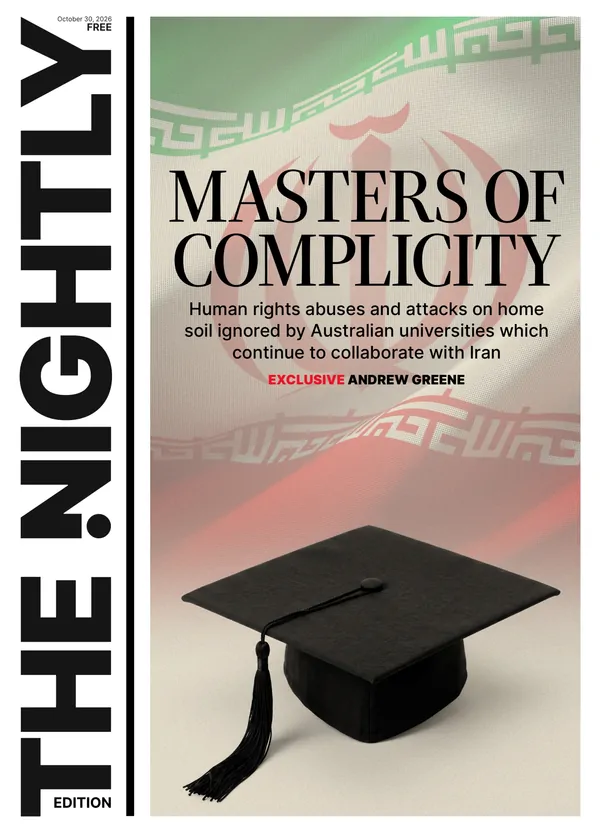
Revelations that most Australia universities liaise with Iranian researchers prompts outrage
Human rights abuses and attacks on home soil ignored by Australian universities who continue to collaborate with Iran.


Australian universities are accused of “collaborating with the enemy” following revelations most tertiary institutions are maintaining research links with Iran despite growing Federal Government sanctions against Tehran.
Senior Education Department officials have confirmed “researcher-to-researcher collaboration” is still occurring with Iranian academics three years after the Foreign Minister wrote to vice chancellors urging them to “put on hold existing cooperation”.
During a senate estimates hearing the department’s assistant secretary for Global Relations and National Security, Simon Moore, was questioned on Australian research collaboration with sanctioned countries including Iran and North Korea.
Sign up to The Nightly's newsletters.
Get the first look at the digital newspaper, curated daily stories and breaking headlines delivered to your inbox.
By continuing you agree to our Terms and Privacy Policy.“With regards to Russia, DPRK, and Belarus, the answer is very low to none, and almost none from departmental and government awareness perspective. Iran is a slightly different story,” Mr Moore said in response to Liberal Senator Matt O’Sullivan.
“There is researcher-to-researcher collaboration that does occur with Iran, but that is small in number and getting smaller as a consequence of work across government to express government’s expectations that no collaboration of this sort occurs with Iran.”
Asked to specify which of Australia’s universities were still involved with Iran, Mr Moore responded: “most universities would have some level of research-to-research collaboration, but in relative terms, very, very small, and getting smaller”.
Last year the Albanese Government expelled Iran’s ambassador Ahmad Sadeghi after evidence emerged linking Tehran’s Islamic Revolutionary Guard Corps to state-directed anti-Semitic arson attacks in Sydney and Melbourne.
Shadow Education Minister Julian Lesser has expressed outrage at the revelations, demanding all tertiary education institutions in Australia to cut academic ties with Iran immediately.
“Iran attacked Australia on at least two occasions. They are one of the worst human rights abusers in the world, and they export terror to other countries,” Mr Lesser told The Nightly.
“There is no excuse for working with this criminal terrorist regime. It’s time our universities took a zero-tolerance approach, rather than collaborating with our enemies.”

In 2023 Foreign Minister Penny Wong wrote to the vice chancellors of Australia’s universities to outline the Government’s deep concerns with the human rights situation in Iran and to request they suspend all academic links with the country.
“I urge you to join with the Government to put on hold existing cooperation with Iranian entities, including with subnational government entities and universities, and to refrain from any proposed new engagement,” Senator Wong wrote.
“The Australian Government stands with the people of Iran, including Iranian students. We do not wish to impose costs on individual students seeking education in Australia or jeopardise their safety.”
Two months ago, Federal Parliament passed legislation to strengthen and streamline Australia’s Foreign Arrangements Scheme, which aims to ensure interactions between public universities are “consistent with Australia’s national interest”.
“The Government recognises concerns regarding researcher-to-researcher collaboration and will require universities to have appropriate policies and processes in place to identify, monitor and manage associated risks,” Senator Wong said in August.
“For the first time, universities will be legally required to assess whether research projects could adversely affect the national interest or be inconsistent with Australia’s foreign policy.”
A spokesperson for Universities Australia, the peak body representing most of the country’s tertiary education institutions, insisted its members all took “national security and research integrity seriously”.
“Recent changes to Australia’s foreign relations laws strengthen universities’ responsibilities to identify and manage national interest and foreign policy risks in research,” the spokesperson told The Nightly.
“Australia needs strong safeguards against genuine security risks while preserving the international partnerships that underpin world-class research, and universities will continue to work closely with government in support of that.”
This week Liberal Senator James Paterson reiterated the Coalition’s support for the Iranian ambassador’s expulsion but repeated calls for the country’s embassy to be completely shut down in Canberra.
The embassy was closed after Ambassador Sadeghi was told to leave the country in August last year following a string of anti-Semitic attacks linked to the IRGC, however, some staff remain and continue to work.
DFAT’s Middle East and Africa division first assistant secretary Ralph King said that the remaining Iranian diplomats were a conduit for Australia to express their grievances to Tehran.
“Yes, the embassy has currently suspended operations,” Dr King confirmed in a senate Estimates hearing on Wednesday.
“The view is that we have retained a formal channel to make clear… our concerns about Iranian actions and to pursue our national interests and the embassy in Canberra serves as a conduit for that purpose.
“We do regularly communicate them, including our views on Iran’s destabilising actions and our complete rejection of their interference in our affairs.”
Earlier this year The Nightly revealed that Australian universities had been identified by a US Air Force-affiliated think tank as collaborating with Chinese defence institutes which develop advanced military warfare for Beijing.
The report by the Alabama-based China Aerospace Studies Institute documented academic exchanges or contacts between 2015 and 2025, including the “long-term” cooperation between the University of Sydney and Chinese defence laboratories and ties between a researcher there to the University of Western Australia.
The Albanese Government has so far imposed more than 230 sanctions on Iranian individuals and entities.