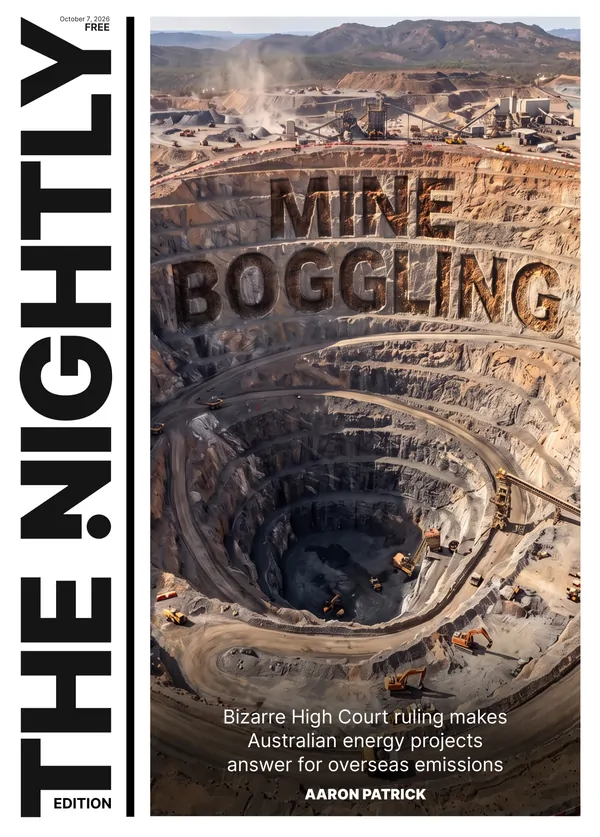
BHP could be next big winner with shares looking to top $70 as investors tip tech rebound
AI-focused small caps, miners, and technology businesses could outperform businesses hit by slumping consumer confidence and falling house prices, professional investors say.


Investors are rotating into miners, technology stocks and selected small caps as rising interest rates, weaker consumer confidence and falling house prices cloud the outlook for Australia’s economy and bank earnings.
About one third of Australia’s top 200 companies will have reported full-year results by the end of this week, with analysts expecting average earnings to rise 13 per cent in the year to June 30, driven largely by stronger profits from the resources sector.
The results season is providing investors with an increasingly important test of whether corporate earnings across sectors outside mining can withstand a weaker domestic economy.
Sign up to The Nightly's newsletters.
Get the first look at the digital newspaper, curated daily stories and breaking headlines delivered to your inbox.
By continuing you agree to our Terms and Privacy Policy.“We’ve had two pretty good updates from Rio Tinto and Mineral Resources,” said Tony Sycamore a strategist at IG Markets. “BHP next week, the result needs to show that the higher copper prices, up 35 per cent for the year, and record iron ore volumes flowed through cleanly to the bottom line.”
Record copper prices have propelled BHP shares 39 per cent higher in 2026, versus a 7.2 per cent gain for the Commonwealth Bank, Australia’s largest home loan lender and one of the companies most exposed to sliding house prices.
BHP to challenge $70
Mr Sycamore believes BHP can extend its rally and push above $70 as soon as next week if copper prices continue climbing and the miner delivers a strong dividend and outlook when it reports on August 18.
The broader S&P/ASX 200 Materials sector, which includes 39 companies dominated by iron ore, gold, lithium and copper miners, was just 2.5 per cent below its record high of 25,321 points on Thursday.
The sector has jumped 19.2 per cent in 2026 and 43.3 per cent over the past 12 months, as investors have shifted away from expensive banks towards resource companies.
“I think BHP can lead the Materials Sector to record highs (next week),” said Mr Sycamore.
“The surge is fuelled by resilient commodity demand and a notable rotation as investors shift from overvalued banks into undervalued material stocks starting in late 2025.”
UBS Australia is more cautious. Its analyst Lachlan Hughes warns BHP faces a hit from surging diesel prices linked to the Middle East conflict, and the risk that its copper production guidance for the year to June 2027 fails to meet elevated market expectations.
UBS has a $59 price target on BHP and forecasts a final dividend of $1.01 a share, based on an assumed 75 per cent payout ratio and earnings of $1.35 a share.
Small-caps still unloved
The other major pocket of opportunity for investors is the small-cap market, where weak valuations are creating potential for out-sized gains as companies adopt artificial intelligence to lift productivity and margins.
The Small Ordinaries Index is down 6.2 per cent in 2026, versus a 5.7 per cent gain for the larger S&P/ASX 200.
Ellerston Capital portfolio manager James Barker argues the sell-off has created opportunities in smaller industrial and technology companies that can benefit from the build-out of AI infrastructure and rising productivity.
He points to Southern Cross Electrical Engineering, GenusPlus Group, SKS Technologies and Mayfield Group as beneficiaries of investment in Australian data centres.
Mr Barker also expects smaller industrial companies to capture a disproportionate share of the productivity gains from AI.
“When output per hour worked is flat, a company can only grow revenue by employing more people,” he says. “Costs rise in step with sales, margins compress and growth becomes something a business has to buy rather than something it generates.
“Artificial intelligence is the most credible circuit breaker available and that smaller companies are structurally better placed to capture the benefit than large incumbents.”
Ellerston estimates only 12 per cent of Australian small businesses have made significant progress in adopting AI, leaving considerable scope for productivity gains.
On Wednesday, shares in fintech small-cap Bravura Technologies surged 12 per cent after it flagged rising profit margins on lower costs and as AI helps improve its software platforms.
The company’s market value has grown 30 per cent over the past year to hit a $1.4 billion valuation on Thursday.
Investment bank and equity research firm Canaccord Genuity also backs small-cap software players Catapult Sports and Hansen Technologies ahead of their upcoming results.
The investment bank told its 46th annual Growth Conference in the US this week that investor interest in defence remained strong, sentiment towards healthcare had improved and optimism was returning to software as investors increasingly viewed AI as a potential margin driver rather than simply a competitive threat.
The renewed enthusiasm for AI infrastructure was evident on Wall Street on Wednesday, after neocloud operator Nebius reported better-than-expected quarterly results.
On the Nasdaq, Nebius surged 20 per cent to $US232.20 per share, with the buying spilling over to Australian founded data centre peers Iren and SharonAI.
Both jumped more than 10 per cent as the retail investor mania for businesses linked to AI infrastructure built up another head of steam.
Sydney-founded SharonAI has said it expects to list on the ASX later this year in deal that could see it cement a multi-billion-dollar valuation.
CBA’s cloudy outlook as analysts watch for guidance
While resources and technology stocks are attracting investor attention, the outlook for the major banks is becoming more difficult to ignore.
On Wednesday, CBA’s chief executive Matt Comyn warned the property market faces “multiple headwinds” as home loan applications plummeted.
“The banks are softer, but that’s no surprise,” said Mr Sycamore.
“CBA the fall in mortgage growth was expected and is a reality check for investors. I don’t feel like today’s numbers from CBA justify its share price rally since May. It’s the same with Westpac and probably NAB next week, the banks’ valuations look a little bit vulnerable.”
The weakness in housing comes as investors reassess the outlook for interest rates. Futures markets are pricing about 15 basis points of additional increases for the remainder of 2026, implying roughly a one-in-two chance of another increase from the current 4.35 per cent cash rate.
Almost all of Australia’s largest companies will report their results over the next fortnight, giving investors a much broader picture of how businesses are coping with the changing economic environment.
Mr Sycamore said management guidance would be particularly important, with investors looking for evidence of how companies expect to perform in the six months to December and whether higher interest rates and inflation are adding to their costs.
The key questions will be what weaker consumer confidence and falling house prices mean for household spending, profit margins and costs.
“The Federal Government’s redistributive Budget has added to the malaise,” Mr Sycamore said. “Changes to capital gains tax and negative gearing have created a less attractive investment regime, driving a broader reset in risk and return expectations.”
Analysts expect the materials sector will deliver some of the strongest profit growth again in financial year 2027, with Macquarie calling for average profit growth of 17 per cent.