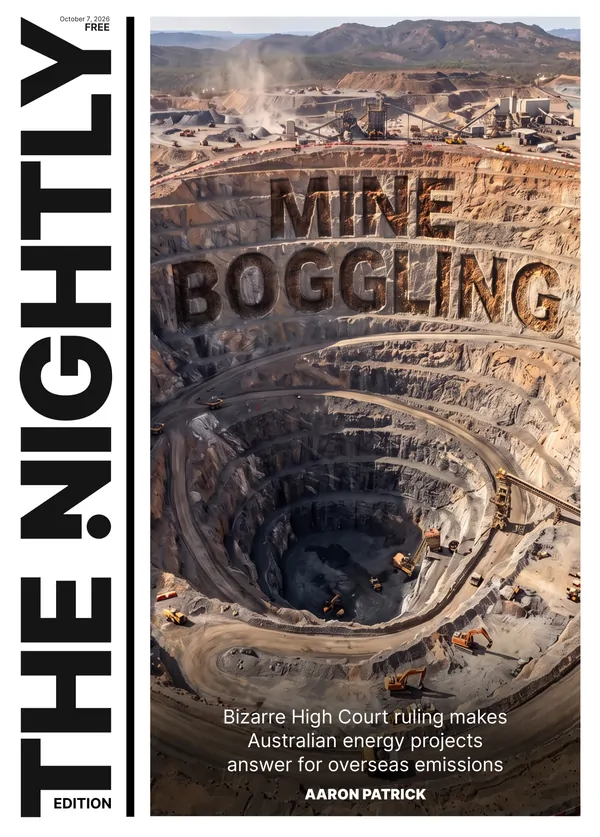
Climate Change Minister Chris Bowen refuses to be drawn on landmark scope three emissions ruling
Climate Change Minister Chris Bowen has refused to be drawn on the ramifications of a landmark court ruling that has ignited fears about the future of new fossil fuel projects in Australia.


Climate Change Minister Chris Bowen has refused to be drawn on the ramifications of a landmark court ruling that has ignited fears about the future of new fossil fuel projects in Australia.
In a High Court ruling on the expansion of a massive coal mine in NSW’s Hunter Valley on Wednesday, three of the five judges agreed regulatory authorities are legally required to consider indirect scope three emissions.
That could force developers of resource projects to account for climate impacts entirely outside of their control, such as the emissions from burning coal and gas once the commodities are exported overseas.
Sign up to The Nightly's newsletters.
Get the first look at the digital newspaper, curated daily stories and breaking headlines delivered to your inbox.
By continuing you agree to our Terms and Privacy Policy.Asked about the judgment on the sidelines of the pre-COP31 climate change conference in Fiji on Thursday, Mr Bowen said he would not comment on court decisions.
“You’re asking me whether I agree with a decision. A court decision is the law of the land. It’s no matter whether I agree with it or not,” he told reporters, according to The Australian.
“And I’m dealing with my colleagues on the matters before us. I have nothing further to say.”
Pressed further on how the Federal Government would respond, Mr Bowen said “I have nothing to add to my previous answer”.
The test case that has sent shock waves through Australian mining and energy community stemmed from a challenge against Mach Energy’s move to extend the life of its Mt Pleasant coal mine in NSW by 22 years and nearly double its yearly output.
Mach Energy took a NSW Court of Appeal’s unanimous rejection of development approval to the High Court, which struck down the appeal.
“By majority, the High Court held the (planning) commission had failed to consider imposing conditions to minimise to the greatest extent practicable all greenhouse gas emissions, specifically ‘scope three’ emissions as required (by law),” the court said in a summary.
“By focusing only upon 2 per cent of the project’s emissions, the commission failed in its reasons to consider whether conditions should be imposed to ensure that greenhouse gas emissions are minimised to the greatest extent practicable.”
The ruling was celebrated by climate activist groups but has sparked fears for the prospect of winning approval to bring online more projects, including Woodside’s $34 billion Browse offshore LNG field off WA.
The Chamber of Minerals and Energy WA called on governments to provide clarity on the consequences of the judgment.
“What we see is we have a legal system that activists and lawfare proponents can exploit, and so any future project that is on the table is at risk,” chamber chief executive Aaron Morey said.
“The reality is this High Court ruling threatens to export Australian jobs and livelihoods while doing nothing to reduce global emissions.”
Scope three emissions from an Australian resources project can produced anywhere in the world, such as gas being used for heating overseas, meaning investment would just desert WA with no net reduction in emissions, according to Mr Morey.
Originally published as Climate Change Minister Chris Bowen refuses to be drawn on landmark scope three emissions ruling