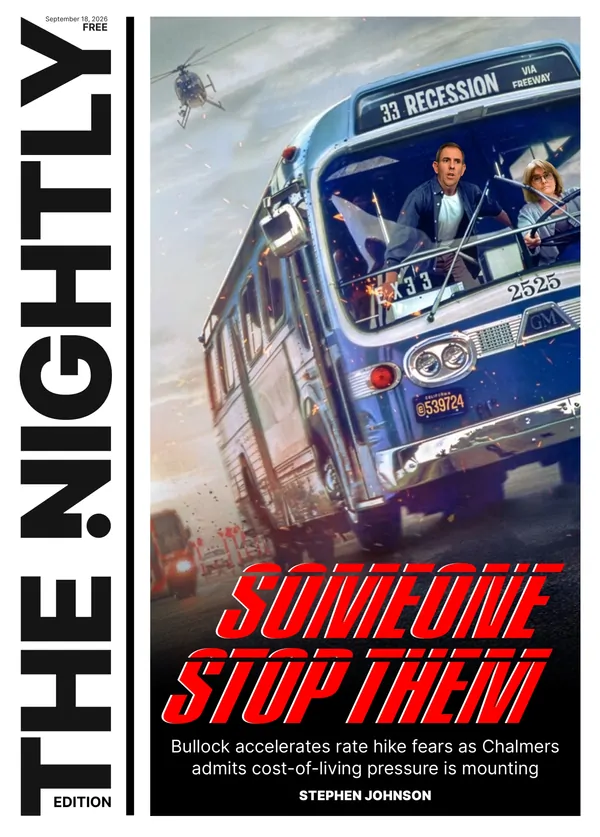
Australian Economy: Early Christmas spending splurge raises interest rate rise fears
A buying spree on luxury items from shoes to concert tickets could force the central bank to reverse three interest rate cuts - and potentially go further.


A pre-Christmas spending splurge and the widening Federal deficit have sparked fears interest rates may have to be hiked to levels last seen almost two decades ago.
Household spending increased 1.3 per cent in October, the biggest monthly increase in almost two years and more than double the rate economists expected.
Ironically, the buying spree was prompted by three interest rate cuts this year, which some economists say may have to be reversed to stamp out inflation.
Sign up to The Nightly's newsletters.
Get the first look at the digital newspaper, curated daily stories and breaking headlines delivered to your inbox.
By continuing you agree to our Terms and Privacy Policy.Judo Bank chief economic adviser and former Treasury economist Warren Hogan predicted the Reserve Bank of Australia would raise rates in February, March and May to bring inflation within its 2-to-3 per cent target zone.
Seventy-five basis points of rate increases would return the cash rate to 4.35 per cent and cost the average home owner about $4000 a year. Dr Hogan predicted rates would continue to rise to 5.1 per cent, the highest level since 2008, a pessimistic forecast many economists don’t agree with.
“I’m praying that it doesn’t have to go higher,” he told The Nightly. “Every month they delay, starting the process of getting interest rates at the right level, is it raises the chance they have to do more.
“Today’s data just reinforces it once again: the consumer is out there spending again. Right now, it tells you inflation is not going away.”
Music festivals
Rate cuts this year triggered spending on clothing, footwear, furniture, electronics and even concerts, EY chief economist Cherelle Murphy said.
“The Reserve Bank will be concerned that businesses will continue to increase prices at a rate higher than it can tolerate,” she said.
The Reserve Bank is battling pressures on several fronts, from strong consumer spending to big government deficits, which the Parliamentary Budget Office on Thursday warned would stop Treasurer Jim Chalmers from being able to balance the Budget within four years.
Dr Chalmers rejected economists’ assertions government spending is making inflation worse and keeping rates higher than they would otherwise be.
“Well, it’s rubbish,” he told ABC radio. “Private demand has now contributed more to growth in our economy than public demand for four quarters in a row. In fact, in the quarter just gone, the private economy made a three times bigger contribution than public spending.”
AMP economist My Bui said Thursday’s consumer spending figure - the annual 5.6 per cent increase was the highest in two years and well above the 3.8 per cent inflation rate - made rate cuts in 2026 impossible.
“Today’s data underscores the RBA’s view that household spending is recovering and there is some ‘tightness’ in the supply capacity of the economy,” she said.
“We think that there is still some fragility given the noisy nature of the data but acknowledge that the Reserve Bank will likely remain on hold for the foreseeable future, given robust spending data, higher than expected inflation, and an unemployment rate of 4.3 per cent.”
Health costs
The latest Australian Bureau of Statistics data on household spending shows the amount spent on clothing and footwear surged by 3.5 per cent in October, followed by a 3 per cent monthly increase on furnishings and household equipment, which includes electronics.
New South Wales had the biggest monthly spending increase of 1.6 per cent, followed by Queensland and the Australian Capital Territory on 1.5 per cent, but this followed a weak September.
Over the year across Australia, the broad miscellaneous goods and services category soared by 9.4 per cent, covering everything from haircuts to childcare, jewellery and financial services.
Health costs soared by an annual pace of 7.5 per cent, ahead of recreation and culture on 7.3 per cent, food on 7 per cent and hotels, cafes and restaurants on 6.4 per cent.
Adding to Australia’s inflation woes, the Parliamentary Budget Office on Thursday noted the Federal Government and the states and territories were further in deficit “despite improved forecast revenue in each jurisdiction”.
This would make it harder for the Commonwealth to return to a Budget surplus in the next four years.
On Wednesday Reserve Bank Governor Michele Bullock warned bigger Budget deficits were raising the neutral cash rate, which was neither stimulating nor curbing demanding in the economy.
ANZ economists Aaron Luk, Sophia Angala and head of Australian economics Adam Boyton said strong consumer activity during October and last month’s Black Friday sales could mean a more subdued December in the lead-up to Christmas.
“There is some risk that the earlier start to promotions pulled some spending into October from November, which suggests this result is unlikely to be repeated next month,” they said.