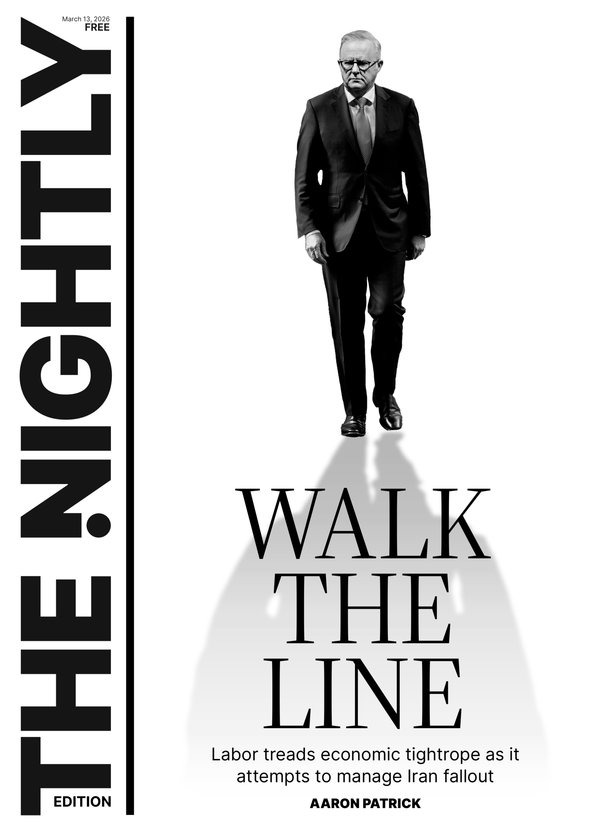
RBA expected to rise rates as Australian mortgage holders face double whammy as US-Iran war continues
Australian families face a devastating double blow as the fallout from the Middle East smashes domestic households.

The war on Iran has added to the stress on Australian mortgage holders who now face higher interest rates and skyrocketing energy costs as the Middle East crisis continues to smash family budgets.
The Reserve Bank of Australia is widely expected to raise the official cash rate next week and again at its May meeting – taking to three the number of rate rises this year.
Treasurer Jim Chalmers is understood to be preparing for inflation to be in the high 4 per cent range as the war in the Middle East shows no signs of ending.
Sign up to The Nightly's newsletters.
Get the first look at the digital newspaper, curated daily stories and breaking headlines delivered to your inbox.
By continuing you agree to our Terms and Privacy Policy.And the Albanese government is urging Australians to avoid panic buying fuel amid rising prices and fears of shortages, as it acknowledges “real risks in the supply chain” for food and goods around the country.
Oil shortages across the globe boosted fears of a return to the 1970s oil led stagflation event.
Stagflation is a unique challenge when economies are battered by slowing growth and rapidly rising cost. Combined they smash household living standards.

Over the last week, oil prices have skyrocketed as the conflict between the US and Iran led to the blockage of the Strait of Hormuz – a critical supply route that about 19 per cent of the world’s oil passes through.
At the time of writing, the Iranian government said the Strait of Hormuz must remain closed as a “tool to pressure the enemy”, while the US promised a navy escort through the waterway.
Are we heading for stagflation?
Rising oil prices over the last week renewed fears of a 1970s-style stagflation event, when the price of crude soars, while the economy slides into a recession.
Betashares chief economist David Bassanese says the chances of stagflation in the US are rising.
“Higher US tariffs along with the crackdown on illegal immigration have both conspired to weaken labour demand and labour supply,” he said.
“Yet we can now add a third stagflationary negative supply shock – the war with Iran, which has already raised global oil prices by 30 per cent.
“Whatever the justification for this war, the hit to US energy costs will also act to dampen economic activity while boosting inflation.”

Despite these concerns, Westpac chief economist Luci Ellis said Australia was a long way from a return of the 1970s when an oil shock led to Australian living standards being smashed by stagflation.
“World economies are much less oil dependent than they were in the 1970s, especially advanced economies,” she told NewsWire.
“A longstanding closure of the Strait of Hormuz would be extremely bad for emerging markets and low income countries because of the impact of fertiliser and food prices.
“Once food prices escalate, that is when you get social unrest, so my expectation is if it drags on more than a few months, countries will take steps to make sure it opens.”
Domestically, it would take a long period of high petrol prices before Australia experienced a stagflationary environment.
What oil shock means for rates
Ms Ellis – who previously worked for the RBA for more than three decades – says the central bank will lift interest rates in March and May, even if the impact of rising oil is temporary.
“This is a once bitten, twice shy situation,” Ms Ellis told NewsWire.
“They’ve made it clear they want to get on with it and when they get the Q1 inflation data – on our estimates – it will be too high.”
All four major banks now predict interest rates will be lifted in both March and May, taking the cash rate to at least 4.30 per cent.
If the prediction is accurate, all three rate cuts in 2025 will be undone in three consecutive meetings after the RBA began lifting the cash rate from February.
While economists are focusing on three interest rate hikes in a row, the bond market is pricing in more pain for borrowers.
Australia’s Cash Rate 2022
It is pricing 68 basis points of additional rate hikes in 2026 that would take the cash rate to just under 4.60 per cent.
This follows the RBA’s first interest rate hike of 25 basis points in February and would take rates up by just short of 100 basis points over the year.
“This aligns closely with expectations for three 25 basis point hikes in total, which would push the cash rate to 4.60 per cent by year end – its highest level since October 2011,” IG market analyst Tony Sycamore said.
The money markets have increased their rate hike expectations as a combination of the US/Iran war and hawkish comments from the RBA spooks the bond market.
“The escalating turmoil from the Middle East conflict and surging energy prices is poised to tighten its grip on Australian households, amplifying cost-of-living pressures at a time when inflation remains sticky,” Mr Sycamore said.
Cost of living about to surge
In a blow to households already grappling with higher mortgage rates, the cost of living is also tipped to rise.
Mr Chalmers told colleagues this week that Treasury’s preliminary analysis of the impact of the war suggests headline inflation will be in the “high 4s”.


The updated inflation forecast will be part of the budget he hands down on May 12.
Headline inflation, which includes volatile and seasonally adjusted prices, was at 3.8 per cent in January.
AMP chief economist Shane Oliver told NewsWire that households could be confronted with a “double whammy” of higher rates and rising fuel costs.
“I suspect consumers will batten down the hatches and that means there is likely weaker spending ahead,” he said.
NED-9108-Monthly-Inflation-Indicator
Mr Oliver said the RBA “faces several risks” when it meets next week to decide on the next cash rate move in light of the recent global turmoil.
“On the one hand if they don’t hike and petrol prices continue to rise and that flows through to inflation and eventually inflation expectations, it makes it harder to get inflation back down,” he said.
“The flip side, though, households will see a hit to their spending power which will dampen spending elsewhere in the economy.
“So underlying inflation might actually be depressed despite higher prices for oil and fertiliser.”
Originally published as Aussie mortgage holders face double whammy as rates set to surge