AARON PATRICK: The War Memorial’s Anzac Hall will teach new generations about sacrifice
AARON PATRICK: The ambition, sensitivity and quality of the displays in the new Anzac Hall will place it among the world’s greatest war memorials.


Six years after work began expanding Australian War Memorial in Canberra, the Anzac Hall was officially opened on Tuesday evening at an event that treated military veterans and the workers who built the structure as VIPs.
About 600 people, led by Governor-General Sam Mostyn, attended the ceremony in the Anzac Atrium held under a Black Hawk army helicopter used on operations in Papua New Guinea and Pakistan.
The atrium links the original building, which opened in 1941, to the Anzac Hall, the biggest expansion in the history of one of the nation’s most-visited institutions.
Sign up to The Nightly's newsletters.
Get the first look at the digital newspaper, curated daily stories and breaking headlines delivered to your inbox.
By continuing you agree to our Terms and Privacy Policy.Despite significant financial and logistical challenges, including a labour shortage during the pandemic and a spike in energy prices triggered by the Ukraine war, the project cost only 10 per cent more than its original $500 million budget.
“We carry a weight here, the weight of doing justice to their stories,” War Memorial director Matt Anderson said. “The weight of getting it right.”
Ms Mostyn, the daughter of a colonel who served in the Vietnam War, told guests the project was “a monumental endeavour testing the limit of materials and future proofing this site in astonishing ways”.
The new, two-level hall has exhibits from World War II, including a Japanese midget submarine, spliced into three pieces, that attacked Australia. There is a restored Japanese tank, the tail fin of a German fighter plane flown by one of the war’s top aces and a V2 rocket.
Businessman Kerry Stokes, the Memorial’s chairman when the project was approved, said it was “magnificent” as he arrived with wife Christine Simpson Stokes. Other guests included Admiral David Johnston, the Chief of the Defence Force, Defence Minister Richard Marles, War Memorial Chairman Kim Beazley, former Defence Force Chief Angus Campbell, and most members of the federal Parliament, which ending proceedings early to allow MPs to attend.
Long after the dignitaries leave, the two-level exhibition is likely to become an iconic site.
From an FA-18 fight-bomber to a drawing of Sarbi, the military dog, the ambition, sensitivity and quality of the displays places the Anzac Hall among the world’s great memorials to war.
Emotional force
But it is the galleries on Afghanistan, East Timor and Iraq that will draw new generations of Australians to the War Memorial.
An example of the attention to detail by the memorial’s staff are three mounted bullet fragments that hit an Australian Chinook helicopter, registration A15 202, operating out of Southern Afghanistan during the peak of the war.
The transport helicopter’s fuel line was pierced, which could have led to a crash. The helicopter is part of the elegantly lit display.
While the hardware is impressive, it is human stories that deliver an emotional force likely to be felt by visitors long after they leave.
One is a sign for Poppy’s, a recreation centre at the Australian base at Tarin Kowt, named for Trooper David Pearce, who was so old at 41 years that the other soldiers called him Poppy. He was killed in 2007 by a bomb while driving an armoured car for the 14th Light Horse Regiment, which was protecting engineers working on a civil reconstruction project.
Then-prime minister Tony Abbott delivered the sign over to the memorial in 2013 after visiting the base to mark its closure.
A photo of Trooper Pearce in desert-like terrain around the base shows a man who looks happy. Interviews with veterans displayed among the exhibits feature soldiers proud, not of the killing of war, but of the profession of arms.
The Victoria Cross
All four of the men awarded the Victoria Cross during the war, Mark Donaldson, Ben Roberts-Smith, Daniel Keighran and Cameron Baird, lived in Tarin Kowt. Apart from Corporal Baird, who died in battle, all were invited as honoured guests.
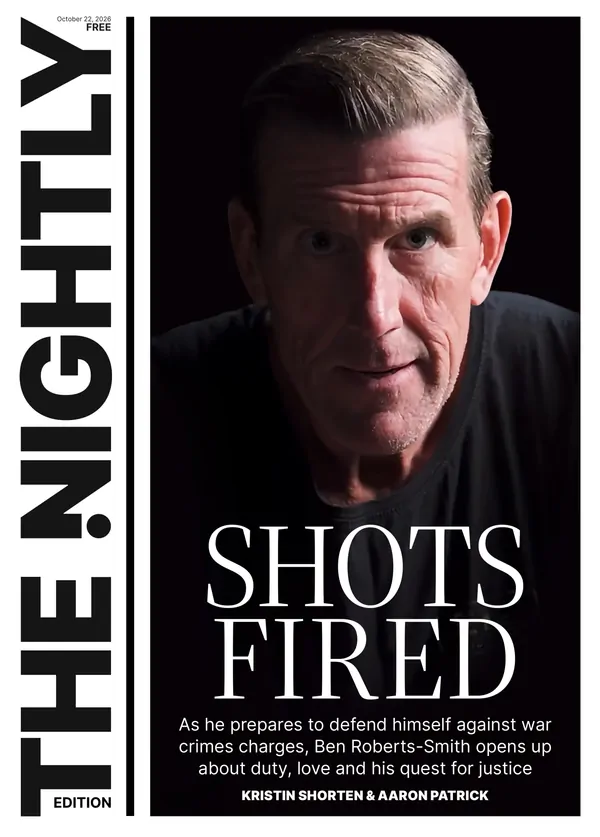
Mr Roberts-Smith, facing charges he executed prisoners, obtained permission from a court last week to attend the event. The ex-SAS corporal became ill over the weekend and sent his regrets, according to his representatives, saving other guests the awkwardness of greeting a man whose life has almost overshadowed the whole war.
“Ben Roberts-Smith is a Victoria Cross winner who has demonstrated bravery in the face of the enemy,” Defence Industry Minister Pat Conroy said as he arrived at the event. “Ultimately it is a decision for the War Memorial but I understand why they invited him.”
The accusations made against Mr Roberts-Smith and others are not ignored in the Anzac Hall. Nor are they highlighted.
A redacted version of the Brereton Report into war crimes allegations is behind glass, a reminder that the war’s true history remains in dispute.
A single panel describes the Battle of Shah Wali Kot, where the 2nd Commando Regiment and the SAS’s 2 Squadron won the greatest battle of the war, and Mr Roberts-Smith saved his team by charging multiple Taliban machine guns.
Anthony Albanese read from a letter written in the dying days of World War II by a Hilda Barnes about her son, pilot Osmond Barnes, who went missing over Germany in January, 1944, according to a copy of the prime minister’s speech distributed to media outlets in advance.
“We are still hoping he may be found in hospital somewhere,” Ms Barners wrote. “He may have lost his memory or even disfigured by burns.
“I am enclosing a photo of him. I thought it might help if he has lost his memory. You will have an idea of what he looks like. He was 20 years and 10 months of age at his presumed death.”
Which was an example of exactly what the War Memorial is for: so Australia never forgets those men and women who died for those who stayed at home.