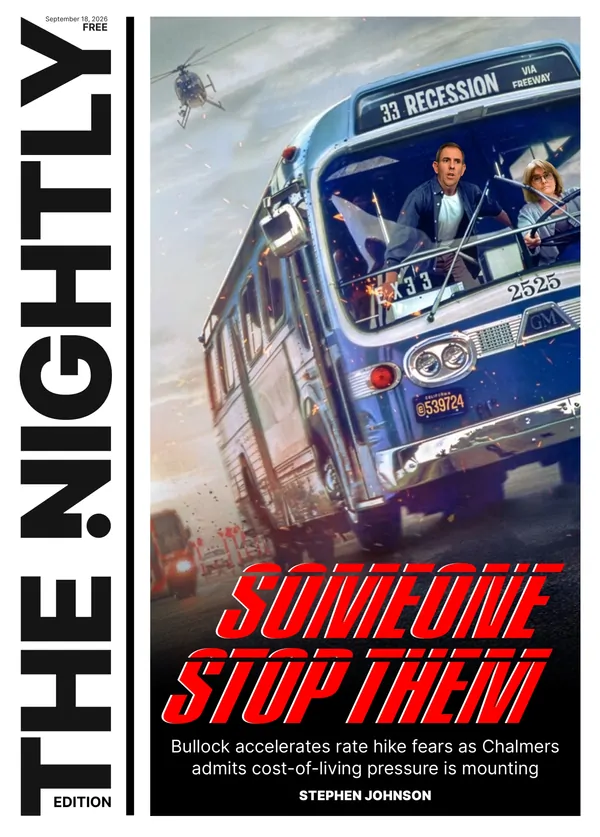
AARON PATRICK: Labor’s war on aspiration suffers a loss, Anthony Albanese, Jim Chalmers retreat from CGT push
AARON PATRICK: Anthony Albanese and Jim Chalmers were forced to retreat on tax rises by a revolt of a class that has wielded little political influence in recent decades: builders, strivers and entrepreneurs.


Almost half a billion dollars. That’s how much money Anthony Albanese and Jim Chalmers will now not be able to take away from hard-working Australians over the next four years, from a young woman who wants to open a clothing boutique to the university professor with a promising treatment for heart disease.
The Prime Minister and Treasurer portrayed the decision on Thursday to reduce tax increases on investors and trusts as a limited concession. The $475 million in extra tax revenue they won’t be allowed to spend on public servants, welfare and corporate subsidies is a small slice of extra money expected to be raised from changes in this year’s Budget.
But the significance of the compromise is profound. The Labor Government was forced into retreat by a revolt of a class that has wielded little political influence in recent decades: builders, strivers and entrepreneurs.
Sign up to The Nightly's newsletters.
Get the first look at the digital newspaper, curated daily stories and breaking headlines delivered to your inbox.
By continuing you agree to our Terms and Privacy Policy.One of them is fund manager Geoff Wilson, who described the original plan as a war on aspiration and mobile capital. He would know. Over 29 years he has built a business that helps 130,000 Australians save for their retirements by investing in share markets.
After the partial back down, Mr Wilson was unsatisfied. He called the changes a “pathetic attempt” to placate opponents. There is “only one adjustment they need to do,” he told The Nightly. “Carve out all Australians’ companies. Nothing has changed.”
Although the abolition of negative gearing on real estate and increases in the capital gains taxes were aimed at slowing home prices, they were seen as a penalty on ambition. They reinforced the perception the Government’s underlying objective is redistribution rather than the creation of wealth.
Mr Albanese, on Thursday morning, pretended the changes were part of a plan all along to consider outsiders’ opinions and make changes.
“On Budget night, we foreshadowed planned consultation on our tax changes with small businesses and startups,” he said. “And today we’re announcing the next steps in the implementation details.”
Unpopular
As anyone following the debate over the past month knows, Mr Albanese and Dr Chalmers were bludgeoned into the back down. An Essential Poll in the Guardian — not exactly a centre of conservative activism — found 25 per cent of people supported the Budget and 43 per cent considered it bad.
Under the changes, all 2.7 million small businesses in operation and 98 per cent of all businesses will avoid the higher capital tax rate. The change is designed to remove the penalty on success.
Mr Albanese, who has overseen a historic expansion in government spending, increased union powers and a larger public service, claimed to “back innovators and startups”. “There’s no place that’s better to engage in economic activity than Australia.” he said.
The night before, if he was interested, the Prime Minister could have got a different perspective from the owner of a small-but-thriving publishing company, Claire Lehmann.
After 10 years, Ms Lehmann’s business generates $1m in revenue and employs four staff. She told the Sydney Institute political forum she would not have started her online magazine if she realised how hard it would be to operate in Australia, a small market out of sync with most other time zones.
Soccer attention
Back in Canberra, Mr Albanese warned about the rise of right-wing populism, a reference to One Nation’s emergence as the most popular party. Part of One Nation’s success was due to “free advertising on the front page of various newspapers”, the Prime Minister said.
Rather than criticising the media for covering an important story, he could have mentioned a more important problem that is his responsibility: a large and expanding government debt that makes substantial tax cuts impossible.
You could sense Mr Albanese grasping for safer ground towards the end of today’s press conference when he was asked about Pauline Hanson’s plan to abolish SBS. The Prime Minister quickly segued to the World Cup soccer tournament, which is shown on the public broadcaster, raising the question of whether today’s announcement was rushed to allow the public’s focus to switch to the competition and what could be the Socceroos’ most-watched game.
“I’ll be getting up and watching Australia in the United States at 5am on Saturday morning, as will many other Australians,” Mr Albanese said. “I went on the program with Santo and co just a couple of nights ago.”
Santo Cilauro hosts the Cup Fever! show, the perfect medium for a half-Italian political leader who prefers soft comedy to hard questions.