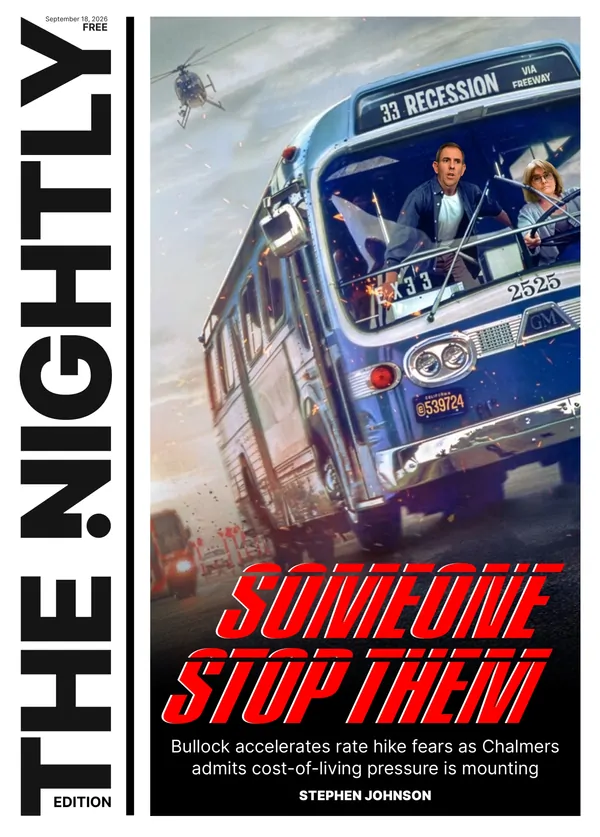
AARON PATRICK: This is what happens when you cross Treasurer Jim Chalmers
AARON PATRICK: The Treasurer’s attack on former Reserve Bank governor Philip Lowe over inflation and interest rates was unfair and could hurt the central bank’s independence, economists said.


Jim Chalmers sent a message to the Reserve Bank of Australia this week: cross me and I will punish you.
The Treasurer slapped down the central bank’s mild-mannered ex-governor Philip Lowe for making a common critique among experts these days: loose government spending is pushing up interest rates.
“Phil Lowe would have liked to have been reappointed by the Government,” Dr Chalmers said on Wednesday. “After he wasn’t reappointed he’s become a fairly persistent critic of the Labor Government.”
Sign up to The Nightly's newsletters.
Get the first look at the digital newspaper, curated daily stories and breaking headlines delivered to your inbox.
By continuing you agree to our Terms and Privacy Policy.Anthony Albanese made a jibe about the long-term public servant’s identity.
“Phil Lowe?” the Prime Minister said. “The footballer, former Manly player, or former RBA governor? You have people who are exes who get their name on the paper.”
Economists who know Dr Lowe said accusing the former bureaucrat of acting out of spite was unfair, unnecessary and mean.
“It demeans the dignity of his office to respond to Phil Lowe in the way he did,” independent economist Saul Eslake said.
Richard Holden, an economics professor at the University of NSW, said: “It sends a message to future RBA governors that does curtail their independence.”
Slap down a sign of interest rates high stakes
The put downs are a sign of the high stakes over interest rate rises, which could cost the average home borrower more than $1000 this year.
The Treasurer has repeatedly distanced himself from the “independent” central bank’s decision, denying Government spending is to blame for rising inflation.
Many experts refuse to absolve the Government of responsibility, including current Reserve Bank governor Michele Bullock.
If the Coalition can convince voters the Government is to blame for higher rates, Dr Chalmers’ credibility will take a huge hit.
Labor seats could be lost.
Which may help explain why Dr Lowe lost his job in 2023 thanks to a Cabinet decision not to renew his contract. After seven years running the central bank he wanted another three.
At the time Dr Chalmers was unhappy interest rates hadn’t been cut, according to an account last year by journalist John Kehoe in the Australian Financial Review. The treasurer reportedly complained in a private meeting with Dr Lowe that the central banker lacked empathy and needed to leave Sydney’s affluent eastern suburbs where he lived.
An important economic policy principle is that ministers should not pressure central banks over interest rates. Inevitably they want lower rates to win over voters and their interference will make inflation worse, economists believe.
A source close to Dr Chalmers disputed the account of the 2023 conversation. It was civil and respectful and the Treasurer did not tell Dr Lowe he had an empathy deficit or needed to leave Sydney, the source said.
“I have a very respectful view of Phil Lowe,” Dr Chalmers said yesterday.
Dr Lowe is overseas and is not giving interviews, new employer, the Australian Securities Exchange, said on Thursday.
He told the AFR earlier this week: “I think we’re condemning ourselves to slow growth in supply, slow growth in demand and a stagnation of our living standards.”
Government spending blamed for fuelling inflation
Dr Lowe received support from new shadow treasurer Tim Wilson, who needs to persuade Australians to blame Dr Chalmers, not Ms Bullock, for higher rates.
“It is unbecoming of the Treasurer to lash out at a respected former chair of the Reserve Bank just because he said the quiet bit out loud,” Mr Wilson told The Nightly.
“If the Treasurer wants to earn respect he should stop pouring debt petrol on the inflation fire that is forcing up interest rates on households and small businesses.”
In hindsight, given the inflation break-out, Dr Lowe was correct to keep rates high and Ms Bullock should not have cut rates three times last year – cuts Dr Chalmers was happy to share in the credit for.
Which is why Mr Wilson said this week the Reserve Bank “should focus on reducing inflation” and suggested the Coalition might change the rules to emphasise this priority.
Economists hate inflation, which makes people poorer by reducing the value of their savings and income. But killing inflation involves increasing unemployment through higher interest rates, and the government seized upon Mr Wilson’s suggestion.
“If what Tim Wilson says were to be implemented, it would mean that the RBA would be jacking up interest rates much more aggressively, and that would have a direct impact on unemployment rates,” assistant treasurer Daniel Mulino said on Thursday.
While the Government went after its critics, Finance Minister Katy Gallagher was held accountable for misleading the public.
Savings or spending?
An amusing exchange between Senator Gallagher and Liberal senatorJames Paterson was broadcast on Thursday morning on Sydney radio station 2GB.
Senator Paterson asked Senator Gallagher to explain a claim she made immediately after the interest rates were raised on February 4 that the Government has found $114b of savings – Canberra jargon for budget cuts.
Senator Gallagher’s assertion was designed to relieve the Labor Party of responsibility for the rate increase.
There was a problem with the figure, which Senator Paterson likely identified based on research by a Treasury analyst-turned-journalist, Luke Kinsella, who wrote about it on the day.
“Is that net savings or gross savings?” Senator Paterson asked.
“It’s savings and re-prioritising,” Senator Gallagher replied. “So we’re saving, essentially, to offset new priorities.”
“So are you saying that’s net of spending decisions, that you reduced the expenditure by $114 billion?”
“That’s gross.”
“Right. What is the net figure?”
“I don’t have that available.”
Senator Gallagher later adjusted her answer to describe the $114 billion as “savings and reprioritisations”, which means some of the money was spent on different things.
“I have not overclaimed that achievement,” she said.
“That has been basically to support offsetting new spending and also those demand-driven programs, which are not decisions of government, but which have had a very significant impact on the expenditure side of the budget since we came to government.”
Thanks to the Parliamentary Budget Office, the truth is known. The Albanese Labor government has increased spending by $142 billion and raised $31 billion in taxes.
That leaves a total spending increase of $111 billion, which is almost exactly the opposite of Senator Gallagher’s initial claim.
Not only is spending by her and Dr Chalmers driving up national debt, it is contributing to inflation and higher interest rates.
Just ask Philip Lowe.