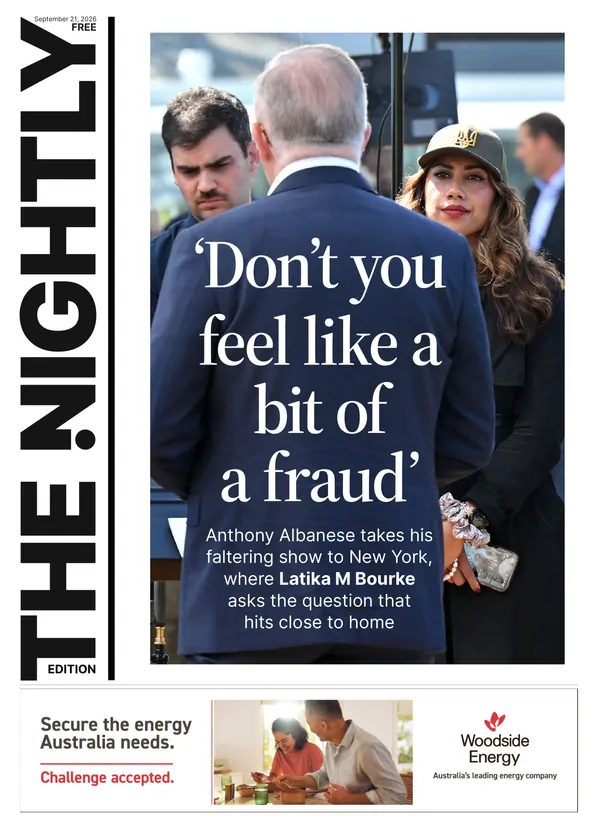
LATIKA M BOURKE: Keir Starmer's exit is a massive warning for UK’s Labour to fix policies now
LATIKA M BOURKE: The party and former prime minister Keir Starmer have paid the price for its party-first and small-target approach.

British Labour finally embraced an Australian-style knifing to depose its gormless and fundamentally inadequate leader, but it was Keir Starmer’s decision to copy Anthony Albanese’s pre-election small-target strategy that has brought about his downfall.
And Labour MPs should note that they risk making the UK appear an international laughing stock if they do not accept that Sir Keir’s demise was not the cause, but the symptom of a wider malaise.
In 2022 and 2024, Australian Labor and the UK Labour party faced elections, respectively. Albanese had little in the way of an agenda. He won because the former government was offensive, tired and had depleted the majority of its talent pool.
Sign up to The Nightly's newsletters.
Get the first look at the digital newspaper, curated daily stories and breaking headlines delivered to your inbox.
By continuing you agree to our Terms and Privacy Policy.Their sister party in the UK borrowed the method and went to the election promising “Change” but without any plan, or appetite to address the UK’s low economic growth, high welfare spending and the pressing demands the geopolitical climate places on the nation’s defences.
“When the Labour party came to power in 1945, in 1964, in 1997 they had a very clearly worked out project that all stacked together, that was very thoroughly worked out, that contained within it a real critique of the state of public services and what we were gonna do with it,” Ben Judah, who served as political adviser to Cabinet Minister David Lammy when he was the foreign secretary recently told the Latika Takes podcast.

“And I don’t think that the Labour Party quite had that coming into government. And I think that there’s been a real lack of a central theory of how to deal with the challenges in the British state.
“With the government, we’ve currently got some ministers going for a kind of progressive futurism, the techno-optimist answer, you’ve got some going for the old Labour tax and spend answer. You’ve got some going for the Blairite, Third Way answer.
“And without a kind of compelling framework for what you want to reform and do with the state, it’s gonna be really difficult to be Prime Minister.”
It is a warning the Labour MPs celebrating Sir Keir’s demise should heed as it is their party-first mentality that has brought them to this point.
Their laziness in 2024 in relying on the implosion of the governing Tories, who suffered bitterly from the fallout of the Brexit referendum that they foisted on the country, is their original sin.
Ten years later to the day on Tuesday, after that Brexit vote, Britain is carving out the name of its seventh prime minister ever since. Sir Keir has only himself to blame. His party was given a once-in-a-generation chance to present and secure a mandate for radical reform, but relied instead on howling about the very legitimate incompetence of the other lot.
Failure of the party-first approach
The party and Sir Keir himself have paid the price for adopting this small-target strategy ever since, just look at May’s local elections, when the party lost control of heartland councils for the first time in history.
While all roads end with the leader, as Sir Keir discovered, the Labour Party has a narrowing window to rectify their mistake, or face replicating last month’s council election results, which were a bloodbath and resulted the loss of heartland councils to Reform.
It is little wonder that, having been falsely promised a new economic fortune, voters are wondering if the plain-speaking disruptor Nigel Farage may be a credible option.
While he eventually opted to leave with dignity rather than derision as he administered his own last political rites, it is the acknowledgement Sir Keir should have made in his farewell speech.
His final act, in not having to force his party to blast him out despite having vowed as recently as Friday that he would resist any coup and stand if it succeeded, was gracious.
But his speech was as self-indulgent as it was revealing.
He began by talking about himself, describing his arrival at Downing Street as the proudest moment of his life, then claimed a string of achievements in his two years. Top of his list was the fight he had with the Labour Party to reorient it into an electable, mainstream party, compared to its socialist, anti-Semitic direction under Jeremy Corbyn.
No pain, no gain
Celebrating his success and illustrating it with the performance of his political party just underlined the myopia of UK Labour, it’s always party first.
Voters are fed up with the political parties behaving as though tribalism, and not solutions, are the priority. Such behaviour is manna for populists.
Andy Burham has the chance to reset this. The move towards the soft-left candidate signals a willingness, from MPs, to embrace a more radical approach.
But what that is remains a mystery and therefore a danger zone.
Mr Burnham campaigned in his stunning byelection last week that delivered the fatal blow for Sir Keir’s languishing leadership, with a plea of “hope”. While he offers a boldness that Sir Keir did not, he has no clear ideology on economic policy or foreign policy.
He cannot escape the need to raise the nation’s defence spending to 3.5 per cent of GDP and quickly, for example.
The UK will spend 23.6 per cent of its total spending and 10.6 per cent of its GDP, a whopping £322.6 billion ($610 billion), on welfare in 2025 and 2026 alone. So, will Mr Burnham cut welfare or raise taxes? Both of these present pain that will quickly puncture his “King of the North” schtick.
He will certainly capture the limelight and reach the public in a way that will enrage Farage with jealousy.
But he and the Labour Party must embrace pain and sell it to the public, if they are to avoid the popular mayor becoming just another frontman on the Downing Street carousel.