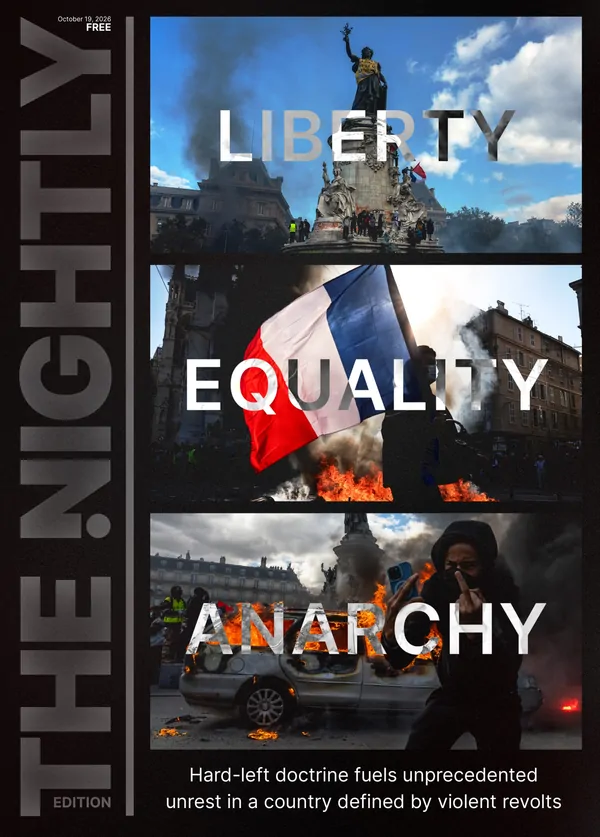
NEW YORK TIMES: France’s Far Right seizes the moment as rioting stuns the country
The National Rally, already ahead in the polls, presented itself as the party best placed to restore law and order.
After riots erupted this weekend in cities across France, its centrist government blamed the main far-left party, accusing its politicians of inciting the violence. That party blamed the government, accusing it of stirring public anger through years of bad governance and heavy-handed policing.
What did the main far-right party do? It blamed both, and launched into campaign mode.
“We are paying for decades of being soft on crime, of weak authority, of the moral, psychological, and material disarmament of our internal security forces,” Jordan Bardella, the president of the far-right National Rally party, said after emerging from a police station in central Paris on Sunday. He said he had gone there to support police officers.
Sign up to The Nightly's newsletters.
Get the first look at the digital newspaper, curated daily stories and breaking headlines delivered to your inbox.
By continuing you agree to our Terms and Privacy Policy.Then he addressed France’s “honest citizens” who were stunned Sunday by the smashed storefronts and burned-out businesses destroyed by rioters the night before. He said they had a vital role to play in reinstating national stability. And that would be by voting in the coming election for his party.
“People need to wake up now,” Bardella said. “They need to make the right political choices, and in any case, we stand ready to restore order in the country.”
Sunday was a day of mourning, shock and finger-pointing in France. The day before, huge peaceful protests for better school conditions and against rising living costs were overshadowed by black-clad and often masked agitators of unclear affiliation who attacked government buildings and shops across the country, sometimes stealing wine or electronics.
For the National Rally, which bills itself as the party of law and order as well as an advocate for expelling immigrants in the country illegally, Sunday was also a day of political opportunity. It is six months before a presidential election that the party’s candidate, Marine Le Pen, is the favourite to win.
“The picture of France emerging this morning, in light of all the destruction, plays well into their hands,” said Bruno Cautrès, a political scientist at Sciences Po, a university in Paris. “We can clearly see that the National Rally is not a loser here.”
The party’s approach mirrors how far-right groups across Europe are presenting themselves as the solution to different kinds of social and governmental challenges. In July, Spain’s government briefly lost control of the borders of a Spanish territory in North Africa, allowing a surge of migrants and handing the country’s far-right party, Vox, a new issue to campaign on. In Germany, the far-right Alternative for Germany party, or AfD, is leading national polls, in part by channeling anxiety over the country’s identity.
In France this week, as Bardella criticized the government’s policing, Le Pen seized the moment to criticize Jean-Luc Mélenchon, the leader of the main far-left party, France Unbowed, and one of her main rivals for the presidency. She said “legitimate social demands” had been “hijacked by the far left and the rhetoric of Jean-Luc Mélenchon” and his colleagues, whom she accused of fostering chaos by “legitimising violence” — an accusation that the party denies.
The riots arrived at a sensitive time in France, with the country already dealing with a daunting budget deficit and a deadlocked parliament in which no party has a majority.
“The far right are sure to gain from this,” said Alexis Veller, 53, a filmmaker, who stopped his motorcycle Sunday morning to take photos of broken storefront windows and tagged walls in central Paris. “We are a very fractured country,” he said. “The situation is very, very worrying.”
Political analysts cautioned that the six months until the election is a long time in politics, and that voters’ motivations are complex and rarely focused on a single issue.
Still, the violence perfectly aligned with the image the National Rally has long painted of a France divided into two and battling for survival, said Vincent Martigny, a political science professor at the University of Nice, Côte d’Azur.
The party has portrayed the country as split between the France of the city centres — filled with woke students and rioters, it says — and the “good France” in the quiet countryside, he said.
“They try to oppose these two Frances, for an obvious reason, because their electorate is not in the city centres, nor in the suburbs, they are clearly in this other France,” Martigny said, adding that “this fuels the feeling decay, of decline.”
Whether the unrest offers a long-term bump in the National Rally’s fortunes will depend, in part, on if the protests continue, he said.
On Sunday evening, Le Pen released a video address in which she painted this very picture of a divided France. She was filmed sitting behind a wooden desk, with the French flag behind her, hands clasped — the image of a president in waiting.
“I condemn the hijacking of this anger by thugs who are sowing chaos in the cities of France,” she said.
“In six months,” she said, “the French people will be able to choose a different path: That of restored authority and security.”
The National Rally supports a bigger, stronger police force, and campaigned in legislative elections in 2024 for mandatory minimum sentences and an end to reduced sentences, as well as building more prisons. It also pledged to lower the age when defendants can be tried as adults by two years, to 16, and to cut state subsidies to the parents of juvenile criminals.
Since the current wave of protests broke out in working-class suburban high schools, Bardella has condemned students causing damage to schools and expressed support for police officers injured in confrontations with protesters.
Across the Atlantic, President Donald Trump and Vice President JD Vance, who have both expressed support for Le Pen in the past, weighed in on the unrest in ways that amplified the National Rally’s critiques. Though the identities of the black-clad and masked rioters are largely unknown, the American leaders portrayed the unrest as caused by immigrants.
“France is burning!” Trump said on social media. “The immigration of people from an entirely different world, people with hatred in their hearts, has shattered that once great country. Close your Borders and take control, before it is too late!”
Vance blamed the violence on “Western liberals” who “imported the third world into France and other countries in the name of diversity and compassion. They ignored fundamental questions of assimilation and compatibility.”
He added: “I hope Americans are paying attention. This is the future congressional Democrats seek for your country.”
Given how unpopular Trump’s government is in France, it was not clear whether those messages would help or hinder the National Rally.

At the police station Sunday, Bardella was confronted by the area’s Green lawmaker, Pouria Amirshahi, who was touring his constituency wearing the tricolor sash of an elected official. It was scandalous, he said, that while he was working, Bardella was out campaigning.
“They spend their time, as you can see, rubbing their hands together over this violence as if their time has come,” Amirshahi said.
Amirshahi then turned to the camera.
“We in France should unite,” he said. “We should stand together in the face of the challenge ahead of us, and not fall into this pattern of division and this pornography of violence that seems to excite him right now.”
But Bardella wasn’t listening. He had already hopped into a car and left.
Originally published on The New York Times