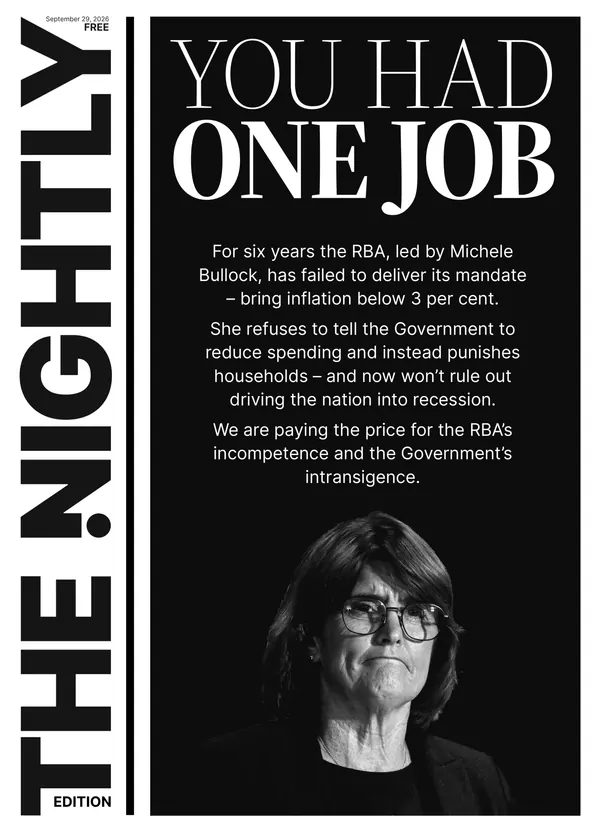
BEN HARVEY: Michele Bullock blames Jim Chalmers’ spending for stubborn inflation and rate hikes
After months of mixed messages, RBA chief Michele Bullock has finally pointed the finger, accusing Jim Chalmers’ big-spending government of fuelling the price surge that’s forcing rate hikes.


Once again, we all feel like Bill Murray in Groundhog Day.
The inflation blame game was back on in earnest this week, courtesy of the Reserve Bank’s decision to hike interest rates.
The argument, again, is over the cause of the stubbornly exuberant consumer price index. There are three suspects: government spending; spending by the private sector in the form of people like you, dear reader, buying too many shiny new things; and mismanaged monetary policy by Michele Bullock.
Sign up to The Nightly's newsletters.
Get the first look at the digital newspaper, curated daily stories and breaking headlines delivered to your inbox.
By continuing you agree to our Terms and Privacy Policy.On Tuesday, Bullock was loath to assign blame, or accept it.
“The pick up is due to a combination of factors across a broad range of components and sectors,” she told us.
And there was little contrition about the decision in August to cut rates (“We’ve become increasingly confident that inflation is on track to be in our 2 to 3 per cent target range on a sustainable basis,” she assured us back then) even though subsequent data has shown the move was premature.
By Friday, Bullock had sharpened her narrative. After dancing around the bleeding obvious in ways that would make Sir Humphrey blush, she pointed the finger at Jim Chalmers, declaring that runaway government spending was fuelling inflation.
Well, derr.
Chalmers preaches responsible fiscal management but the reality is he hasn’t seen a budget line item he didn’t like the look of. It’s like he’s playing a real-life game of Brewster’s Millions — determined to spend his pile as fast as he can.
As a result of that largesse, government spending as a proportion of GDP is now 27 per cent — the highest level since we tooled up for the Vietnam War.
Even with a trillion dollarbucks in debt and with deficits as far as the eye can see, he’s still handing out money like nobody’s business.
Except it is somebody’s business — ours.
Chalmers is blind to the writing on the wall and is doing his best to blame anyone except himself for the predicament. On Tuesday, the Treasurer was quick to point out that the Reserve had identified resurgent private sector spending as a key cause of the latest inflation breakout.
“Growth in private demand has strengthened substantially more than expected, driven by both household spending and investment,” the Reserve said in its statement.
Fair cop. But surely Chalmers accepts that the impact of increased private spending is exacerbated by the concurrence of public spending.
Bullock calls this “aggregate demand”. In laymen’s terms it means there are too many people bidding for the same number of goods and services.
Because Chalmers, and apparently you, dear reader, have your feet to floor spending like you’re in the last days of Rome, Bullock is having to pump the brakes to avoid (at least for long) the spectre of inflation with a four in front of it.
That’s the kind of CPI figure that can cost people their jobs.
Chalmers’ expenditure addiction means we can’t rely on a drop in public spending to ease inflation.
So, it’s up to you, dear reader. The problem is, you’re not as responsive to interest rate pain as you once were.
If you are a debt-free baby boomer you’ll likely welcome high interest rates because it means your term deposits yield ever greater returns.
If you have a home loan, history shows it takes three successive interest rate rises for you to consider closing your wallets and purses.
Even then, with the wolf at the door, you’ll likely work more to maintain your living standard. The low unemployment rate means it’s easy to pick up a few extra hours so we can afford an extra serve of smashed avo on toast.
What a pickle we are in.
There is a silver bullet, but it’s very difficult to fire: increased productivity.
If we all refuse to stop spending then we need more output per worker so we have more stuff to compete over.
If we increase supply it means we don’t have to reduce demand through the blunt force trauma of interest rate rises or the vote-sapping menace of reduced Government services.
“Years of weak to no productivity growth is a big part of that story,” Bullock said on Tuesday.
She’s right.
But increasing productivity is difficult because we’ve become a lazy nation of workers who insist on four-day weeks working from home and who show initiative only when filing Fair Work actions because someone made us feel unsafe at the office.
A couple of days ago the requirement for increased productivity was examined in page two of a national newspaper. On page three there was a story about unions not wanting to work when it’s hotter than 35C, which in this country basically means they down tools in December and come back to work in March.
The inflation genie is a stubborn bastard and nobody seems serious about stuffing him back in the bottle.