Business hits back over RBA governor’s productivity jibe
Business groups say policymakers are better off assessing how the ‘ever-growing mountain of regulatory burden’ was hurting Australia’s productivity, instead of telling firms to lift their game.


Business groups say policymakers are better off assessing how the “ever-growing mountain of regulatory burden” is hurting Australia’s productivity, instead of just telling firms to lift their game.
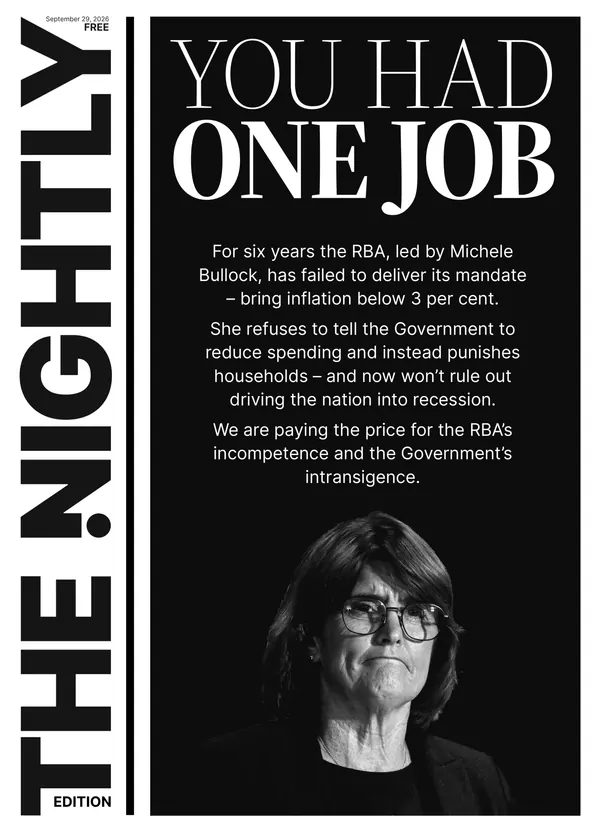
The comments on Wednesday come a day after the Reserve Bank delivered its fourth interest rate hike this year, with governor Michele Bullock telling businesses to “step up to the plate” and contribute more to lifting the nation’s productivity.
Australian Industry Group chief executive Innes Willox pointed to some of the hurdles local businesses battled with, including some of the highest corporate taxes in the OECD, one of the least flexible industrial relation systems in the world, as well as a mountain of regulatory burden.
Sign up to The Nightly's newsletters.
Get the first look at the digital newspaper, curated daily stories and breaking headlines delivered to your inbox.
By continuing you agree to our Terms and Privacy Policy.In this context, Mr Willox said it should come as little surprise investment wasn’t at the levels required to deliver productivity gains.
“Business would invest more in their businesses if they could be more confident of a decent return on that investment,” he said.
“Business operates within the rules and restrictions that are placed on its capacity to invest.
“The focus for policymakers should be to engage with how poor regulation is contributing to our productivity malaise.”
Australians are now working 2.4 per cent more hours over the year, while output per hour fell 0.2 per cent.
Echoing Mr Willox’s comments was Australian Chamber of Commerce and Industry chief executive Andrew McKellar, who said the Government needed to encourage stronger business investment to lift the nation’s sluggish productivity.
“We’ve got to invest more in skills and training to boost labour productivity. Obviously, we’ve got to encourage the uptake of new technologies and innovation,” he told the ABC.
“Those are key things. It’s not just about (artificial intelligence), but it’s broader innovation and investment in research and development across the economy as well.”
Mr McKellar added something had to be done about “the burden of regulation”.
“Businesses around the country, and particularly small business, they’re choking on the increased level of regulation that we’ve seen in recent years,” he said.
With interest rates now at a 15-year high of 4.6 per cent, Mr McKellar said businesses were facing additional pressures.
“They’ve been facing rising costs throughout the year. They’re really struggling with cash flow and profitability, just making a go of it,” he said.
“They’ve also got this huge burden of red tape and regulation, which has been increasing in recent years.
“So, when you put all of that together, we know that in the past 12 months, about one-third of all small businesses have considered closing their doors, something like this only makes it worse.”
Ms Bullock on Tuesday said more businesses in the RBA’s liaison program were worried about rising fuel and transport costs as the Middle East conflict dragged on.
She said some of them were considering passing it on to consumers.
And more pain could be on the way, with Wednesday’s inflation figures increasing the chance of a rate hike on November 3.
Inflation soared to a three-month high of 4 per cent in August, putting it above the RBA’s 2 to 3 per cent target for the 13th straight month and sparking fears of more rate hike pain.
Two of the nation’s biggest lenders, Westpac and ANZ, are already tipping another rate hike in November, which would take the cash rate to an 18-year-high of 4.85 per cent.
Originally published as Business groups say red tape burden contributing to nation’s productivity malaise