Treasurer Jim Chalmers denies high government spending is fuelling inflation
The Treasurer claims he’s ‘taken responsibility’ for Australia’s inflation challenge despite failing to acknowledge Labor’s key failing.

Treasurer Jim Chalmers is like a doctor who refuses to diagnose a problem that’s staring him in the face.
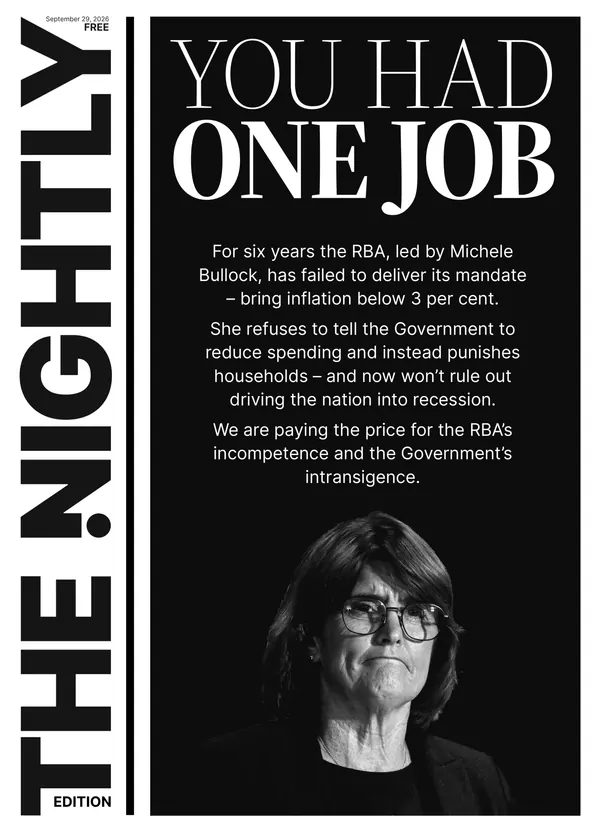
A day after Reserve Bank governor Michele Bullock blamed “domestic capacity pressures” for this year’s fourth rate hike, Dr Chalmers denied higher government spending was fuelling inflation.
“On multiple occasions, I’ve taken responsibility for my part of the fight against inflation,” he told reporters in Sydney on Wednesday.
Sign up to The Nightly's newsletters.
Get the first look at the digital newspaper, curated daily stories and breaking headlines delivered to your inbox.
By continuing you agree to our Terms and Privacy Policy.“I did that multiple times yesterday, doing it again today, and have done it on other occasions.”
This doctor, who did a PhD on former Labor prime minister Paul Keating, clearly had no time for another doctor with a PhD in economics from the Massachusetts Institute of Technology, former Reserve Bank governor Philip Lowe who has told an Institute of Public Affairs podcast the Federal Government should be delivering Budget surpluses with unemployment at low levels.
“When it comes to Phil Lowe, obviously Phil’s entitled to his view - he expresses it relatively regularly,” Dr Chalmers said.
“My focus is on the job at hand, not on the commentary whether it’s on Institute of Public Affairs podcast or in other places.”
With interest rates now at a 15-year high of 4.6 per cent, Dr Lowe spoke out two days after Dr Chalmers unveiled a Budget deficit for 2025-26 that was $6 billion less than forecast in the May Budget by virtue of higher superannuation and business tax revenue.
But the deficit was still $22.3b, making up 0.8 per cent of GDP.
“Now we find ourselves running sizable Budget deficits at a time where we’re at full employment and commodity prices are very high. We should be running sizable surpluses,” Dr Lowe told the IPA’s chief economist Adam Creighton.
Treasury’s final Budget outcome released on Monday also revealed government spending during the last financial year made up 26.9 per cent of GDP, which was the highest in four decades outside of COVID despite unemployment being at a relatively low level of 4.6 per cent as higher iron ore prices boost company tax revenue.
“Government spending has been adding to demand progressively over time, and that’s putting upward pressure on inflation,” Dr Lowe said.
Dr Lowe is far from the only economically literate critic of Labor’s high spending with University of New South Wales economics professor Richard Holden on Tuesday accusing the Government of “gaslighting the Australian public” when it came to its high spending.
Prime Minister Anthony Albanese responded by referring to him as a “well-known critic of the Government” - despite Professor Holden being the architect of Labor’s Budget policy to remove negative gearing on established investment properties from July next year.
Dr Chalmers refrained from the character assassination on Wednesday - but he went on to gaslight the Australian public with his usual spin about the Middle East being the only key driver of August’s three-month high inflation rate of 4 per cent and not Labor’s profligate ways.
“We can see in today’s inflation figures that the overwhelming reason why annual headline inflation has come up in August compared with July is because of the impact of higher global oil prices flowing through to fuel costs,” he said.
A new milestone was reached on Tuesday with the Reserve Bank raising interest rates for the 16th time since Labor came to power just over four years ago.
That is one more than the 15 that occurred under John Howard when he was Liberal prime minister from 1996 to 2007.
No amount of spin doctoring will cover this up, with economists at Westpac on Wednesday joining ANZ in expecting a follow-up hike on Melbourne Cup day that will see Australians suffering a hangover before the horse race that stops a nation even starts on November 3.
This would take the RBA cash rate to 4.85 per cent - the highest level since late 2008 during the global financial crisis.
Denial of an obvious problem - of high government spending - will only worsen the inflation illness with Labor acting like a drunken sailor on shore leave let loose on the racetrack.
It’s a pity Dr Chalmers didn’t do his PhD on Keating when he was a late 1980s Labor treasurer who actually achieved back-to-back surpluses by slashing government spending instead of relying on high commodity prices.