GDP: Australia’s economy grew at fastest pace in three years, adding to inflation pressure
The fastest economic growth in three years has sparked fears of even more rate rises to tackle rampant inflation, that’s tipped to get worse as the Middle East conflict escalates.


Australia’s economy grew at the fastest pace in almost three years in 2025, new figures published today show, sparking fears of even more interest rate hikes.
Gross domestic product last year expanded by 2.6 per cent, the steepest pace of economic expansion since the March quarter of 2023 when the Reserve Bank was last repeatedly raising interest rates, Australian Bureau of Statistics national accounts data showed.
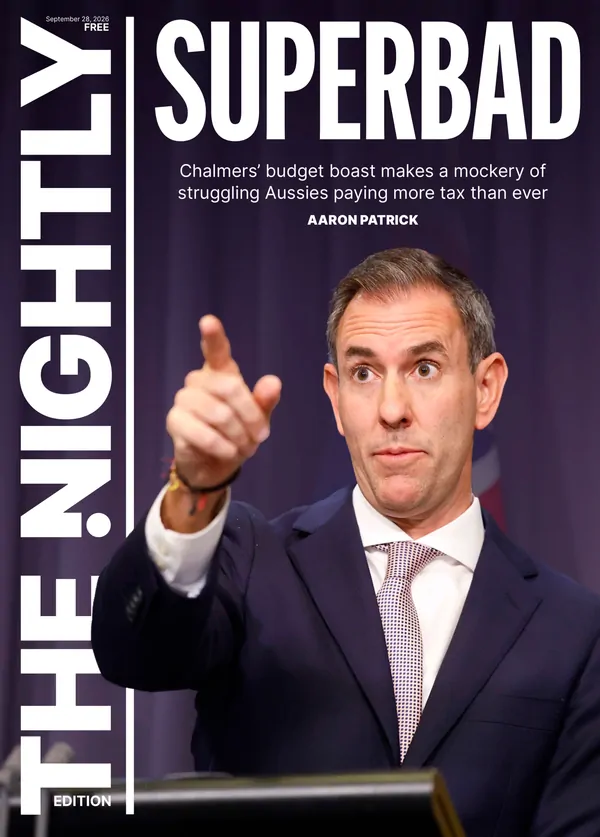
Treasurer Jim Chalmers hailed the “strongest GDP growth in almost three years” based on strong business investment, consumer spending and residential construction, as the war between Iran and the US-Israel alliance threatened to push up petrol prices.
Sign up to The Nightly's newsletters.
Get the first look at the digital newspaper, curated daily stories and breaking headlines delivered to your inbox.
By continuing you agree to our Terms and Privacy Policy.“It’s stronger growth than any major advanced economy,” he told reporters in Canberra.
“These are really encouraging numbers because they provide a robust foundation to confront the intense, global volatility which has been dialled up in recent days by the dramatic escalation of hostilities and the Middle East more broadly.
“We are really well placed to deal with what’s coming at us from around the world and these numbers make that really clear.
“The economic consequences are uncertain but they are likely to be very substantial.”
Economists, however, regard faster economic growth beyond a certain “speed limit” as inflationary because productivity is still weak.
“Today’s national accounts data is a case of when good news is actually bad news,” Deloitte Access Economics partner Stephen Smith said.
“While stronger growth may seem like positive news, it will be a concern for the Reserve Bank. The RBA is already of the view that the economy is operating above its potential.”
Productivity in 2025 grew by just 1 per cent and was flat in the December quarter, which means consumers end up paying more as the higher costs of producing goods and services are passed on.
This, in turn, adds to inflation, which at 3.8 per cent is well above the Reserve Bank of Australia’s 2-3 per cent target, with Dr Chalmers alert to higher petrol prices arising from Iran’s retaliation on the Strait of Hormuz.
“The implications for prices from higher oil prices and other prices in the economy are traded off against the potential for this conflict on growth,” he said.
“There is a very real prospect that it would put upward pressure on prices at the same time it weighs on global growth.”
A double-digit surge in crude oil prices since Sunday, triggered by the war in the Middle East, has pushed average unleaded petrol prices above $2 a litre. Westpac said average prices could increase by between 25 cents and $1 a litre.
This could see the cost of filling up a medium-sized SUV rise $13.75 to $55.
Dr Chalmers ruled out temporarily slashing the fuel excise like the former Coalition government did in 2022 when Russia’s Ukraine invasion pushed Australian petrol price above $2.20 a litre.
“When it comes to the fuel excise, that’s not something that we’ve been considering. We’ve got a lot of cost-of-living help rolling out,” he said.
On Tuesday night, investors’ expectations for an RBA interest rate increase on March 17 soared from zero per cent to 27 per cent after governor Michele Bullock suggested an increase in a fortnight was “live” option in the wake of the Middle East conflict pushing up crude oil prices.
“Does that make a March hike likely? It makes it plausible,” Moody’s Analytics head of Australian economics Sunny Nguyen said.
Before Wednesday’s data, Australia’s big four banks expected a May rate rise, based on the RBA waiting for March quarter inflation figures.
While Australia’s economic growth was the strongest in three years, it was still well below the long-term average rates above 3 per cent.
“Unless we can get better productivity growth, we’re not going to be seeing that. We’re going to be seeing sluggish, sluggish growth,” Ms Bullock said on Tuesday.
When adjusted for immigration-fuelled population growth, GDP per capita expanded by just 0.9 per cent last year.
During the December quarter, GDP per capita grew by just 0.4 per cent or half the overall GDP expansion of 0.8 per cent.