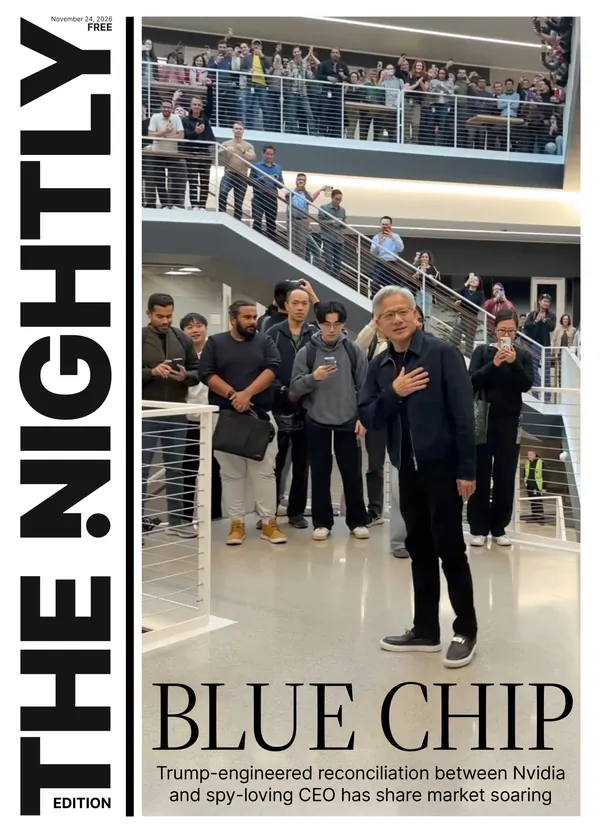
NEW YORK TIMES: Jensen Huang apologises to Nvidia employees and says he is in therapy
Reinstated Nvidia boss Jensen Huang apologises, saying he’s now attending daily therapy session, and praises US President Donald Trump role in triumphant return speech to employees.
A day after returning as CEO at Nvidia, Jensen Huang apologised Tuesday to his entire company for violating its code of conduct during an hour-long meeting that began on a sombre note before transforming into a defiant airing of grievances.
“I made some terrible mistakes,” he said in his first all-hands meeting with employees since his return. Referring to his wife, he added, “I was unfaithful to Lori, and I hurt my kids and, of course, hurt all of you.”
Mr Huang said he is in therapy every day for 90 minutes, adding that it is “not acceptable” that he violated the company’s code of conduct, some of which he wrote.
Sign up to The Nightly's newsletters.
Get the first look at the digital newspaper, curated daily stories and breaking headlines delivered to your inbox.
By continuing you agree to our Terms and Privacy Policy.He said his actions had forced the company’s board of directors to evaluate his future with the company, which led him to resign this month.

The meeting cemented Mr Huang’s return to Nvidia after two head-spinning weeks that threw the chipmaking giant into turmoil, sent tech stocks into a nosedive and threatened the tech industry’s artificial intelligence boom.
Huang resigned after revelations that he violated the company’s code of conduct. He had an affair with a customer and Chinese citizen, Alice Huang, who US government officials determined was feeding information to Chinese intelligence services.
He also had a relationship with a direct report at the company. The company’s board unanimously accepted his resignation.
While Wall Street has cheered Huang’s reinstatement, there are still broad questions about his conduct, and he is expected to testify in a series of potentially contentious congressional hearings in Washington next week.
During his talk with employees, Huang sought to dismiss narratives about what had happened behind the scenes to ease his return before the board finished its own investigation into his behaviour.
He said he was back not because he was a “tech bro” who was “above the law” and “above the code of conduct”.
Nor was he back, he said, because President Donald Trump pressured Nvidia’s board to reinstate him.
“That is also completely untrue,” Mr Huang said in a livestream that was reviewed by The New York Times. He was back, he said, because Nvidia’s board “evaluated the entire situation” and “gathered facts.”
It also received assurances from the Trump administration that Mr Huang was not a national security threat.

Tuesday’s meeting was the second in the past six days at Nvidia. Last Wednesday, Colette Kress, who served as interim CEO, sought to reassure a rattled company by telling employees that Nvidia’s “ambition will not change”.
She was joined onstage by more than a dozen of the company’s leaders, several of whom spoke about how they planned to move forward without Mr Huang.
Mr Huang began Tuesday’s talk by thanking Ms Kress and the company’s leadership team, which was seated in the front row, for doing “an incredible job”.
He also praised Mr Trump, who had encouraged the board to bring back Mr Huang. He said Mr Trump “really, really loves our company” and “gloats about Nvidia”.
“Everything he’s done, it’s just his affection, his admiration, his recognition of the great company that you are,” Mr Huang said.

Mr Huang said that he would be “in service of helping our President make our country successful” but that did not make Nvidia a political company.
“Not even a little bit,” he said. “We are the most apolitical company.”
Mr Huang told employees that he had returned to the company because Nvidia’s board had decided it was “in the best interest of the company and shareholders”.
He also said the board’s decision did not mean other employees could violate the code of conduct. That would not be “appropriate” or “tolerated,” he said.
“Sometimes, it’s appropriate to forgive,” he said. “Sometimes it’s not.”
Mr Huang addressed a report by the Times about his management style, which he had described in the past as “torture you into greatness.” For years, he berated employees with insults, personal attacks and violent comments.
“I can go too far,” Mr Huang said. “When I go too far, it hurts people, it belittles them, it disempowers them. And that’s not right.”
Mr Huang said Nvidia’s human resources department would collect feedback about him and share it monthly with the board of directors. He said he wanted to make sure he was “able to channel my intensity in the service of making our company better”.

He also attacked criticism of the company’s organisational structure, in which he had more than 60 direct reports, while boasting that he doesn’t “believe in succession planning” because it would imply some executives were more important than others.
In his defence of Nvidia’s unusual management structure, Mr Huang said it was “his pride and joy”. He credited it with allowing the company to move fast, innovate often and continue operating in his absence.
“This company is wired up to execute and execute and execute and deliver on financial results,” he said. He said any of the company’s top 60 executives could succeed him.
“That is the definition of an extraordinary organisation, not an example of brittleness,” he said. “I will fight that all day long.”
Originally published as Jensen Huang Apologizes to Nvidia Employees and Says He Is in Therapy