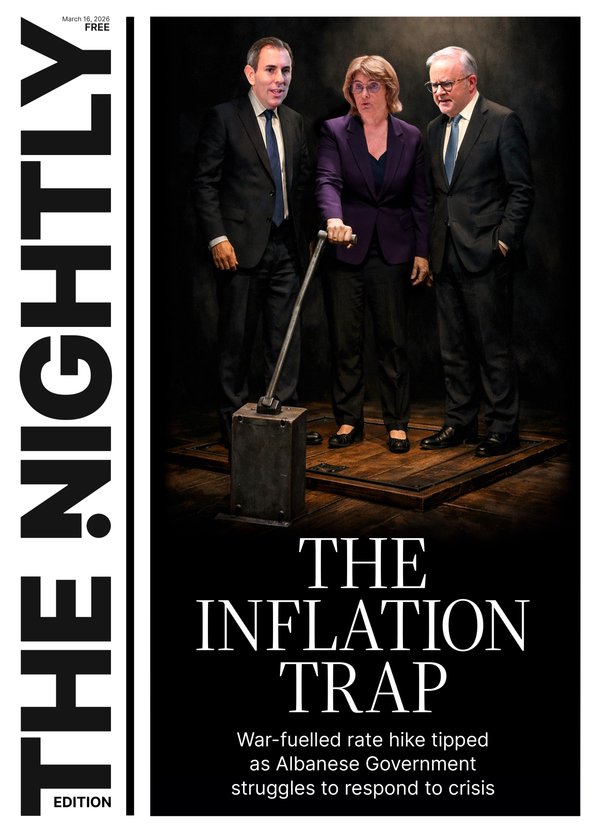
Reserve Bank weighs rate hike as shock oil price surge hits households
Surging oil prices and above target inflation growth have given the Reserve Bank a difficult decision to make, but it won’t help household budgets.
The Reserve Bank of Australia is facing a tough choice as an oil price shock comes at the worst time for the central bank.
Money markets are now placing around a 70 per cent chance the RBA will announce a rate hike on Tuesday afternoon, pushing the official cash rate from 3.85 per cent to 4.10 per cent.
Until the US/Israel strikes against Iran started just over two weeks ago, leading to turmoil on global oil trade, it had been widely expected the RBA would keep rates on hold after its March meeting.
Sign up to The Nightly's newsletters.
Get the first look at the digital newspaper, curated daily stories and breaking headlines delivered to your inbox.
By continuing you agree to our Terms and Privacy Policy.But AMP chief economist Shane Oliver says the recent oil price spike has thrown a spanner into the works for the bank’s monetary policy board members.

With the conflict between Iran and the United States and the blockage of a key trading point known as the Strait of Hormuz, the price of oil has skyrocketed from $US56 ($A80) to more than $US100 ($A143) a barrel over the last 21 days of trading.
“(Oil shocks) pushes up headline inflation but it can depress economic activity leading to falling underlying inflation,” Mr Oliver told NewsWire.
“You end up with less demand which means weaker prices.
“There are fewer people going to restaurants, fewer people going on holidays and overall it means it is much harder for companies to put up their prices.”
Mr Oliver said rising petrol prices basically acted as a brake on consumer spending, stopping households from spending in other parts of the economy.
“It acts like an interest rate hike or a tax hike,” he said.
“It takes money away from households and they have less money to spend in the economy and can slow things down.”

The current oil price shock immediately hits households, with every $10 a barrel rise in the price of oil translating to 10 cents more paid at the petrol pump.
“It roughly translates to a $14 hit to the household budget, which is about $730 a year, so I think people are feeling under the pump,” Mr Oliver said.
Mr Oliver said he believed rates should be left on hold due to the uncertainty, but he expected the RBA would raise rates on Tuesday.
“We think it makes more sense to wait till May before deciding what to do on rates, but to continue to sound hawkish in the interim,” he said.
Ebury market analyst Anthony Malouf agreed, saying the RBA should be cautious about lifting interest rates on Tuesday.
“In our view, the RBA will likely prefer to wait for further confirmation from the data, in particular the full March quarter consumer price index print due in late April,” Mr Malouf said.
NED-9108-Monthly-Inflation-Indicator
The inflation rate is currently at 3.8 per cent, although Treasury models a temporary jump to the “high 4s” from the oil price shocks. The RBA’s target range is 2-3 per cent.
“If we were putting pencils down on those forecasts today, we’d have inflation peaking somewhere between the mid to high fours,” Treasurer Jim Chalmers said.
“But there’s a little ways to run yet. And the biggest variable … is really how long this drags out for.”
Despite an above target inflation reading, Mr Malouf said the RBA should hold as both consumer and business confidence fell following the first interest rate hike in February.
At its February meeting, the RBA lifted interest rates by 25 basis points to 3.85 per cent.
Mr Malouf pointed to separate research by the Commonwealth Bank showing household spending dropped for the first time since 2024.
“Indeed, some recent data released last week has shown that consumer momentum has slowed, with CBA spending data for February falling 0.5 per cent month-on-month to record its largest monthly fall since mid-2021,” he said.
Mr Oliver conceded that regardless of the decision, it would be a risk for the RBA.
“On the one hand if they don’t hike and petrol prices continue to rise and that flows through to inflation and eventually inflation expectations, it makes it harder to get inflation back down,” he said.
“The flip side, though, households will see a hit to their spending power which will dampen spending elsewhere in the economy.
“So underlying inflation might actually be depressed despite higher prices for oil and fertiliser.”
RBA governor Michele Bullock will announce the rate decision at 2.30pm AEDT on Tuesday, following a two-day board meeting.
Originally published as Reserve Bank weighs rate hike as shock oil price surge hits households