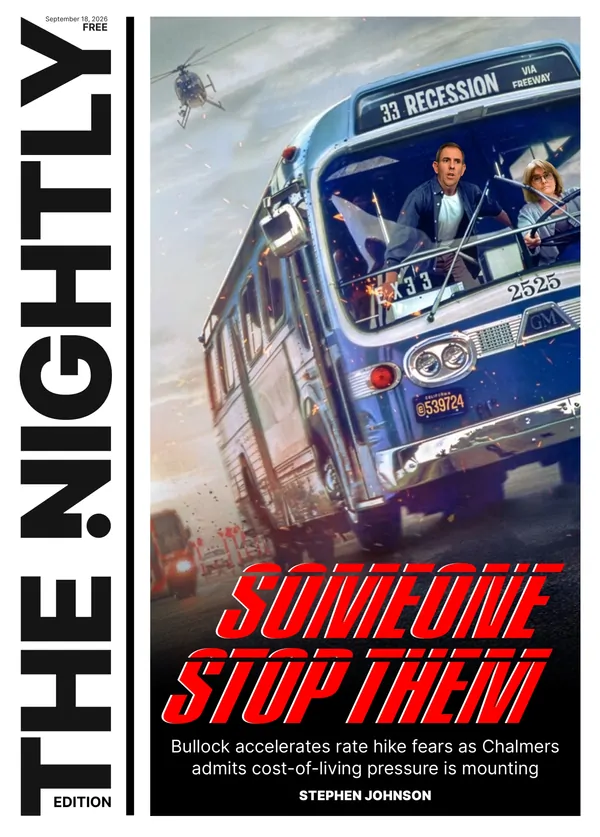
Reserve Bank of Australia hikes interest rates by another 25 basis points to 4.35 per cent
The Reserve Bank has raised interest rates by another 25 basis points to 4.35 per cent, undoing last year’s relief. Governor Michele Bullock hinted at more pain and cautioned against higher government spending.

Reserve Bank governor Michele Bullock has hinted at even more pain and warned Labor to restrain its upcoming Budget spending after home borrowers copped a third-consecutive mortgage hike.
Her board on Tuesday almost unanimously opted to increase the RBA cash rate by another 25 basis points to 4.35 per cent.
The worst inflation in almost three years convinced eight of the nine voting members, on the RBA monetary policy board, to raise rates to the highest level since February 2025, undoing the effects of the central bank’s three cuts last year and adding at least $120 to average monthly mortgage repayments.
Sign up to The Nightly's newsletters.
Get the first look at the digital newspaper, curated daily stories and breaking headlines delivered to your inbox.
By continuing you agree to our Terms and Privacy Policy.NAB has updated its forecasts to have a June hike, that would take the RBA cash rate to a 15-year high of 4.6 per cent, while ANZ and Commonwealth Bank say an August increase is now a risk.
Ms Bullock said a tight labour market before the Iran war was further fuelling inflationary pressures, and hinted Tuesday’s increase may be far from the last to combat a possible wage-price spiral.
“Developments in the Middle East remain highly uncertain but under a wide range of possible scenarios, the conflict adds to global and domestic inflation,” she told reporters.
“If left unchecked, higher costs get embedded into price and wage-setting decisions.
“These second-round effects could lead to even higher and more persistent inflation and if so, would require even more tightening in monetary policy to get inflation under control.”
Australia’s chief central banker also addressed a concern about government spending adding to demand after the RBA’s updated statement on monetary policy noted “governments may consider policies to support households and businesses” - ahead of an expected cost-of-living Budget next Tuesday.
“To the extent that the government is demanding goods and services of the economy - in the variety of ways that they do whether it’s direct expenditure or giving money to households to spend on goods and services in the private sector - that adds to demand,” she said.

“All I’m saying is the extent to which government make up the shortfalls for households, by giving them more money, it makes it harder to dampen demand.”
Treasurer Jim Chalmers vowed his fifth Budget next week would be responsible and denied Federal Government spending was to blame for the most aggressive rate hikes since 2023.
“We will save more than we spend,” he told reporters in Canberra on Tuesday.
“We will bank all of the upward revisions to revenue and that’s because we recognise that even though the Budget is not the primary driver of prices in our economy, or these interest rate decisions, we intend to play a helpful role, not a harmful role.
“The Reserve Bank statement, it’s important to recognise, does not point to public spending as a factor in their decision to increase interest rates today.”
But Dr Chalmers also had a dig at the independent central bank for putting up rates.
“Australians are already paying a hefty price for this war in the Middle East and this decision will make things harder for people,” he said.
“Just because this was the decision that was widely expected and broadly anticipated won’t make it easier for millions of Australians with a mortgage.”
With inflation already too high before the oil crisis, shadow treasurer Tim Wilson said Labor was to blame for the latest RBA increase.
“Yet another interest rate rise is a damning verdict on Jim Chalmers’ active inflation agenda, compounded by the Iran conflict, and the RBA has assumed the Treasurer won’t get it under control by assuming rates may yet rise and stay there for two years,” he told The Nightly.
Updated Reserve Bank forecasts have assumed a 15-year high cash rate of 4.6 per cent, which is a quarter of a percentage point higher than now with the latest increase, which Ms Bullock said was only “a bit restrictive”.
The RBA on Tuesday also predicted inflation would climb to 4.8 per cent by June, up from a February prediction of 4.2 per cent made before the US and Israeli strikes on Iran.
“Already, we’ve seen a sharp increase in fuel and related commodity prices and this is already feeding through to inflation - the recent increases in interest rates will have no impact on this,” Ms Bullock said.
“When inflation is already too high, and the economy facing capacity pressures, it doesn’t take much additional spending to make the job of returning inflation to target more challenging.”
Inflation in March hit a near three-year high of 4.6 per cent, putting it even further above the board’s 2 to 3 per cent target.
“Having raised the cash rate three times, monetary policy is well placed to respond to developments and the board is focused on its mandate to deliver price stability and full employment. It will do what it considers necessary to achieve that outcome,” the RBA said.
“With the conflict in the Middle East continuing, there are plausible scenarios where inflation is higher and activity lower than envisaged under the baseline forecast.”
The RBA has now raised rates at three consecutive meetings for the first time since March 2023, during its last hiking cycle.
The February increase pre-dated the Iran war, while the March increase was a split five-to-four decision a fortnight into the conflict.
The latest quarter of a percentage point increase adds $121 to an average, new, owner-occupier mortgage of $736,000.
Unemployment was tipped by the Reserve Bank to hold steady at 4.3 per cent by the end of 2026, before rising to a six-year high of 4.6 per cent by December 2027.
Tellingly, the RBA forecast growth of 1.9 per cent for 2026, down from 2.1 per cent predicted in February
“In our view, it is quite optimistic to have such a low rate of unemployment given the slowdown in growth they forecast,” Ebury economist Anthony Malouf said.
By the end of next year, headline inflation was forecast to moderate to 2.4 per cent - or the mid-point of the RBA’s target band.
“The bank has updated its forecasts to incorporate recent data and developments in the Middle East,” the RBA said.
“The baseline forecast, which assumes that the conflict is resolved soon and fuel prices decline, sees underlying inflation peaking higher than was expected in February.
“It then declines as demand growth slows and capacity pressures ease in response to higher interest rates.”
NAB on Tuesday updated it forecasts to have a June hike while Westpac was already forecasting an 18-year high cash rate of 4.85 per cent in 2026.
“Today’s decision by the RBA Monetary Policy Board, while not quite unanimous, showed a clear preference to prioritise the price stability,” economists Sally Auld and Gareth Spence said.
One more increase would take the RBA cash rate to a 15-year high of 4.6 per cent, with the RBA’s statement on monetary policy assuming a cash rate of 4.6 per cent from December 2026 onwards.
“There is now a credible risk that rates could rise to levels not seen for around 15 years,” Deloitte Access Economics partner Stephen Smith said.