Westpac banks $6.8b as boss warns of more rate pain and house prices tipped to plunge nearly 11pc
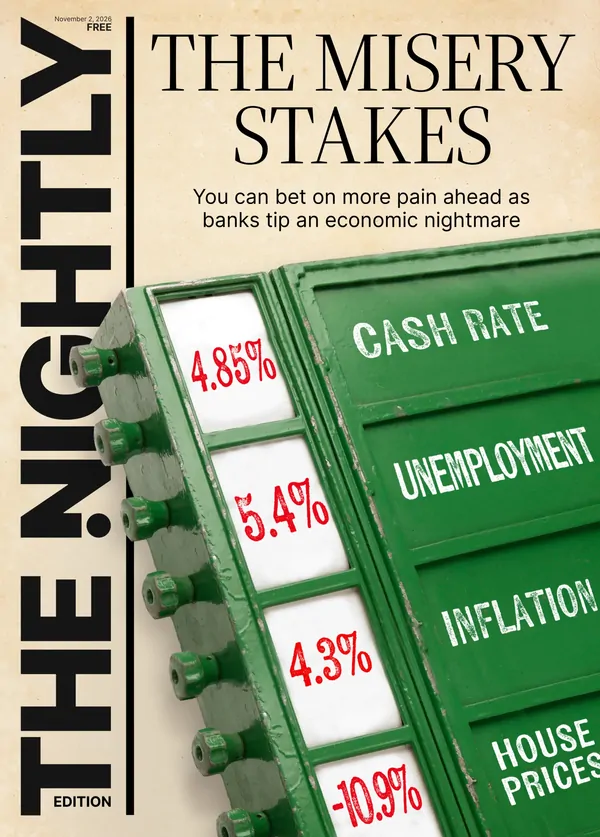
Westpac’s annual profit fell short of expectations at $6.81 billion as the big four bank forecast a near-11 per cent slide in house prices and its boss raised the prospect of more interest rate pain.
Westpac’s annual profit fell short of expectations at $6.81 billion as the big four bank forecast a near-11 per cent slide in house prices and its boss raised the prospect of more interest rate pain.
Shares rose 1.7 per cent in morning trade despite the 1.5 per cent full-year profit decline, with strong business lending helping offset pressure on its mortgage business.
“I think there’s a chance there’s another rate rise based on where things are at,” chief executive Anthony Miller said when asked about further tightening beyond the increase Westpac expected at Tuesday’s Reserve Bank meeting.
Sign up to The Nightly's newsletters.
Get the first look at the digital newspaper, curated daily stories and breaking headlines delivered to your inbox.
By continuing you agree to our Terms and Privacy Policy.The country’s second-largest mortgage lender forecasts house prices will fall 10.9 per cent in the 12 months to March 2027. Its economists expect two rate cuts in the second half of next year.
Yet Mr Miller maintained the view he expressed in Perth in August, when he dismissed predictions of a catastrophic housing collapse as “overplayed”.
“The housing cycle has turned, although at this point the downturn is consistent with previous cycles,” he said on Monday.
Westpac’s fourth-quarter mortgage applications fell 15 per cent from a year earlier, though they remained above their five-year average. The bank expects housing credit growth across the banking system to slow to 3.8 per cent in the coming financial year.
Mr Miller said separation, divorce, injury, death and an unexpected loss of income could push customers into hardship.
“But the only one (factor) that has increased in terms of reasons why people have entered hardship in the last 12 months is overcommitment,” he said.
“Three rate cuts, and then 12 months later, four rate rises.”
He said the speed of that reversal had contributed to the increase in hardship, but urged borrowers to seek help early.
“Come in if you need help, we will help,” he said.
“It is quite significant the number of people who come into the hardship program and exit within 90 days.”
The share of Westpac’s Australian mortgage balances receiving hardship assistance rose from 0.53 per cent to 0.60 per cent over the year, excluding RAMS.
Other borrowers added to their savings, with Australian mortgage offset balances rising $10b to $81b. The bank’s broader measure of stressed exposures improved over the year, though mortgage arrears rose in the second half.
UBS analyst John Storey said weaker second-half revenue trends were cushioned by cost discipline and lower-than-expected loan-impairment charges.
“Continued cost delivery, at time when project UNITE spend and execution risk are ramping up, is needed if the revenue outlook is softer,” he said.
He expected competition for loans and deposits to keep squeezing margins into 2027.
Business lending grew 12 per cent and institutional lending jumped 18 per cent, outpacing 7 per cent growth in Australian housing loans excluding RAMS.
Analysts challenged the returns Westpac was earning for the risks of expanding beyond mortgages. Mr Miller said growth was concentrated among existing customers and the bank was not seeking to “grow for the sake of growth”.
Infrastructure, energy and resources helped drive demand, but Mr Miller said data centres had not contributed significantly to institutional lending growth over the past year.
“We’re coming at it very thoughtfully because I think there is a little bit too much hype,” he said.
Inside the bank, Mr Miller was more enthusiastic about artificial intelligence. Westpac reports 95 per cent of staff use AI tools monthly, and he said it helped accelerate the migration of a legacy St George data warehouse.
“This helped us complete the migration more than two years earlier at half the cost,” he said.
Westpac is targeting more than $600 million in productivity benefits next year. It ended September with 34,682 full-time equivalent staff, down 554, but has not quantified AI’s contribution to that reduction.
Rival National Australia Bank plans to cut up to 2500 jobs by mid-2027, including up to 1500 by year-end.
Asked about further workforce reductions, Mr Miller gave no target. He said 4500 people had joined Westpac during the year and 5050 had left.
“I don’t think it’s about headcount out to get costs down. It’s about running it more efficiently and having a different shape of workforce,” he said.