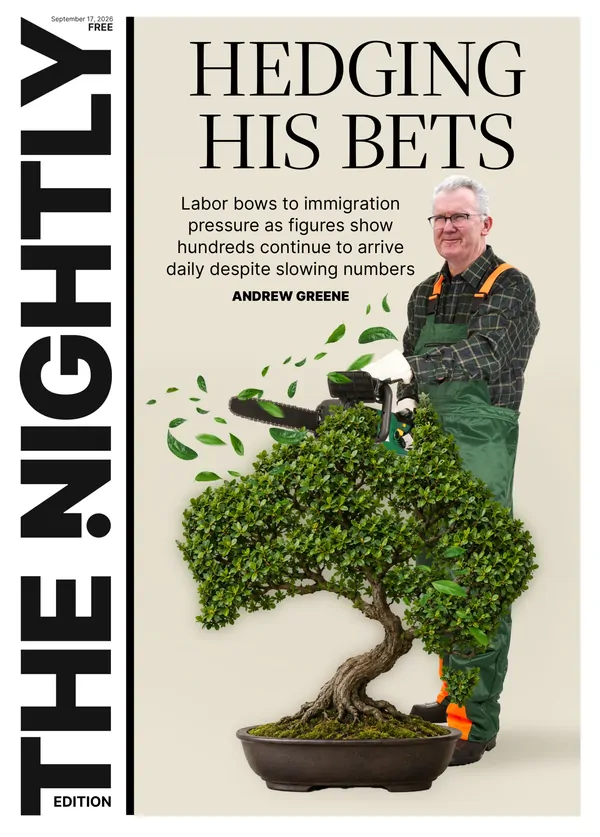
AARON PATRICK: Australians finally have a real choice when it comes to immigration policy
AARON PATRICK: The new approach demonstrates that how deeply Australian attitudes to immigration have changed.


Home Affairs Minister Tony Burke made a big call in his immigration policy changes on Thursday.
He said the changes are needed to “make sure what is published and forecast is reached”, words that make him accountable for lowering the number of immigrants moving to Australia permanently to 225,000 next financial year from 292,100 in the latest measured period.
In the annals of immigration policy, it is hard to find another minister who personally committed to a figure for what is known as net overseas migration.
Sign up to The Nightly's newsletters.
Get the first look at the digital newspaper, curated daily stories and breaking headlines delivered to your inbox.
By continuing you agree to our Terms and Privacy Policy.That’s because Australia’s “demand driven” system gives ministers limited power over how many foreigners are allowed to call Australia home. Citizens can leave whenever they want. If the economy expands, workers need to be found quickly.
Faced with this uncertainty, no ministers wanted to be accountable for a figure they couldn’t be certain would be achieved.
The new approach demonstrates that how deeply Australian attitudes to immigration have changed. Support for the “Big Australia” proposed by the Rudd Labor Government has vanished. Australians, tired of crowded suburbs, roads, trains and schools, want relief.
The Labor Party and Coalition are promising to give it to them. The key question for the Albanese Government is whether Mr Burke’s promised cuts will be enough to ease the pressure on a stressed country.
The methods Mr Burke plans to use will cause some pain but will probably succeed in reaching the 225,000 target next financial year, according to Abul Rizvi, a former Immigration Department official who proposed a target three years ago.
Also known as NOM, the figure is a statistical calculation of the permanent increase in the population. The proliferation of visas and impossibility of knowing who wants to stay makes it an estimate.
“In terms of setting a NOM target and committing to deliver, that is a huge change,” Mr Rizvi says. ”All the other stuff is tinkering.”
Some of the measures might backfire. The restrictions on students’ spouses are going to turn off a lot of smart people. They tend to study for longer degrees and contribute more to the economy.
The government has already cracked down on dodgy courses and applicants. Some 40 per cent of foreign students are being rejected, up from the normal 10 per cent. Sometimes their courses don’t look legitimate. Other times they don’t have enough money to pay, and are relying on obtaining residency and jobs to cover their debts.
Backpackers are going to be hit too. Those forced to enter a lottery to stay longer will reconsider whether rules designed to funnel them into agricultural labour are worth the risk. New Zealand might be a safer option.
Among those who won’t be affected by the changes are the 20,000 refugees and persecuted people admitted every year, a big increase from the Coalition’s days in office. Anthony Albanese has protected them, a sign of how strong their support is within the labour movement.
Liberal leader Angus Taylor, whose NOM target is tied to home construction, said Mr Burke can’t be trusted to lower migration because the government has “missed their target every year ... by hundreds of thousands”.
There is truth to the allegation that the government lost control of immigration after the pandemic. It is also true that the Labor Party and Coalition avoided a debate about economic-driven immigration for decades, convinced it was good for business, workers and the coffers of the federal Treasury.
That consensus helped create a phenomenon One Nation supporters derisively call the “uniparty”. Pauline Hanson’s plan to cut 750,000 temporary visas is a bold bet on the resentment festering across Australia.
With Mr Burke’s promises today, the nation has been given a clear choice between fewer immigrants, a lot fewer immigrants and empty the backyard, the frontyard and the bedrooms of immigrants.
The battle is on.