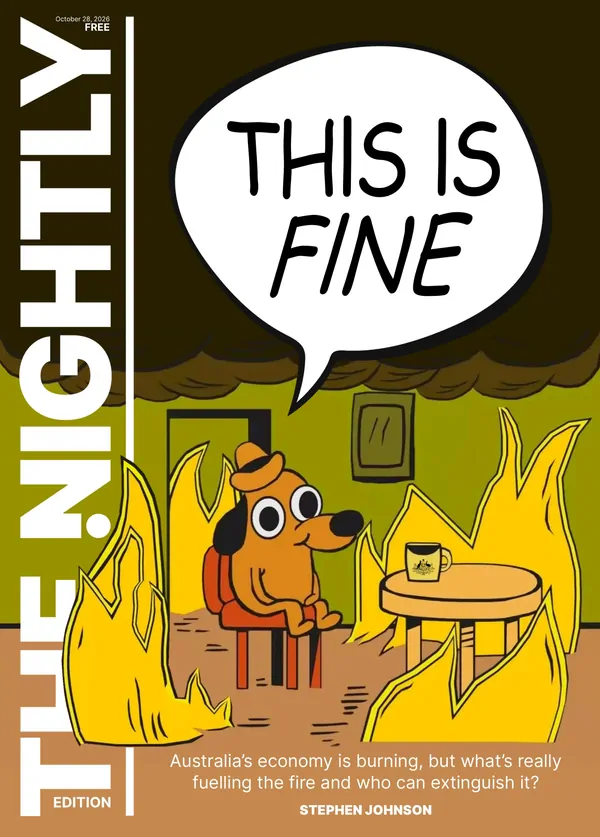
EDITORIAL: Cycle of gloom exposes Labor failings
EDITORIAL: Australians expect their government to run budgets in a responsible way so that when there are shocks it can respond.

It seems when a key set of statistics on the economy is released, the same pattern follows again and again.
It goes like this: Inflation numbers are released; the Reserve Bank of Australia acknowledges government spending is a factor in driving demand which fuels inflation; Treasurer Jim Chalmers tries to deflect attention to the oil price rise from the war in the Middle East; the RBA pulls the cash rate trigger, banks respond, and home loan interest rates go up again.
In what will be another blow to stressed home loan borrowers, we are already in the cycle after the Bureau of Statistics on Wednesday revealed headline inflation had soared to 4.3 per cent in September.
Sign up to The Nightly's newsletters.
Get the first look at the digital newspaper, curated daily stories and breaking headlines delivered to your inbox.
By continuing you agree to our Terms and Privacy Policy.The RBA’s preferred measure of underlying inflation, the trimmed mean, remained elevated at 3.6 per cent with both measures of inflation above the bank’s 2-3 per cent target for the 14th straight month.
RBA governor Michele Bullock’s messaging was familiar.
“The increase in inflation reflects both consistent capacity pressures in the Australian economy and global cost pressures associated with the conflict in the Middle East,” Ms Bullock said.
“Because of both these factors, inflation is likely to remain elevated for some time.”
Asked by Liberal deputy Jane Hume if Government spending was contributing to high inflation, Ms Bullock said: “I’ve said this a number of times — part of the inflation problem is that demand is greater than the ability of the economy to supply”.
“Demand is made up of demand from government and the private sector so . . . yes, to the extent that it is contributing to aggregate demand and aggregate demand is above supply, then it’s contributing to that.”
By mid afternoon all the big four banks — CBA, NAB, ANZ and Westpac — were predicting the RBA’s next meeting on Melbourne Cup day, November 3, would bring the fifth cash rate hike since February.
That would take the cash rate to an 18-year high of 4.85 per cent.
Dr Chalmers stuck to the usual lines.
“We already had an inflation challenge in our economy and the war in the Middle East is making it worse,” he said.
“Budgets aren’t the primary driver of prices in our economy.
“But we can and continue to play a helpful role in the fight against inflation.”
Dr Chalmers has already alluded to the upcoming mid-year Budget update including a savings package.
It remains to be seen whether that means net savings or “savings” reallocated and spent elsewhere.
The Government’s spending addiction has left it exposed.
Australians expect their government to run budgets in a responsible way so that when there are shocks — such as the GFC and COVID — it has the capacity to respond.
And therein lies a great failure of the Albanese Government.
When the shocks came — this time the Ukraine and Middle East wars — the Government was found wanting.
It had not saved for a rainy day.
Its response is consistent.
It is to deny, deflect and hang on in the hope we forget and the news cycle moves on.
The tactic lies at the heart of its operational model.
But tactics cannot cover failings for ever.