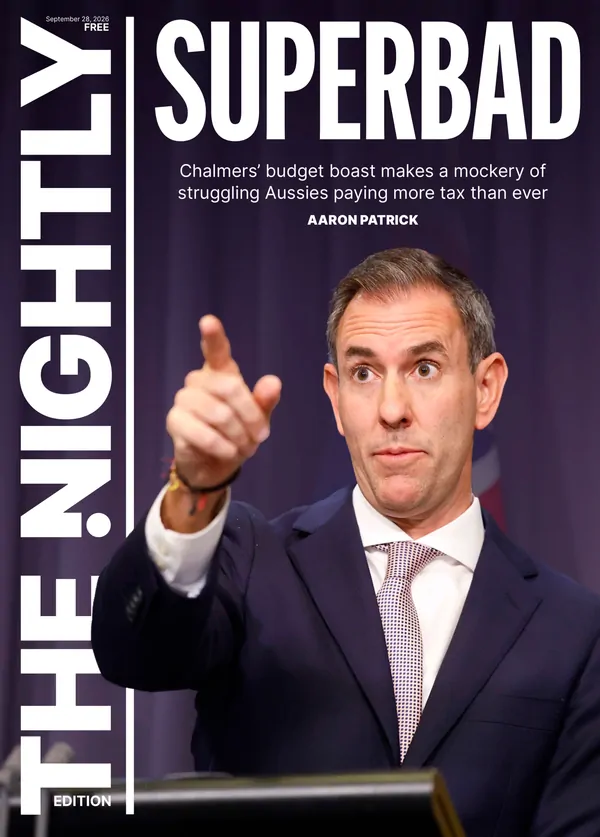
EDITORIAL: Government’s bid to deflect rate rise blame won’t ease pain
Jim Chalmers has started to prepare the ground for another rate rise by claiming Australia was not alone in facing an inflation problem.
One day out from the next expected interest rate rise and the deflection shield has been lifted into place in Canberra.
The Reserve Bank of Australia is expected on Tuesday to raise interest rates, taking the cash rate to a 15-year high of 4.6 per cent.
That would be on top of three rate rises already this year.
Sign up to The Nightly's newsletters.
Get the first look at the digital newspaper, curated daily stories and breaking headlines delivered to your inbox.
By continuing you agree to our Terms and Privacy Policy.And there are some suggesting there will be a fifth interest rate rise on November 3.
The RBA says the rate rises have been necessary — and clearly it believes they still are necessary — in order to tackle inflation.
Inflation has become seemingly entrenched above the RBA’s 2-3 per cent target.
Part of the debate has centred on the inflationary role played by government spending in the capacity-constrained economy dragged down by weak productivity growth.
So Treasurer Jim Chalmers got in early on Monday in the expectation the finger pointing would commence again after the RBA’s expected rate hike on Tuesday.
Dr Chalmers had his flak deflectors running at maximum speed as the Government released the final Budget outcome for the 2025-26 financial year.
It showed higher business and superannuation taxes had delivered extra revenue that had reduced the size of the deficit.
The deficit came in at $22.3b, which was $6b less than forecast in the May Budget and made up 0.8 per cent of the economy instead of 1 per cent as predicted four months ago.
Dr Chalmers stressed the improvement in receipts was “not from wage earners”.
“It is overwhelmingly from higher super and investor income than what we anticipated in the Treasury’s forecast in May,” he said.
But the bottom line was the taxing and spending numbers did not make for enjoyable reading.
Tax as a percentage of gross domestic product for the 2025-26 financial year had been forecast at 23.6 per cent but instead hit 24.1 per cent of GDP.
The Budget had forecast government spending as a proportion of GDP would hit 26.6 per cent for 2025-26, but it rose to 26.9 per cent — the highest since the 1986-87 financial year outside of COVID.
And the deficit was still more than double the $10b deficit for 2024-25, a point shadow treasurer Tim Wilson highlighted, noting Labor’s spending growth of 4.3 per cent was double the 2.1 per cent economic growth pace.
Dr Chalmers started to prepare the ground for another rate rise by claiming Australia was not alone in facing the problem.
“We see much more pressure on inflation from developments in the Middle East in particular and that’s why if you look right across the major advanced economies, there is an expectation of higher interest rates around the world as a consequence of higher inflation coming from primarily oil prices,” he said.
But that won’t be of any consolation to the millions of financially-stretched Australians with home loans who are already doing it tough.
They will be forced to again tighten their belts — if they are able to.
And they will not look only at the RBA when they seek out who to blame.
They will be looking also at the Albanese Government.