EDITORIAL: Report points to Afghanistan leadership failure
EDITORIAL: It is the first public acknowledgement by the Defence Force that senior leaders should share in the blame for any misconduct by junior soldiers.

The Australian Defence Force’s withdrawal from the war in Afghanistan was announced way back in April 2021.
And yet the fallout continues.
The most recent reminder of that disastrous conflict is the publication of a summary of a report by the Inspector-General of the Australian Defence Force.
Sign up to The Nightly's newsletters.
Get the first look at the digital newspaper, curated daily stories and breaking headlines delivered to your inbox.
By continuing you agree to our Terms and Privacy Policy.The report, published online on Tuesday, contains damning findings about failures of leadership.
It is the first public acknowledgement by the Defence Force that senior leaders should share in the blame for any misconduct by junior soldiers.
The report was commissioned by the Defence Force after the Brereton inquiry cleared officers of blame regarding what it said was the unlawful killing of 39 Afghans by 25 soldiers.
“The breakdown in command occurred in an incremental way over an extended period of time,” the report says. “Signs of broader decline appear to have been evident to some in higher headquarters. That there was no effective intervention and that this decline was allowed to continue, suggests an absence of effective leadership at various levels.”
The report holds SAS officers responsible for permitting “an inversion of authority” that handed control to patrol commanders, usually sergeants.
“This resulted in junior officers being effectively subservient to non-commissioned officers, and occupying a position which can best be described as ‘learned helplessness’,” the summary says.
“To gain acceptance and to offset a perceived lack of support from higher command, some junior officers prioritised ‘mateship’ over ‘leadership’ . . . this contributed to a blurring of lines between ranks, particularly as between non-commissioned officers and junior officers, and an undermining of the chain-of-command.”
It became widely known that weapons, radios or other military equipment were being placed next to dead bodies and photographed as proof they belonged to the insurgency, according to the report.
“There was tangible data available for higher headquarters through trends in growing numbers of Enemy Killed in Action,” the report says.
“Some commanders were alert to this data. There is no suggestion that those aware of rumours were specifically complicit in the misconduct, however, it is extraordinary that no effective action was taken given the gravity of the matters the subject of rumours.”
Two SAS soldiers have been charged with war crimes, Oliver Schulz, whose trial for murder is scheduled to begin in February, and Ben Roberts-Smith, who has said it could take up to seven years for his case to reach a jury.
Both men deny the charges.
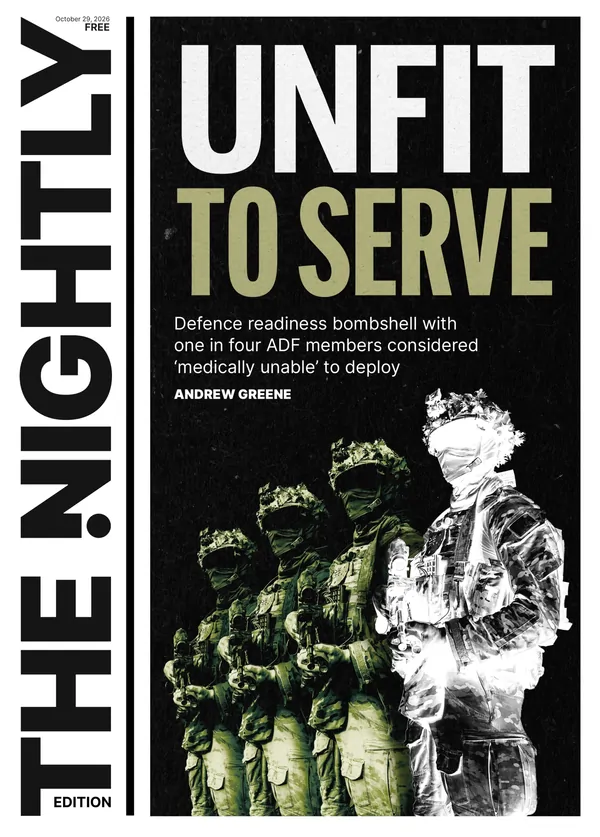
In further problems for the ADF, it was revealed on Thursday almost a quarter of ADF personnel are not considered medically able to deploy including members who are now transitioning out of uniform.
Defence chief of personnel Lt-Gen. Natasha Fox told a Senate estimates hearing that “over 75 per cent of the ADF are actually in a deployable, military employment classification”.
But there was a welcome burst of promising news with the arrival of Virginia-class fast-attack submarine USS Colorado at HMAS Stirling south of Perth as the AUKUS pact continued to progress.
Much rests on the success of AUKUS — including a needed boost of morale in our defence ranks.