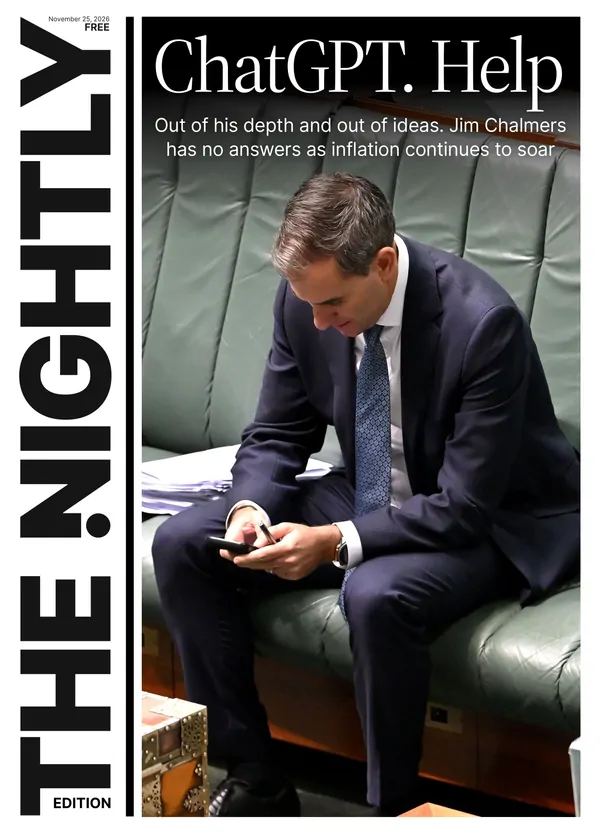
TIM WILSON: Labor is all economic platitudes and no solutions
TIM WILSON: Instead of telling us what we already know, Jim Chalmers needs to tell us what he’s going to do about it.

Inflation is a design feature of the economy Labor built, and the Treasurer should use his economic statement in December to deliver a mini-budget to cut inflation and restore confidence.
While the latest inflation data will send shockwaves through the Albanese Government, Australian households and small businesses doing it tough will be worried about what it means.
A temporary headline rate of 4.9 per cent is well above expectations, as was the lift of the underlying structural rate of 3.8 per cent.
Sign up to The Nightly's newsletters.
Get the first look at the digital newspaper, curated daily stories and breaking headlines delivered to your inbox.
By continuing you agree to our Terms and Privacy Policy.The Treasurer has lost control of the economy. He acknowledged this in his ministerial statement to the Parliament on Monday.
He conceded under his economic model that “interest rates are biting, unemployment is rising, prices are going up, wages aren’t keeping pace, and families are hurting”. But for all the empathy, he has no solution.
There is no debate that the Iran crisis has had an influence. As Reserve Bank governor, Michele Bullock, said recently they’re “compounding the inflation problem, we still see inflation arising from domestic capacity pressures”.
The “domestic capacity pressures” problem stems from the economy Labor built. Labor’s economic model is to spend on the less productive parts of the economy, and is funded by debt and higher taxes on the productive sectors.
As private job growth falters they spend more to keep job numbers up creating an inflation vortex that is dragging the economy into a sinkhole, and it is speeding up.
The only pathway to change is a change in the economic model itself. And that starts with a pivot from Federal Budget and turning the end of year financial health check into a mini-budget.

The case is clear. First, the economic conditions are now substantially worse than May and there is an urgency to tackle inflation. In May inflation was forecast to be back to 2.5 per cent by the middle of next year. The latest data shows it is nearly double that.
The OECD has now lifted its forecast for Australian inflation three times in a row, and the IMF has identified that “greater efforts will be needed to contain spending growth”.
The Opposition wrote to the Prime Minister earlier this year offering a bipartisan solution and has offered $31.3 billion in savings.
These requests have fallen on deaf ears. The Treasurer said recently he would “deliver modest net savings” but history shows where he saves $2 in one hand, he goes on to spend $3 in the other.
Second, the Treasurer should shield Australians from higher oil prices, and downstream products. As one of the largest per capita consumers of diesel in the world we know it will only make cost of living harder in the new year, particularly through food prices. Soon the global challenge will be the price of fertiliser, and access to it too.
To ease pressure the Federal Government could legislate the Coalition’s fuel price shield that would halve the excise on petrol knocking about 27 cents a litre off the price at the bowser.
Third, the Treasurer should repeal all the taxes he introduced in the Budget without democratic mandate. Putting aside the issues of honesty, it is the worst possible time to legislate higher taxes on housing, growth and small business.
Despite claims the higher taxes were designed to make housing more affordable, with real wages going backward housing affordability has declined. The data doesn’t lie.
Home loans have collapsed and while there have been significant price drops at the top end of the market, the average first home buyer loan is at a record $617,000.
Meanwhile investor confidence and finance has collapsed. Home buyer loans for new builds are down a third under this Government, and with new SMSF lending for housing scrapped and negative gearing changes the RBA has projected existing builds will be completed and then new construction will thin.
Changes to capital gains have hit business confidence. We have had record business insolvencies over the past two financial years, and about 40 are going broke a day. Even more are voluntarily closing the books because they’ve given up, or they have no one to sell to.
It is no wonder unemployment that was assumed in the Budget to be 4.5 per cent was lifted to 4.9 per cent last week and may go above 5 per cent before Christmas.
But the worst impact from these tax changes has yet to be revealed. Small business still doesn’t understand the impact of the new tax targeting trusts that is passing through Parliament. Estimates range from $10,000 just to understand, and then $50,000 to adjust, and could accumulate to a $13.3b deadweight cost on the economy.
The recent Senate inquiry revealed how little the Government has thought through the consequences of their tax. CPA Australia told the inquiry it will be up to $2.8b upfront and up to $595 million every year after that for compliance.
Further evidence highlighted small businesses could incur costs and time delays to reissue licences, insurance and finance, as well as stamp duty if they restructure.
That’s why a Federal Coalition government will immediately repeal Labor’s new taxes.
The objective of the Federal Budget should be to align the incentives to grow the economic pie and ensure hard work pays off. Those aren’t the incentives in the economy Labor built, and the Treasurer should use a mini-budget to correct it.