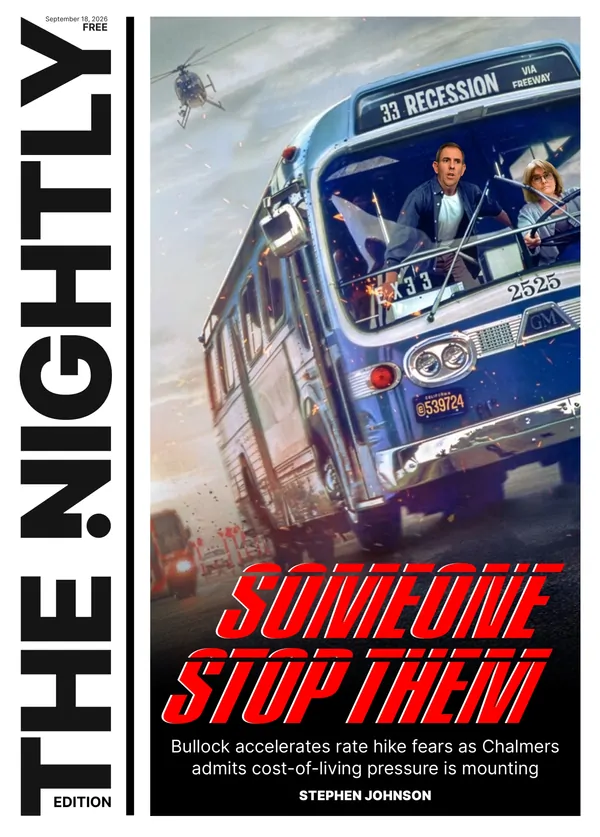
AARON PATRICK: Should we believe Jim Chalmers’s interest rate denials?
AARON PATRICK: No matter what the Treasurer claims, a $100 billion spending spree by the Albanese government is contributing to inflation and rate rises.


Jim Chalmers is trying to convince Australians that out-of-control inflation is not his fault, raising an interesting question: if you repeat a deception enough, will it be believed?
In a radio interview this morning the Treasurer said: “Government spending wasn’t the reason why rates went up yesterday. It wasn’t a factor in the decision.”
On Tuesday official interest rates were increased for the third time in three months, to 4.35 per cent, by the Reserve Bank of Australia to bring inflation under control.
Sign up to The Nightly's newsletters.
Get the first look at the digital newspaper, curated daily stories and breaking headlines delivered to your inbox.
By continuing you agree to our Terms and Privacy Policy.Credible economists say Dr Chalmers’ expanding government — roughly $100 billion deliberately added to spending since elected in 2022 — is contributing to inflation.
This isn’t a fringe view. Reserve Bank governor Michele Bullock said on Tuesday: “The extent to which the government makes up the shortfalls for households by giving them more money, it makes it harder to dampen demand”.
Ms Bullock, a Labor appointee, was referring to the unfortunate necessity to use interest rates to reverse the effects of spending by all levels of government.
Dr Chalmers tried to write off Ms Bullock’s observation as a response to a hypothetical question, and therefore irrelevant. It is true that journalists know, in order to get an answer from Ms Bullock about how the government makes her job harder, that they have to phrase questions hypothetically.
But to dismiss the opinion of a senior and politically aware public servant on a matter of great public importance as irrelevant is an insult to one of the high offices of state.
Independent economist and well-known Budget analyst Chris Richardson praised Ms Bullock for the honesty of her answer.
Is $22bn a lot?
As the man in charge of Australia’s biggest balance sheet, Dr Chalmers carries the greatest individual responsibility for fighting inflation. It is a fight he has avoided, apparently until now.
The federal budget deficit is likely to be around $30 billion this year. That money, in the form of welfare, wage subsidies, public servants and infrastructure construction, is fuelling an economy running far too hot.
Suddenly presenting himself as a fiscal conservative, Dr Chalmers reportedly plans to raise property taxes in next week’s budget, a measure that he seemed to allude to this morning as “winding back spending”.
“The budget won’t be pumping a lot of extra stimulus into the economy,” he told the ABC.
Whether that statement is true depends on if you regard $22 billion — the Commonwealth Bank’s estimate of the deficit next financial year — as a lot of money.
Relief from rates?
The Albanese government didn’t win one of the largest majorities in history by upsetting voters. Which may explain why The Australian reported on Tuesday, with a degree of authority and lack of sourcing that suggests the information came from the government, that a $200-to-$300-a-year tax cut is planned for all workers.
“I’m not going to add to that speculation today,” Dr Chalmers said this morning when asked to confirm the news.
The timing of the tax-cut news suggested the government wanted to blunt the pain of a widely anticipated interest rate rise. Which raises another awkward question: is next Tuesday’s Budget going to provide financial relief from interest rates?
Which, of course, would undermine the entire painful exercise begun by the Reserve Bank this year of hurting everyone who has debt, and many who don’t.
The opportunity for the obvious solution has passed. Rather than allocate billions to favoured voters, the Albanese government could have kept the budget in balance when fortune delivered a commodity price surge in 2022, 2023 and 2024.
A surplus would have made an inflation break-out less likely in 2025 and easier to contain if it did happen.
Now, the government must grapple with the economic consequences of its spending spree. Dr Chalmers can argue he does not share responsibility for higher interest rates, but the evidence demonstrates that’s a lie.