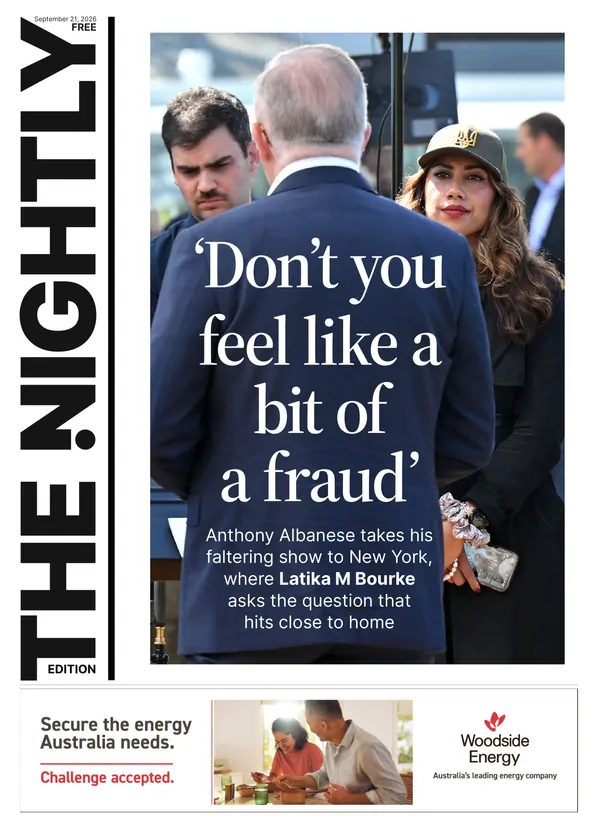
Anthony Albanese warns Australia faces worsening floods and fires in major Climate Week speech in New York
Anthony Albanese has urged leaders on the sidelines of the UN for more action on climate change, arguing resilience in affected communities can only go so far.
Residents in communities affected by floods and fires are set to experience repeated trauma from repeated natural disasters unless greater action is taken on climate change, the prime minister has warned.
In a keynote speech to the New York Climate Week summit on the sidelines of the United Nations, Anthony Albanese said it was not a matter of if, but when, the next large-scale natural disaster will take place.
Opening the summit on Tuesday, Australian time, the prime minister said the resilience of communities and emergency responders to natural disasters should no longer be the status quo.
Sign up to The Nightly's newsletters.
Get the first look at the digital newspaper, curated daily stories and breaking headlines delivered to your inbox.
By continuing you agree to our Terms and Privacy Policy.“As leaders, we must match their bravery. Unfortunately, without strong action, the science tells us these events will get worse and more intense,” he told the summit in New York.
“We can’t rely in the fortitude of our people alone, as tough as they are. We need to come together to meet the problem head on.”
The prime minister said while weather patterns have always been unpredictable, large-scale natural disasters would become even more common.
He warned record-breaking temperatures in Europe, as well as a potential summer of extreme heat and bushfires linked to El Nino would exacerbate the situation.
“The global community cannot afford to be frozen in time while the world warms around us,” he said.
“There’s no avoiding the scale of our responsibility or the cost of inaction, because there’s no denying what it also represents.”
Australia was using its credentials on climate efforts at home as well as in the broader Pacific region as part of its pitch for a non-permanent seat on the UN Security Council in 2029 and 2030.
Mr Albanese said in the keynote speech nations could not afford to forget Pacific allies on the climate front.
“(It’s) a region where those who’ve contributed the least to the climate crisis are among the most vulnerable to its consequences,” he said.
“We are backing Pacific action and innovation. Turning up, following through and creating a more connected and unified region.”
But the Australian Security Leaders Climate Group said Mr Albanese could not claim credibility on the international stage for climate leadership when coal and gas projects were being expanded back home.
Former Australian Defence Force chief and group member Chris Barrie said climate change needed to be the biggest security concern for the country.
“If the prime minister is going to New York to say climate security is national security, Australians are entitled to ask a very simple question: where is the plan?” he said in a statement.
“The government has yet to set out a clear, climate security framework showing how escalating climate risks are being incorporated.”
Also speaking at the Climate Week summit, UK Foreign Secretary Ed Miliband said governments across the world also needed to link climate security to national security.
Russia’s invasion of Ukraine in 2022, which impacted gas markets, as well oil price surges stemming from the war in Iran, highlighted the need for the approach, he told the forum.
“Countries need to pool information because a shock beginning in one country can rapidly travel through supply chains, financial markers and migration patterns to other countries,” he said.
“We have to become better at managing shocks.”