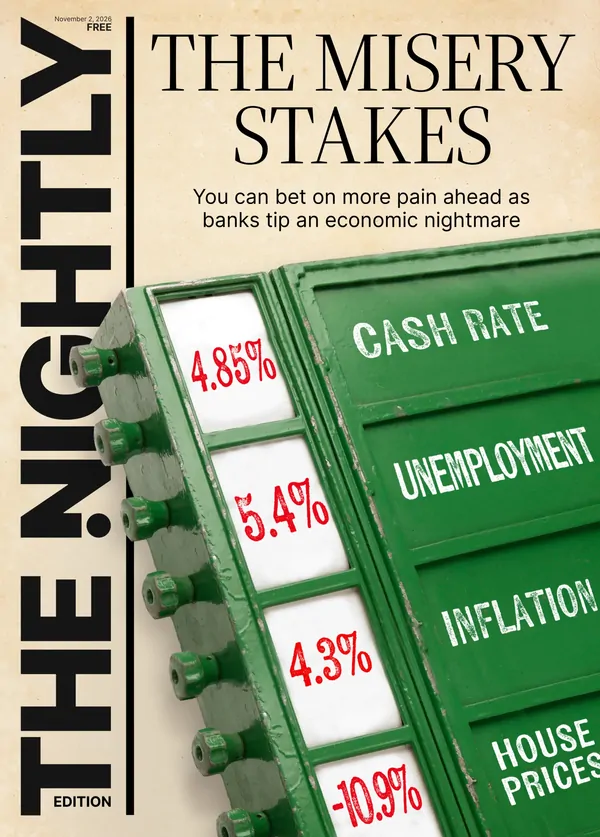
Commonwealth Bank slashes house price growth forecasts nationwide in largest expected downturn on record
The value of homes across the country have been forecast to fall nearly 20 per cent, in what economists say will be the largest downturn on record.


Home prices across the nation have been forecast to fall as much as 20 per cent, in what economists say will be the largest downturn on record.
Economists at the Commonwealth Bank on Tuesday revised property price forecasts nationally to fall 14 per cent, and 15 per cent in capital cities — the worst in more than four decades.
Senior economist Trent Saunders said while Sydney and Melbourne had experienced deep corrections to date, there was also fast-paced downturns in Brisbane and Perth.
Sign up to The Nightly's newsletters.
Get the first look at the digital newspaper, curated daily stories and breaking headlines delivered to your inbox.
By continuing you agree to our Terms and Privacy Policy.
Citing research from property analysts Cotality, Mr Saunders said virtually every suburb in Brisbane, Adelaide and Perth had posted a price fall over the past three months, “underscoring how widespread the correction has become”.
“Brisbane and Perth have already exceeded the 8 per cent peak-to-trough declines we forecast in September, despite tight longer-run supply-demand conditions,” he said.
CBA released the forecasts just hours before the Reserve Bank lifted interest rates to an 18-year high of 4.85 per cent.

But this would still leave prices well above their long-term levels, Mr Saunders added, given prices jumped 17.6 per cent in 2025. CBA expects prices to be down in 2026 by 7 per cent and 4 per cent next year.
Mr Saunders said the expected declines in Brisbane and Perth were in stark contrast to their exceptional price gains last year and at the start of this year, which had initially suggested a supply and demand shortage.
“However, the speed of the subsequent reversal suggests that overexuberance became a more important driver of strong proce growth ... as the upswing progressed,” he said.
“Broader selling conditions have also weakened across the country. Sales over the past three months were 23 per cent lower than a year earlier and 18 per cent below the previous five-year average.”
Rival big four bank Westpac has already forecast of a 10.9 per cent peak-to-trough decline.
Both scenarios could be worse than the 7.7 per cent drop that occurred in 1982 and 1983 during a year-long recession and drought and the 8.2 per cent fall between 2017 and 2019 following the Australian Prudential Regulation Authority’s crackdown on interest-only loans.

Labor’s May Budget also replaced the 50 per cent capital gains tax with a minimum 30 per cent tax and indexation for inflation.
The House of Representatives last month passed the Government bill on discretionary trusts.