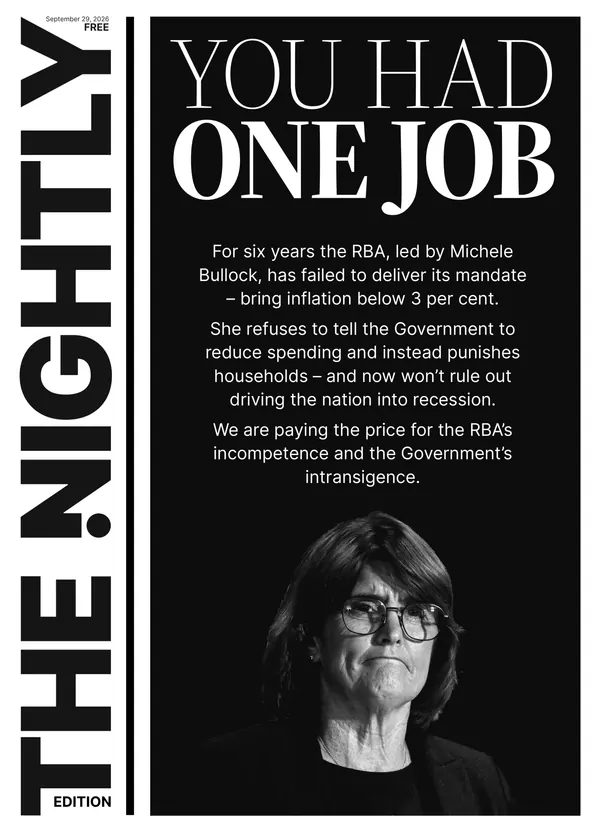
Former RBA governor Philip Lowe says Australia should be running Budget surpluses, slams Labor’s management
Philip Lowe, who was Reserve Bank governor during COVID, has slammed Labor’s Budget management, arguing it’s leading to higher interest rates and inflation.


Former Reserve Bank governor Philip Lowe has slammed Labor for failing to deliver a Budget surplus during the past two financial years — arguing it’s leading to higher interest rates.
Dr Lowe has given a rare interview with the conservative Institute of Public Affairs think tank — two days after Treasurer Jim Chalmers unveiled a Budget deficit for 2025-26 that was $6 billion less than forecast in the May Budget by virtue of higher superannuation and business tax revenue.
But the deficit was still $22.3b, making up 0.8 per cent of GDP.
Sign up to The Nightly's newsletters.
Get the first look at the digital newspaper, curated daily stories and breaking headlines delivered to your inbox.
By continuing you agree to our Terms and Privacy Policy.“Now we find ourselves running sizable Budget deficits at a time where we’re at full employment and commodity prices are very high. We should be running sizable surpluses,” Dr Lowe told the IPA’s chief economist Adam Creighton.
Treasury’s final Budget outcome released on Monday also revealed government spending during the last financial year made up 26.9 per cent of GDP, which was the highest in four decades outside of COVID despite unemployment being at a relatively low level of 4.6 per cent as higher iron ore prices boost company tax revenue.
“Government spending has been adding to demand progressively over time, and that’s putting upward pressure on inflation,” Dr Lowe said.
He also slammed Prime Minister Anthony Albanese, from Labor’s left faction, for being less interested in the kind of wealth creation that would lead to more government revenue.
“Public policy is no longer focused on expanding the size of the pie. It’s more about the distribution of income and wealth,” Dr Lowe said.
His intervention in the economic debate is being made a day after the Reserve Bank raised interest rates for the fourth time this year, taking the cash rate to a 15-year high of 4.6 per cent.
Westpac on Wednesday joined ANZ is forecasting a follow-up hike on November 3, half an hour before the Melbourne Cup, that would take the cash rate to a 18-year high of 4.85 per cent, and add another $122 to monthly repayments on an average new mortgage of $731,000.
As governor during and after COVID, Dr Lowe presided over 12 interest rate hikes in 2022 and 2023, with 11 of them occurring after Anthony Albanese led Labor to victory in May 2022 weeks after Russia’s Ukraine invasion led to higher crude oil prices.
That included inflation hitting at 32-year high of 7.9 per cent in December 2022 just two years after he had cut rates to a record-low of 0.1 per cent.
Under Dr Lowe and his successor Michele Bullock, interest rates have risen 16 times on Labor’s watch.
The former RBA governor also questioned Labor’s plan to build 1.2 million homes over five years, after net overseas immigration levels hit a record high annual pace approaching 550,000 in 2023.
“They’ve fallen woefully short of those targets and no prospect in my view of meeting them, and that’s the fundamental problem,” Dr Lowe said.
“We have to accept lower rates of population and that will have to come through lower immigration. I think we’ll end up being poorer as a result of that, but that’s the choice we face.”
Labor under Dr Chalmers delivered two back-to-back Budget surpluses in 2022-23 and 2023-24, as historically high iron ore prices above $US160 a tonne, delivered a company tax revenue windfall.
That marked Australia’s first Commonwealth government surplus since 2007 before the global financial crisis and the first for Labor since 1989 after former Labor treasurer Paul Keating had embarked on deep spending cuts.