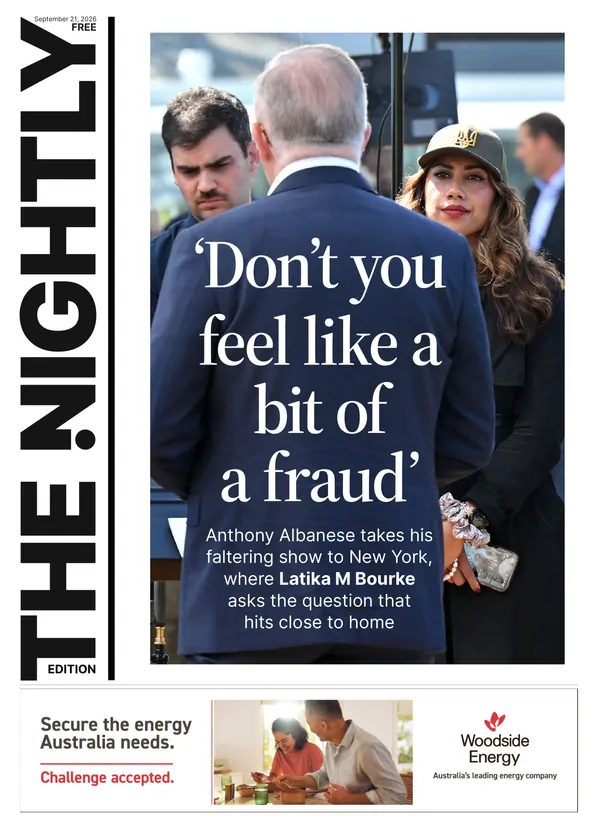
LATIKA M BOURKE: Anthony Albanese has defeated first-term zombies but now One Nation’s threat is closing in
LATIKA M BOURKE: Approaching the halfway mark of his second term, Anthony Albanese has conquered his first-term zombies. Now, the scarier opponents circling and stalking Labor are One Nation.

In the cult TV show The Walking Dead, the series’ hero Rick wakes up in a post-apocalyptic world where zombies have taken over.
Drooling and hissing, a zombie’s single bite is fatal, and contagious as the living become the grotesque undead and quickly turn on their once-fellow human friends, turning them into “Walkers”.
But as the series progresses and the humans work out the Walkers’ weaknesses, they invent ways to trap them, kill them, block them and eventually corral herds of them to use as weapons and zombie shields.
Sign up to The Nightly's newsletters.
Get the first look at the digital newspaper, curated daily stories and breaking headlines delivered to your inbox.
By continuing you agree to our Terms and Privacy Policy.It is then that the true danger reveals itself, not slobbering brain-dead zombies, but other human communities who are armed, ready to break the rules of the previous world order, including cannibalism, to dominate and rule the living.
This fictional plot serves as a useful metaphor for the reality of where the Federal Labor government finds itself.
Approaching the halfway mark of his second term with his eye on seeking a third and maybe even a fourth, Prime Minister Anthony Albanese has conquered his first-term zombies.
Returning a stunning 94-seat majority in May last year, he crushed his Liberal opposition and reduced them to a rump of just a handful of frontbench performers.
He has also tamed his caucus into a supplicant herd, who repeat the talking points supplied by the Prime Minister’s spin team and dare not stray off script.
This total lack of any contest made headlines around Labor’s national conference last month, when Mr Albanese oversaw a stage-managed affair that denied delegates any debate over key issues.
The Prime Minister delighted in the fact that the only dissident was the dumped Cabinet minister Ed Husic, Parliament’s first Muslim MP, who failed to force the government into declaring Israel’s war in Gaza a genocide.
When asked about his former minister’s input, Mr Albanese reduced Mr Husic to one of 400 delegates.
Mr Husic’s motion was never going to see the light of day. He carried no influence as a minister and even less as a renegade backbencher and possesses a talent for destroying careers that solely belong to him.
But Mr Albanese should look beyond the messenger to realise that Mr Husic’s broader call for Labor to actually discuss policy positions and ideas is the right one.
Mr Albanese has a grip across his party like no other prime minister in living memory.
John Howard served four terms but consistently dealt with internal debates over sensitive issues, particularly on illegal migration.
The Rudd and Gillard years were defined by their internal chaos, as was the Tony Abbott-Malcolm Turnbull-Scott Morrison combo of Coalition governments that followed.
Spooked by the decade of revolving-door prime ministers, the Labor caucus understandably realises its strength in unity.
This does not mean there are no debates within the government — there are.
One MP praises Treasurer Jim Chalmers as being particularly receptive and open to robust debates on tax and housing policy.
But it is too little and may have reached the point of not being visible enough. Because, to continue the zombie metaphor, the scarier opponents that now circle and stalk Labor are One Nation.
And Pauline Hanson does not play by the same rules.
She is already banning journalists from media outlets that she does not like, and has happily platformed a far-right convicted criminal in the UK who agitates against Muslims.
But if voters immediately care, they are not telling pollsters that this is the case. In fact, what they are telling researchers is something that should alarm Labor.
Last month, RedBridge’s polling turned up a fascinating insight. Nearly half of voters identified cost-of-living is their number one issue and around three-quarters place it in their top three concerns.
Yet when it came to their reasons for why they wanted to vote for One Nation, they selected other reasons, with a strong mood for change, dislike of the two traditional governing parties and Pauline Hanson’s authenticity.
Just 2 per cent said the cost-of-living.
This means voters are divorcing their choices from outcomes ie., they are willing to support Pauline Hanson without expecting or believing that she will fix the issues that worries them most and is partly behind driving them her way.
This should terrify Labor. Telling voters Pauline Hanson lacks credibility or experience to run the country may not matter to them.
What matters is that she sits outside the status quo. And right now the face of status quo is Mr Albanese.
This mentality is also showing up in focus groups according to well-placed insiders, with One Nation-curious voters rationalising away Pauline Hanson’s demands for “monoculture” and attacks on Muslims for as long as she represents radical change from the current line-up of insiders.
One Labor member of parliament recounted a lifelong voter — a barrister in a better-off part of Brisbane — saying that while they would continue to vote Labor at the next election, they liked what Senator Hanson was doing in shaking up the joint.
“Pauline Hanson’s biggest political asset is that her supporters see her as their wrecking ball against a political model they believe no longer works for them,” said RedBridge’s co-founder and former Liberal Party strategist Tony Barry.
“Among the One Nation voter cohort, which at the moment typically makes up at least one in four Australians, fully 90 per cent believe Australia is heading in the wrong direction and just 5 per cent say it’s heading in the right direction. This strongly negative mood sentiment is at the core of the One Nation voter profile - protracted pessimism and a latent frustration with the political model.”
Figures around the prime minister like to comfort themselves that at this time in the last electoral cycles, polls were pointing to the possibility of a prime minister Peter Dutton.
History can rhyme again. Perhaps it will. But wiser Labor heads know that the currents in politics represent unfamiliar territory.
Which is why Anthony Albanese may need to change tack. The scarring from the Rudd-Gillard wars is evident on those who served in these governments from the prime minister down.
But as one MP described it, it equally affects the MPs who entered in 2019 and 2022, who were horrified, from the outside, by how quickly their party trashed the grand prize of winning power.
But there is a danger in confusing discipline for debate, and Mr Albanese has allowed his party almost none.
It is true that it makes for “orderly government” as the Prime Minister is so fond of saying.
But it also sends a signal to the public that their elected representatives are feckless, unwilling or incapable of taking up their concerns — in effect, zombie MPs. Forget about coming across as authentic; just a pulse would do.
The prime minister is relying on his broken Budget promises to address both these issues — drastic changes show a willingness to “do something”, and the government hopes the measures will usher more voters into their own homes by the time of the next poll.
But the reversals the government has had to engineer, especially to Capital Gains Tax concessions for start-ups, and the overnight backdown on the unintended “widow’s tax,” denying tax breaks to anyone who inherited their property from their spouse, show the costs of the command-and-control style.
A little more consultation might have spared the government from having to stage these embarrassing retreats as well as demonstrate to the one-third of Australians who are persistently telling pollsters they like what they are seeing in One Nation, that some proof of life exists beyond Mr Albanese’s brains-trust of left-wing Senators, Finance Minister Katy Gallagher and Foreign Minister Penny Wong.
The highest price of his own style was Labor’s silence as the community demanded and then forced the Prime Minister into calling a Royal Commission into the massacre of Jews on Bondi Beach.
Labor’s primary in the RedBridge poll last November before the attack was 38 per cent, One Nation’s was 18 per cent. Eight months on, Labor has never recovered and sits on a primary of 29 per cent.
One Nation has twice hit a peak of 31 per cent, putting it in front of Labor twice.
Mr Albanese is famously vengeful. There is an enormous cast of backbenchers hoping for promotion, so they would need prime ministerial encouragement to fearlessly contribute ideas out loud.
“Having a few debates would be part of the solution to combating One Nation,” one Queensland MP said.
The Prime Minister’s reticence is as understandable as it is self-serving. Mr Albanese was a master at using policy debates to elevate his own rise, especially at conference such as in 2015 when he undermined his predecessor Bill Shorten from enshrining asylum seeker boat turn-backs in Labor’s platform.
So his fear of debate is not just about wanting to present a picture of discipline but also a reflection of his own insecurity.
But if he leaves voters wondering why they gave him 94 MPs, only for the bulk of them to say and do as little as possible, he should not be surprised if voters grow disillusioned and see the once great Labor Party as out of touch with their despair that life doesn’t seem to be getting better.