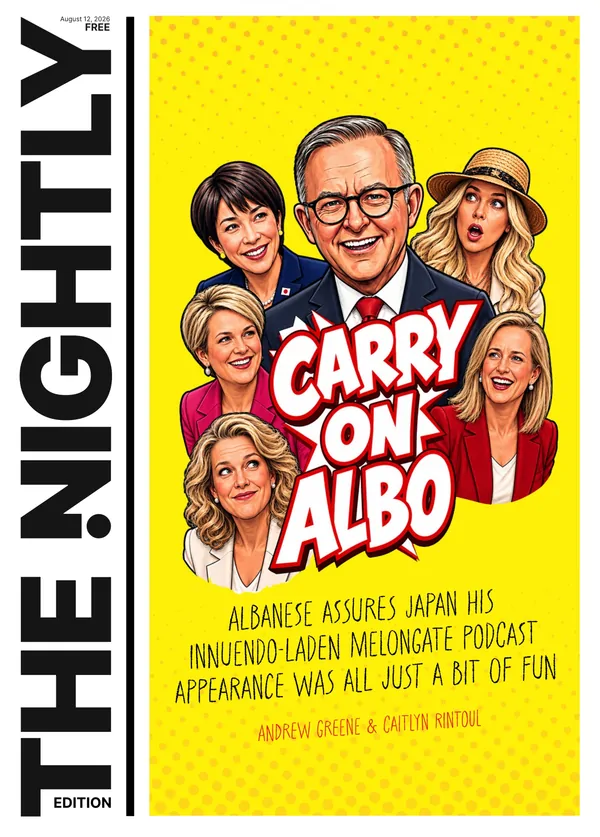
NSW Premier Chris Minns defends Prime Minister Anthony Albanese amid Japan melon saga
A state premier has saved Anthony Albanese as questions persist about whether the Prime Minister made jokes about a foreign leader’s breasts.
NSW Premier Chris Minns has told a reporter to ask the 1000 smelter workers whose jobs have been saved by a multibillion-dollar bailout “what they care about today” after Anthony Albanese was again asked if he referred to his Japanese counterpart’s breasts in a controversial podcast interview.
The Prime Minister’s appearance on the Bush Deep podcast has haunted him for the last month, with the Coalition accusing him of creating a “diplomatic incident” by joking about Japanese Prime Minister Sanae Takaichi’s gift of crown melons earlier in the year.
Mr Albanese has denied any lewd intention and the Japanese government has dismissed it.
Sign up to The Nightly's newsletters.
Get the first look at the digital newspaper, curated daily stories and breaking headlines delivered to your inbox.
By continuing you agree to our Terms and Privacy Policy.Asked on Thursday about gestures he made in the interview while fronting a press conference on the $2.5bn bailout for Tomago Aluminium, Mr Albanese insisted using “my hands” while speaking was normal.
“I’ve answered this question many times,” he said.
“The fact is that the Japanese Prime Minister and I have a very good relationship.”

Mr Minns interjected, telling media: “Go and ask the 1000 workers what they care about today.”
He continued: “This is the biggest announcement for this region in a generation. Can we just talk about it for five minutes?”
A leaked Japanese diplomatic cable from July 13 “noted … sensationalised reporting” after Mr Albanese’s appearance on the podcast – the same interview in which he said he would “shag, marry and date” Kylie Minogue.
Of his comments on Ms Takaichi, the cable said Tokyo believed there was no “ill intention” and “no action” would be taken.
It also said that Japan would not provide commentary to let media “move on”.
That cable was sent to the Department of Prime Minister and Cabinet (PM&C), prompting the Coalition to ask the Australian Federal Police to investigate how sensitive government-to-government communication became public.

Later on Thursday, the Senate passed a formal request demanding the Albanese government present the leaked Japanese correspondence as well as “all correspondence between the Prime Minister’s office, and the Department of the Prime Minister and Cabinet” on the cable, “including emails, letters, text messages, instant messages, handwritten notes, minutes, briefings and submissions”.
The request from Liberal frontbencher James Paterson also called for “all internal documents held by the Prime Minister’s office concerning the official correspondence”.
Passed with support from the Greens and the crossbench, the government has until noon on Monday to present the documents.
NewsWire has contacted the Prime Minister’s Office for comment.
Critics cautioned against ‘cultural offence’ claim
Japan’s envoy has downplayed the comments, saying Canberra had made clear Mr Albanese “did not make the comments in the way that has been reported”.
“We are aware of the reporting in the media,” ambassador Kazuhiro Suzuki said on Wednesday.
“We have been informed by the Australian side that Prime Minister Albanese did not make the comments in the way that has been reported.
“In any case, the dinner hosted by Prime Minister Albanese during the (Japanese) Prime Minister’s visit to Australia this May was held in a very relaxed atmosphere, and we believe it helped build a personal trust relationship between the two leaders.”

Australian Institute of International Affairs chief executive Bryce Wakefield said if “we take the leaked diplomatic communication and ambassador Suzuki’s comments at face value, Japan does not appear to regard this as a diplomatic problem”.
Dr Wakefield, who spent years living in Japan and held a tenured academic position in Japanese politics, cautioned critics against assuming any “cultural offence” had been caused.
“Albanese’s detractors are entitled to criticise his conduct,” he said, adding that “they are on much shakier ground if they present that criticism as evidence of Japanese diplomatic offence”.
“There is still a legitimate domestic argument about whether the joke was juvenile, sexist or inappropriate.
“But that is an Australian political argument – it should not automatically be turned into a claim about Japanese cultural offence.”
Dr Wakefield went on to say that commentary invoking “supposedly distinctive Japanese norms of respect and dignity to explain why the episode must be especially offensive” should be taken with a pinch of salt.
“I would be wary of that kind of cultural essentialism,” he said.
“Japanese people are no more uniform in their reactions to a crude joke than Australians are.”
Originally published as NSW Premier defends Albanese amid Japan melon saga