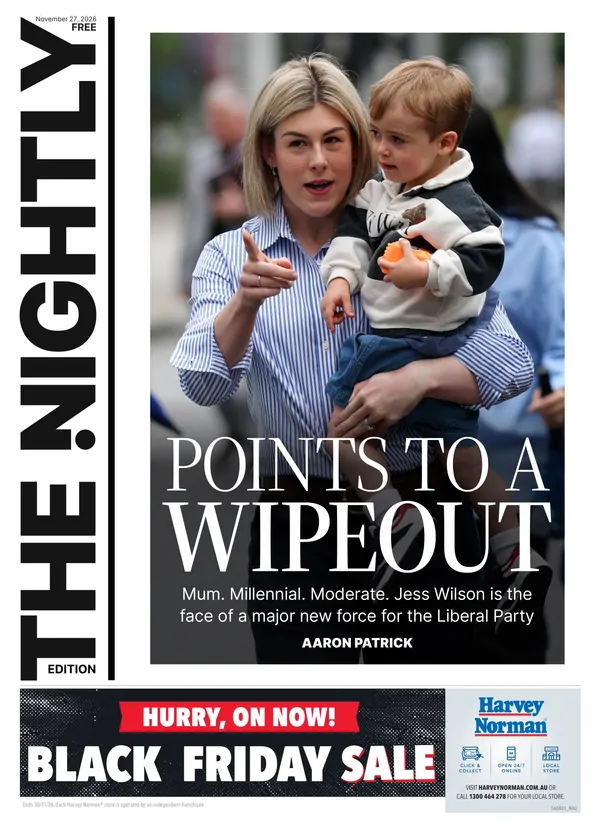
Victorian election results: Jess Wilson’s triumph should terrify Anthony Albanese
AARON PATRICK: Victoria has shown that in a three-way contest One Nation votes end up with the Liberal-Nationals Coalition, a sign Angus Taylor’s position is stronger than it looks.

Liberal leader Jess Wilson’s victory in the Victorian election will send tremors through the Albanese Government for several reasons.
The most important is that the election has shown under real-life conditions what happens to the One Nation vote in a three-way contest: it goes to the Liberal-Nationals Coalition.
With about half the votes counted Saturday night, One Nation had received 20.3 per cent and won no lower house seats. The Coalition had secured a comfortable parliamentary majority of at least 58 seats with only 35.7 per cent of the primary vote.
Sign up to The Nightly's newsletters.
Get the first look at the digital newspaper, curated daily stories and breaking headlines delivered to your inbox.
By continuing you agree to our Terms and Privacy Policy.Illustrating One Nation’s difficulty winning when most other parties direct preferences elsewhere, party leader Warren Pickering is likely to be defeated by Liberal Radmila Dyson by 62-38 per cent in Pakenham, according to a 7 News projection.
In the three Nationals seats most vulnerable to One Nation, Mildura, East Gippsland and Morwell, the junior Coalition partner was comfortably ahead when counting was paused.
Morwell, a town closely associated with coal-fired power plants, is naturally receptive to One Nation’s anti-net-zero position. One Nation attracted an astonishing 40 per cent of the primary vote in the seat, but still looks likely to be beaten by a Nationals candidate on Greens and Labor preferences.

Despite the huge shift in seats to the Coalition — at least 33 confirmed on Saturday — the Liberals’ and Nationals’ combined primary vote only increased 1.1 per cent from 2022.
This break-down in the direct relationship between first-preferences received and seats won is terrific news for federal Liberal leader Angus Taylor.
It suggests his party’s position is far stronger than indicated by national polls, which have put the Coalition behind One Nation and the Labor Party for most of 2026.
Instead of being a three-way contest in which One Nation cannibalises Coalition support, the Victorian election suggests support for One Nation and the Coalition should be seen as a conservative bloc of votes.
The latest poll, by Essential and published in the Guardian last week, estimated support for the government and One Nation was equal at 26 per cent. The Coalition was on 25 per cent.
Instead of just another example of the Coalition coming third, the poll indicates that more than half the voters want to remove Anthony Albanese as Prime Minister.
The preference system, where voters are required to rank every lower house candidate, means that almost all those votes would end up in Mr Taylor’s column if the Victorian experience was repeated at the national level.

Victoria’s outgoing premier, Ben Carroll, repeatedly claimed in the campaign that Ms Wilson would be unable to govern without the support of One Nation. He was wrong.
Mr Albanese uses similar language to imply Mr Taylor would need Senator Pauline Hanson’s parliamentary votes to form a government.
Ms Wilson’s triumph has just made the Prime Minister’s argument sounds dubious.