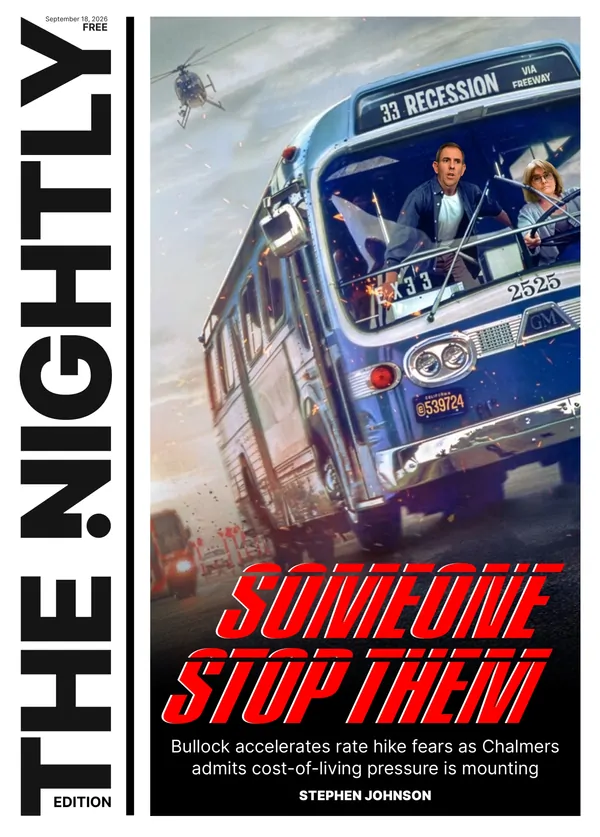
THE WASHINGTON POST: US Federal Reserve keeps interest rates steady despite stubborn inflation
Three Fed presidents dissented, saying they preferred to raise the country’s benchmark interest rate.
The Federal Reserve left interest rates unchanged on Wednesday, resisting for now pressure from inside its own ranks to raise rates to combat persistently high inflation.
It was the fifth straight meeting without a change in the price of money, and the second meeting of Kevin Warsh’s new tenure as chair.
It came amid growing divisions over how to respond to an inflation rate that has exceeded the central bank’s 2 percent target for more than five years.
Sign up to The Nightly's newsletters.
Get the first look at the digital newspaper, curated daily stories and breaking headlines delivered to your inbox.
By continuing you agree to our Terms and Privacy Policy.Three regional Fed presidents - Beth Hammack of Cleveland, Neel Kashkari of Minneapolis and Lorie Logan of Dallas - dissented, saying they preferred to raise rates. Twice now as chair, Warsh has promised to break the run of above-target inflation without moving rates to do it.
“We will deliver,” Mr Warsh told reporters on Wednesday (US time), pushing back on concerns that the Fed had gone soft.
“The suggestion that we’re going to be able to do it with our magic wands is one I want to disabuse you and everyone else of. But the discussion the last two days gave me more confidence even than I had eight and a half weeks ago” upon taking over as chair.
Stock markets nonetheless slid sharply on the news, with the Dow Jones Industrial Average dropping more than 1,100 points.
Yields on the 30-year Treasury bond jumped - the biggest increase in more than a year - a sign that investors are demanding more compensation to hold long-term debt while growing increasingly doubtful about the Fed’s ability to bring down inflation.
“The growing challenge for Fed Chair Warsh is the credibility of his commitment to that inflation target,” said Frances Donald, chief economist at RBC Capital Markets. “The more he talks about his commitment to it while doing nothing, the less credibility he has.”
By keeping its key interest rate in the range of 3.5 to 3.75 percent, the Fed buys itself time. While inflation eased in June, a recent spike in oil prices, a new round of tariffs and surging demand tied to the buildout of artificial intelligence data centers all threaten to push it higher again.
Wednesday’s decision lets policymakers collect two more months of inflation data before they meet again in September, when the case for raising rates could be clearer.
On Wednesday, oil prices rose again after President Donald Trump told Fox News that the United States would hit Iran “hard” following a missile attack from Tehran on U.S. forces in Jordan.
And the squeeze on households is unlikely to ease soon. Even if the Fed raises rates at its next meeting, that move sets the cost of overnight borrowing between banks.
Mortgages and other long-term loans are priced off the same Treasury yields that climbed Wednesday - set by markets according to their own expectations for growth and inflation, not by the Fed.
Mr Trump, for his part, has argued insistently for lower rates; he repeatedly criticised Mr Warsh’s predecessor, Jerome H. Powell, for refusing to bring rates down. But Trump praised Mr Warsh after the decision to hold rates steady Wednesday.
Speaking in the Oval Office, the president said Mr Warsh would “like to see lower interest rates, but he’s got a board and it’s a political board and they want to keep rates up.”
Mr Warsh, a Fed governor from 2006 to 2011, returned to the central bank in May, after a year in which Trump pressured the Fed in ways without modern precedent: He publicly demanded lower rates, tried to remove governor Lisa Cook and endorsed a Justice Department criminal investigation of Powell. Mr Trump chose Mr Warsh to replace Powell in January.
Though Mr Warsh has promised to set rates without regard to political considerations, he has abandoned Mr Powell’s practice of giving markets a sense of what the central bank is likely to do next or how it might react to economic developments.
On Wednesday, despite taking no action, he repeatedly stressed his concern about inflation and his commitment to returning it to 2 percent. The annual inflation rate fell to 3.5 percent in June, compared to 4.2 percent in May.
RBC’s Mr Donald said investors are still learning to read Mr Warsh, who may be trying to provide clarity but is also “providing a new form of central bank hieroglyphics.”
Mr Warsh’s reluctance to telegraph decisions has left the field to others within the Fed.
In the run-up to this week’s meeting, some policymakers argued openly that the Fed may need to raise rates. Mr Hammack, the Cleveland Fed president, wrote in a LinkedIn post that inflation is unduly high and “isn’t coming from only one source - it’s broad based.” Logan, of the Dallas Fed, went further, becoming the first voting member to publicly call for a modest increase in interest rates.
Citing conversations with business contacts, Mr Hammack wrote: “For the first time in my tenure, I’m hearing from businesses who say they think we need to take action to curb inflation, and from consumers who can’t make ends meet about a growing sense of despair.”
Prediction markets now put the odds of a hike at the Fed’s next meeting in September at roughly 50 percent. The Fed last raised interest rates in July 2023.
Outside the central bank, some economists are less convinced that a hike is near.
Josh Hirt, a senior U.S. economist at Vanguard, said this week that he expects the Fed to stay on hold through the end of the year. Inflation remains uncomfortably above target, he said, but those price pressures are expected to fade and hiring already slowing.
“In the near term, we expect conditions to keep the Fed holding rather than hiking,” Mr Hirt said.
Diane Swonk, chief economist at KPMG, said the cooler June inflation reading bought Mr Warsh time to bring the committee along to a hike in September.
Ms Swonk’s worry is less any single month’s reading than the risk that years of elevated inflation train businesses and workers to expect more - and to raise prices and wages accordingly.
“The clock is ticking, and it’s starting to get to the point where you really have got to worry about this muscle memory that we’re building for inflation,” she said.
She expects the Fed to hike twice this year, she said, in September and December.