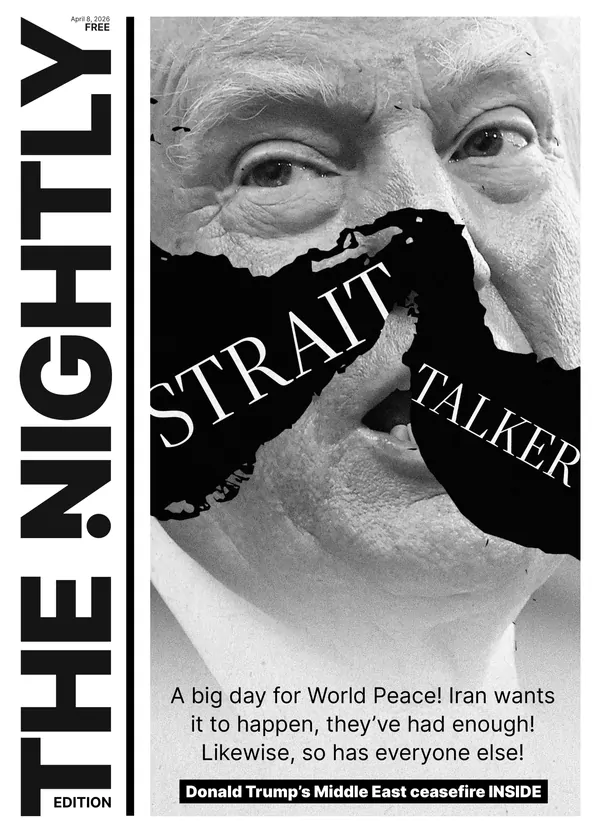
THE NEW YORK TIMES: New deadline looms for US and Iran as fractures emerge in ceasefire deal
Both sides may have enough incentives to prevent the ceasefire collapsing. Iran’s military and political leadership has been devastated while Donald Trump is under heavy pressure from a sceptical public.
US President Donald Trump faces new diplomatic tests as he prepares for weekend talks with Tehran amid doubts about the durability of his day-old ceasefire with Iran and the prospects for building it into a broader peace settlement.
A White House official said US Vice-President JD Vance would lead a US delegation to Pakistan for a meeting Saturday with Iranian officials.
Vance will be joined in the capital, Islamabad, by Trump’s special envoy Steve Witkoff and son-in-law Jared Kushner as they work to bridge huge political differences, some dating back decades, under a two-week clock set by the ceasefire agreement.
Sign up to The Nightly's newsletters.
Get the first look at the digital newspaper, curated daily stories and breaking headlines delivered to your inbox.
By continuing you agree to our Terms and Privacy Policy.But even as Trump officials finalised the Saturday meeting, fractures were already emerging in the limited ceasefire brokered by Pakistan on Tuesday night, just before Trump’s deadline for a threatened “civilisation”-ending attack on Iran.
Robert Malley, who served as President Joe Biden’s special envoy for Iran, said the ceasefire was filled with ambiguities. The United States and Iran are already arguing over them, he said, and that will complicate the path forward.
“It’s hard to know not just where you go from here, but where you are to begin with,” he said. “The talks are starting on very weak grounds.”
In a statement on social media, Iran’s parliament speaker, Mohammad Bagher Ghalibaf, insisted that three clauses of what he said was a 10-point “agreed framework” between the US and Iran had already been violated, including an end to Israeli attacks on Iran-backed Hezbollah fighters in Lebanon. The Trump administration says that was not part of the agreement.
Mr Ghalibaf also condemned the Trump administration for reasserting Wednesday that Iran would never be allowed to have a domestic uranium enrichment program, as Tehran has long demanded.
In such a situation, “a bilateral cease-fire or negotiations is unreasonable,” wrote Mr Ghalibaf, who Iranian state media has said will represent Iran in Islamabad this weekend.
At the same time, US officials were watching to see whether Iran would deliver on its promise to reopen the Strait of Hormuz, which Tehran militarised in response to the conflict.
By Wednesday night (US time), there was little evidence that significant shipping traffic through the mine-laden waterway was resuming.
While the United States and Iran will surely bluster and jockey for advantage in public, diplomats and Iran experts said, both sides may have enough incentives to muddle their way through to Islamabad without allowing the ceasefire to collapse.
Iran’s military and political leadership has been devastated by the five-week war, while Trump is under heavy pressure from a sceptical public, rising energy prices and growing dissent among his supporters as the fall midterm elections approach.
“It’s going to be a very messy, imperfect ceasefire,” said Suzanne Maloney, an Iran expert and vice president at the non-partisan Brookings Institution in Washington. “But my sense is that both sides want to at least test what’s possible at the negotiating table.”
Those possibilities may be limited, but the White House struck an optimistic tone.
Karoline Leavitt, the White House press secretary, said that the United States had received an Iranian proposal that provided “a workable basis on which to negotiate,” notably different from Mr Ghalibaf’s description of the document as an “agreed framework.”
She added that the proposal was “more reasonable and entirely different” from an earlier list of Iranian demands, which she said had been “thrown in the garbage.”
The newer proposal has not been released publicly. “These extraordinarily sensitive and complex negotiations will take place behind closed doors over the course of the next two weeks,” Ms Leavitt said.

She also cautioned reporters against relying on statements from Iranian officials and state media, which have contained such maximalist Iranian demands as the lifting of all US sanctions on Iran’s economy, the withdrawal of US forces from the Middle East and a domestic uranium enrichment program.
But experts said it was unlikely that Iranian leaders had suddenly made major new concessions, given the consistency of Iran’s demands over several years and the economic leverage it has demonstrated by choking off vital energy and chemical shipments through the Strait of Hormuz.
Mr Ghalibaf’s statement made clear, for instance, that Iran still insisted on what it called its sovereign right to enrich uranium, the refining process that produces fuel for nuclear power or atomic bombs.
The Trump administration has said that Iran must agree to zero enrichment, and on Wednesday, Ms Leavitt told reporters that ensuring “the end of uranium enrichment in Iran” remained a nonnegotiable demand for the president.
Given such a wide gap, Mr Malley said it was highly unlikely the Trump administration could quickly conclude a wide-ranging bargain with Iran, especially in such a short time.
He called it more plausible that the two sides would find limited agreements that sidestep the most difficult matters, including the fate of Iran’s nuclear program and its stockpile of 450kg of highly enriched uranium.
“It’s hard to imagine a comprehensive deal, given the gaps and differing visions of both sides,” Mr Malley said. “You can imagine a series of smaller deals that includes the Strait of Hormuz and some sanctions relief.”
EXPERTS MISSING
Ms Maloney and others said the addition of Vance to the US negotiating team was a notable shift in Trump’s diplomatic approach.
It was Mr Witkoff and Mr Kushner who led two previous rounds of talks with Iranian officials over the country’s nuclear program, one last spring and one in late February.
Analysts said that Iran likely views them with profound scepticism, given that Trump launched attacks after both, including on the day before the United States joined Israel in opening the latest conflict with a massive airstrike that killed Iran’s supreme leader, Ali Khamenei, and several other senior officials.
The Iranians may be more receptive to Vance, a longtime sceptic of US military action who publicly warned, before he took office last year, that the United States would be foolish to start a war with Iran and shared private reservations as Trump weighed whether to attack earlier this year.

But veteran diplomats reiterated concerns that Trump was again assigning high-stakes talks to negotiators with very little background in Iran or nuclear issues.
R. Nicholas Burns, who negotiated with Iran as a senior State Department during the George W Bush administration, urged the Trump team to loop in Iran experts in the career Foreign Service who have been largely sidelined.
“The fact that these senior career diplomats were excluded from the Mr Witkoff-led talks with the Iranian foreign minister before the war was diplomatic malpractice,” Mr Burns said.
“Our career diplomats who speak fluent Farsi and understand the negotiating behaviour of the Iranians are a hidden strength of the US”
Mr Burns urged Trump officials to focus in the coming days on ensuring that Iran never gains access to its highly enriched uranium, much or all of which is believed to be buried under the rubble of air strikes last summer, and to ensure that Iran does not become a “gatekeeper” in the Strait of Hormuz.
Iran has made recent public demands for lucrative payments to allow commercial shipping through the waterway.
Further complicating the diplomatic mix is the role of Israel, which one senior US official called an uncertain variable. Israel could push to renew the war and pursue its goal of sparking a popular uprising that would topple Iran’s surviving clerical leaders, which goes beyond Trump’s currently stated war aims.
Trump will also face pressure from Iran hawks at home not to cut a deal of convenience with Iran that ends the war without resolving long-term issues.
Influential talk radio host Mark Levin, who has Trump’s ear, has been highly critical of the ceasefire.
The US official said that Trump could sour on the agreement if those voices were not offset by prominent war critics like former Fox News host Tucker Carlson.
Trump could also be triggered by Iran’s boastful domestic messaging, which is consistent with the kind of posturing routine in Middle East diplomacy, but which might provoke a US President highly attuned to appearances.
Originally published on The New York Times