MARK RILEY: Chalmers and Albanese reject friction claims, but perception is everything
MARK RILEY: A bit of ‘creative tension’ between a prime minister and their treasurer can be a good thing. But too much can lead to damaging instability, as we are seeing play out yet again.


A bit of creative tension between a prime minister and a treasurer is a good thing for a government, John Howard said this week in launching the autobiography of his former adviser Josh Frydenberg.
Of course, this is a matter in which Howard has some considerable first-hand experience.
The “creative tension” between him and his treasurer, Peter Costello, was often so thick you could cut it with a butter knife.
Sign up to The Nightly's newsletters.
Get the first look at the digital newspaper, curated daily stories and breaking headlines delivered to your inbox.
By continuing you agree to our Terms and Privacy Policy.But treasurers often had a responsibility to stand up to prime ministers, Howard said, adding cheekily: “You also need a prime minister who has a propensity to splash a bit of cash in the right direction — but not too much!”
But Australia’s second-longest-serving prime minister has a point. That creative tension has often led to leadership instability — most famously between Paul Keating and Bob Hawke.
Frydenberg suggests in his book that there was one stage in his relationship with prime minister Scott Morrison when that tension threatened to descend into all-out warfare.
It was when Frydenberg discovered that Morrison had secretly had himself sworn in as treasurer, along with several other portfolios, at the height of the COVID pandemic.
Frydenberg, like most of his former colleagues, has still not been able to reconcile that decision.
And although he says many of those colleagues had wanted him to challenge Morrison for the prime ministership in the latter stages of their government, he, like Costello, decided against it.
They say it was in deference to the greater good. Their respective prime ministers might suggest it was because they lacked the gumption to challenge.
But now Frydenberg is embarking on a phantom leadership campaign from outside the party, wondering if there is a chance he might one day realise his dream of leading the country.
There are a couple of sizeable complications to clear.
First, he has to ask whether his potential colleagues share his belief that he could save the party from oblivion.
And second there is the fundamental question of whether he has any chance of taking back his former seat of Kooyong after having been unceremoniously thrown out by his constituents two elections ago.
Howard has some keen insights into this.
He was ejected from his own seat in the 2007 “Ruddslide”.
But he had also performed a stunning act of political resurrection by returning to the leadership and taking the Liberals to victory in 1996 — a prospect so unlikely he had described it as being as being akin to “Lazarus with a triple bypass”.
Howard’s advice to Frydenberg is to take his time.
“People who say you should declare your intentions are crazy,” the former prime minister said at the book launch.
Anthony Albanese immediately dubbed Frydenberg “the shadow opposition leader”, gleefully sticking the needle into Angus Taylor.
But Albanese soon discovered that creative tension at the top was not confined to the conservative side of politics.
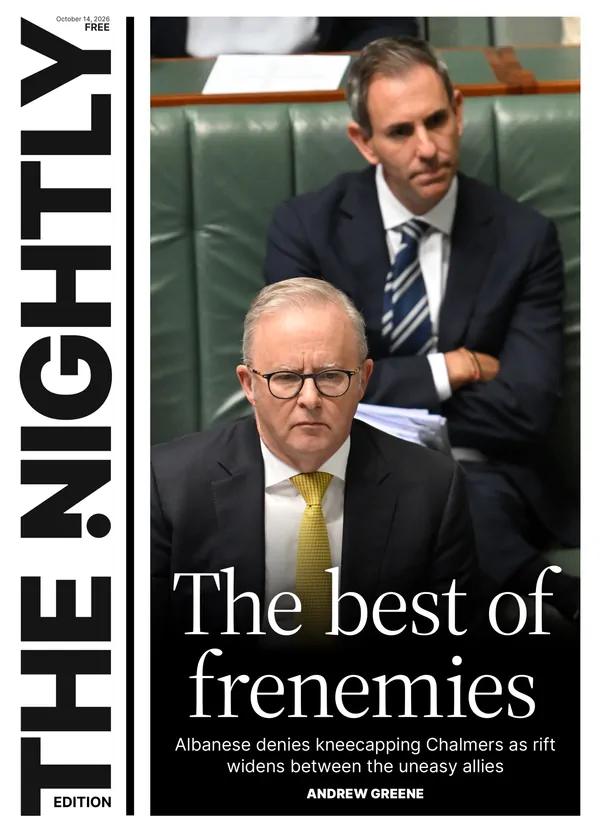
The news cycle on Wednesday was dominated by claims that the Prime Minister had pulled rank on Treasurer Jim Chalmers to force last week’s delay of the Australian Tax Office’s credit card ban.
Both men passionately denied it.
A reconstruction of events preceding the decision would appear to support that denial.
The broader problem for the Government, though, is one of perception.
Many in the political game were immediately willing to accept that the accusations of friction between Albanese and Chalmers were true.
That is because there is a growing sense within Government that the close relationship between the Prime Minister and treasurer is not what it once was.
Most put it down to the missteps on the Budget that have snowballed into a series of rolling tax controversies, placing the Government on the back foot for much of the past several months.
But all reject any suggestion that it is about leadership.
Chalmers has been assiduous in ensuring that nothing he does can be misconstrued as him trailing his coat for the prime ministership.
Indeed, those close to him say he believes Deputy Prime Minister Richard Marles and Health Minister Mark Butler are now both well ahead of him in the line of succession.
They insist any presumed leadership “tension” at the top of this Government would be more “creative” than real. At least, for now.