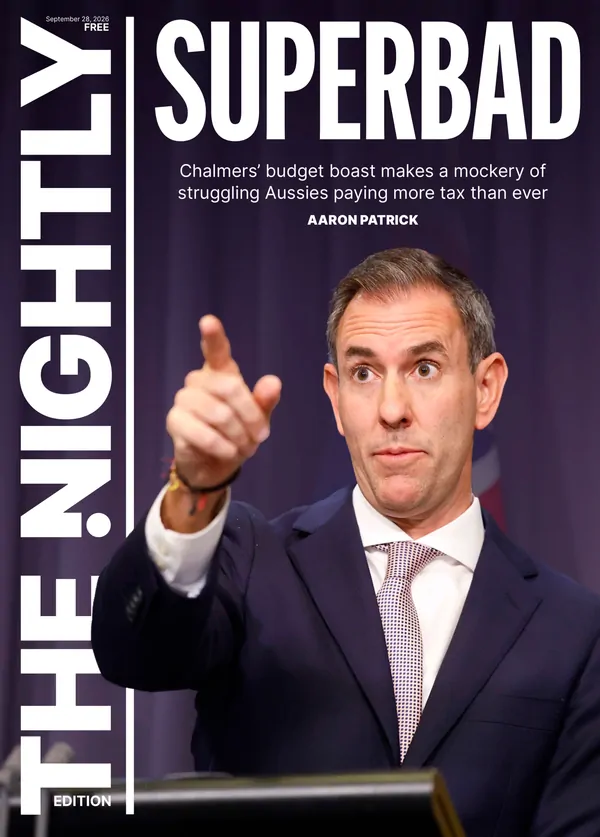
AARON PATRICK: Angus Taylor is about to launch his fight back against One Nation
AARON PATRICK: The Liberal leader hopes his reply to the Budget will electrify conservatives and win back millions of upset, bewildered and alienated voters.

For Liberals, tonight is the moment the fight back against One Nation begins.
Leader Angus Taylor intends to give a speech in response to the Budget that he hopes will electrify conservatives and win back millions of voters upset, bewildered or alienated by the new Australia.
Immigration — not migrants — is the target. Mr Taylor wants the number who arrive each year determined by the level of housing and apartment construction in the year before.
Sign up to The Nightly's newsletters.
Get the first look at the digital newspaper, curated daily stories and breaking headlines delivered to your inbox.
By continuing you agree to our Terms and Privacy Policy.“Australians should only bring in as many people as it can house,” he plans to say.
Having mused about the idea for some time without running into major objections, Mr Taylor will formalise the solution tonight.
The policy’s appeal is its simplicity and logic. The average cost of a house in the capital cities is now above $1 million, creating a financial challenge for buyers that exacerbates social inequality, distorts economic activity and punishes young people who lack wealthy benefactors.
Dark mood
The Coalition calculates there is a 400,000 shortfall of homes for the 1.4 million migrants who have arrived since the Labor Party was elected in 2022. The housing gap has contributed to a 22 per cent rise in rents that have left many children living in the family home well into adulthood. In those crowded houses, many parents are discovering that some love has limits.
The Taylor plan has other components drafted for a country in a dark mood. He intends to deny welfare to foreigners, including unemployment benefits, seniors’ discounts, parental leave and the National Disability Insurance Scheme.
Even before delivering the speech, the Opposition leader is being accused of meanness. But supporters of big migration acknowledge the economic, legal and cultural stresses that accompany the arrival and integration of foreigners have to be managed to preserve support among the broader community.
Without a substantial public debate, Australia has been transformed in the 21st century by immigration required because birth rates far outpaced by deaths. Two weeks ago, in a remarkable but little-noticed press release, the statistics bureau reported that the proportion of the population born overseas, at 32 per cent last year, hasn’t been as high since 1891, a decade before the nation was formed.
Not as tough as it sounds
As Australians, foreign and domestic born, navigate the new world, Mr Taylor intends to send a powerful — and hostile — message to newcomers.
“We’ve got older Australians who are going to lose access to the support they’ve had for private health insurance,” he said on the Sunrise program today. “And meanwhile, Labor is providing programs like these to non-Australians and we think that is the wrong priority.”
The rhetoric is more severe than the plan. With the exception of NDIS recipients and bona fide refugees, immigrants have to wait four years for access to welfare. It takes the same time to become eligible for citizenship too.
That means foreigners on the dole could almost certainly legally become Australians whenever they want, prompting immigration expert Abul Rizvi to quip the plan is a “great promotion” to encourage people to attend a ceremony on January 26 and recite a pledge beginning “From this time forward, under God . . .”
Existing recipients won’t be cut off either.
While Mr Taylor will no doubt be accused of racism, the Coalition is not alone beating up on foreigners. This week’s budget extended what was meant to be a temporary a ban on them buying land, a decision designed to lower prices for houses and apartments below what they would otherwise be.
Why shouldn’t Americans, Brits or Chinese who have made Australia their home be allowed to buy a house?
Populism or policy?
Mr Taylor vowed this morning to “fight every day” higher taxes on investing, especially property owned by landlords, which he called “an assault on aspiration”.
The Coalition counter offer might be an idea that some economists consider the Holy Grail of tax reform. One of the Nine newspapers reported Thursday Mr Taylor is “dusting off a plan to index tax brackets to combat bracket creep”.
What that means is the income thresholds for different rates of tax, such as 45 per cent from $190,001, would rise each year with inflation. The purpose would be to prevent inflation, which is out of control, automatically increasing workers’ income taxes.
The Albanese government has ruled out such a change, which would make it more difficult, financially, to promise tax cuts before the next election.
Leaving the current system in place is sensible politics. Income tax indexation alone would be a more significant reform to the tax system than the entirety of the 2026 Budget — and potentially deliver not one seat for a coalition struggling against the One Nation juggernaut.
Will the Budget-in-reply speech be a mixture of populism and high policy? We’ll find out in a few hours, when Mr Taylor delivers what may be his most-important political speech.