Master Builders warns Labor’s new tax on discretionary trusts will hit 90,000 construction businesses
The peak body for Australia’s construction industry has warned Labor’s proposed new tax on discretionary trusts will affect the supply of new housing, as the cost to businesses is calculated. See their fears.


The lobby group for Australia’s construction industry is warning Labor’s plan to impose a new 30 per cent tax on discretionary trusts will worsen the national housing crisis, by making it more expensive to new build houses and units.
Master Builders Australia’s submission to the Senate economics committee argues the Federal Government plan would affect more than 90,000 construction businesses, with chief executive Denita Wawn arguing the supply of new housing will be hit.
The group calculated a small, family-owned construction business with a taxable income of $400,000 would result in annual, continuing compliance costs of $21,000 to $67,500 and one-off restructuring costs of $82,000 to $175,000.
Sign up to The Nightly's newsletters.
Get the first look at the digital newspaper, curated daily stories and breaking headlines delivered to your inbox.
By continuing you agree to our Terms and Privacy Policy.“The bottom line is that these reforms will increase the cost of building and construction work,” she said. “Whether through restructuring expenses, additional compliance and administrative cost, or reduced business returns, builders will have little choice but to pass these costs on to clients and homeowners.”
The forecast comes as Labor’s plan to build 1.2 million homes over the five years to June 2029, as part of the National Housing Accords, was already 262,000 behind schedule.

“These reforms won’t build a single additional home,” Ms Wawn said. “At a time when Australia is already facing a 262,000 National Housing Accord shortfall, the Government is proposing to burden tradies with more cost, complexity and uncertainty.”
From July 1, 2028, the Government is proposing to levy a 30 per cent tax on discretionary trust distributions, under an arrangement where the beneficiaries can be altered in a bid to protect the assets of a business or a will.
Businesses can escape this tax by restructuring their affairs to become a fixed trust where distributions to beneficiaries can’t be altered but this would also incur a hefty legal cost.

This would be occurring at a time when construction companies top the list of corporate insolvencies where business are going into administration for the first time.
“It is unrealistic to expect small businesses to absorb costs of this magnitude without significant consequences,” Ms Wawn said.
“Independent modelling shows the Budget’s other measures will lead to less homes, higher rents and a reduction in construction jobs, this will make it even worse.”

The warning comes as the Commonwealth Bank, Australia’s biggest home lender, is now forecasting a 14 per cent plunge in national home prices and a 15 per cent plummet in capital city values, which would be the worst in more than four decades.
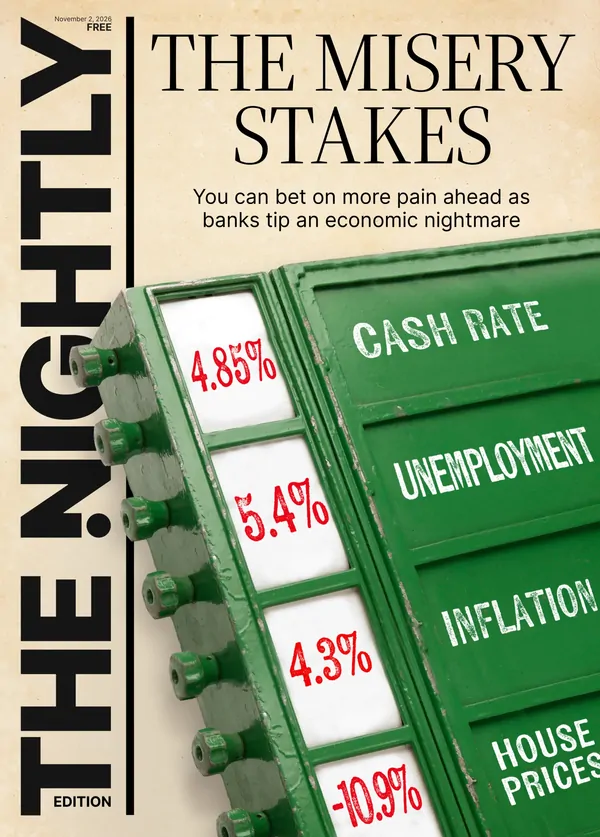
This would be worse than Westpac’s forecast of a 10.9 per cent peak-to-trough decline.
Both scenarios could be worse than the 7.7 per cent drop that occurred in 1982 and 1983 during a year-long recession and drought and the 8.2 per cent fall between 2017 and 2019 following the Australian Prudential Regulation Authority’s crackdown on interest-only loans.
Labor’s May Budget also replaced the 50 per cent capital gains tax with a minimum 30 per cent tax and indexation for inflation.
The House of Representatives last month passed the Government bill on discretionary trusts, with Labor having 94 seats out of 150 seats in the lower house.
The bill has gone to the Senate with the economics committee holding a public hearing on Thursday ahead of a final report being due on November 13.