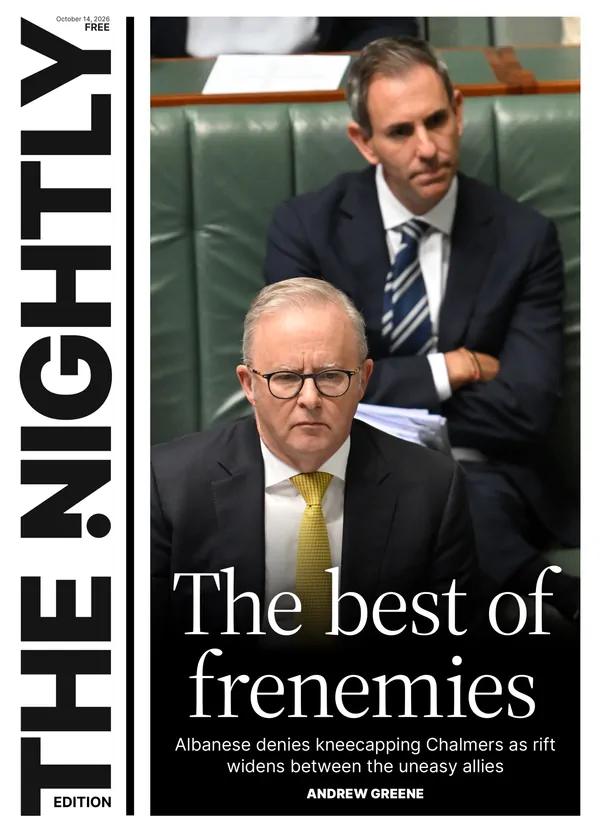
Anthony Albanese goes on the global charm offensive to secure fuel supplies for Australia
Anthony Albanese and Jim Chalmers will hold talks with key counterparts in Asia and Washington as the Government focuses on securing fuel and fertiliser supplies for Australia while it shapes its Budget.
Anthony Albanese will hold his second round of in-person talks to secure Australia’s fuel and fertiliser supplies from Asian partners as Treasurer Jim Chalmers meets key counterparts from major fuel exporters in Washington this week.
The fuel crisis unfolding from the US-Israel-Iran war is colouring everything the Government is doing as it shapes its budget and next major defence strategic update.
Mr Albanese landed in Brunei Darussalam on Tuesday evening, the first Australian Prime Minister to fly to the oil-rich country for a bilateral meeting with the Sultan, where he’ll discuss fuel supplies with the world’s longest serving monarch.
Sign up to The Nightly's newsletters.
Get the first look at the digital newspaper, curated daily stories and breaking headlines delivered to your inbox.
By continuing you agree to our Terms and Privacy Policy.It’s his second trip to Asia in a week, after heading to Singapore where he met Prime Minister Lawrence Wong.
Dr Chalmers will also press Australia’s case for securing vital shipments when he speaks with counterparts from Korea, Japan, China, Singapore, Indonesia and the UK on the sidelines of G20, International Monetary Fund and World Bank meetings in Washington DC.
The Government is in the midst of framing a Budget to be handed down in just four weeks that will now be largely shaped by the war and ensuing fuel crisis.
While supply is the primary focus, it’s likely to fund longer-term resilience measures to buffer Australia against fresh energy shocks in the future, possibly using some of the $30 billion windfall revenue independent economist Chris Richardson has forecast will flow from the war’s economic impact.
Ministers say supplies have been firmed up “well into May”, but they continue to be worried about the longer-term situation as the war drags on.
“The Albanese Government, our preparations for our fifth Budget less than a month from now, and these engagements with key colleagues and counterparts are all focused on fuel security, supply chain resilience and economic reform in uncertain times,” Dr Chalmers said ahead of flying to the US on Wednesday morning for a 24-hour visit.
“I’ll continue Australia’s calls for an enduring ceasefire, an end to the conflict in the Middle East and the proper reopening of the Strait of Hormuz because that’s what the global economy desperately needs.
“From an economic perspective, a proper end to this war can’t come soon enough.”
Mr Albanese was accompanied by Foreign Minister Penny Wong for the overnight visit to Brunei, where he’ll meet His Majesty Sultan Haji Hassanal Bolkiah on Wednesday to discuss fuel and food trade between both countries.
Brunei provides 9 per cent of Australia’s annual diesel imports as well as 11 per cent of annual crude oil imports and 11 per cent of annual fertiliser-grade urea imports.
Following his talks with the Sultan, who has ruled Brunei since 1967 and is one of the world’s richest people, Mr Albanese will fly to Kuala Lumpur to discuss fuel supplies with his Malaysian counterpart.

Opposition Leader Angus Taylor cited liquid fuels as a key example of where governments – including the Coalition administration he served as energy minister in – had welcomed the benefits of globalisation without thinking through all the risks.
“Today’s fuel crisis reinforces the fragility of global supply chains – and the folly of allowing our sovereign industries to be hollowed out where those industries are of strategic importance,” he said.
Australia is also joining UK and France-led international talks this week about safeguarding the Strait of Hormuz – although it is still unlikely to send any support before the war ends.
Iran has choked shipping through the Strait of Hormuz, a vital route where 20 per cent of the world’s oil supplies passed before the war began at the end of February.
It is now reportedly seeking to charge multimillion-dollar tolls for ships to sail through.
US President Donald Trump has ordered his navy to blockade the passage of Iranian vessels through the Strait while talks aimed at ending the war stall.
British Prime Minister Keir Starmer said the summit’s focus would be twofold: diplomatic efforts to end the war, and military planning to give assurances to shipping once that happens.
Acting Prime Minister Richard Marles said the talks around those efforts and how Australia could best contribute were all “predicated on when conditions allow that to occur”.
“We’re deeply invested in having an open Strait of Hormuz and the global fuel supply chain return to normality,” he said.
Defence Industry Minister Pat Conroy said Australia had been clear that there had to be peace first before international efforts to ensure safe passage through the Strait of Hormuz could begin.
The Government has been resisting suggestions that it would send an Australian ship to help clear the way for commercial shipping, although both the current and incoming ADF chiefs have said Defence has the capability to do so.
It is adamant the US has not formally asked Australia to join any military efforts in the Middle East, beyond sending an E-7 Wedgetail surveillance aircraft to help the UAE defend itself.
Australia’s refusal to join the US-led naval blockade of the Strait of Hormuz has been highlighted in the latest viral Iranian propaganda video featuring LEGO characters.