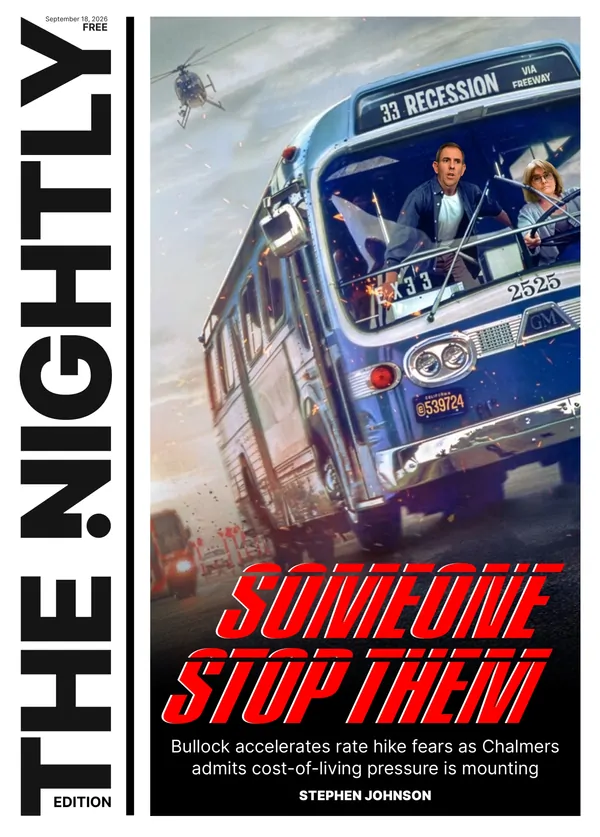
Treasurer Jim Chalmers promises a responsible Budget with Government spending being at a four-decade high
Treasurer Jim Chalmers has declined to confirm if a $300 tax offset will be in the Budget, having criticised the previous Coalition government in Opposition for having a tax offset program amid high inflation.

Treasurer Jim Chalmers has promised his fifth Budget will avoid stimulus spending but declined to rule out a $300 tax offset despite criticising the former Coalition government in Opposition for having a similar policy during a time of high inflation.
Federal Government spending is already at the highest level in four decades outside of COVID and Reserve Bank governor Michele Bullock on Tuesday warned that more government spending would simply add to demand during a global oil crisis.
This followed the Reserve Bank’s third consecutive hike, taking the cash rate to a 15-month high of 4.35 per cent and undoing last year’s relief, with inflation running at 4.6 per cent or a level well above the RBA’s 2-3 per cent target.
Sign up to The Nightly's newsletters.
Get the first look at the digital newspaper, curated daily stories and breaking headlines delivered to your inbox.
By continuing you agree to our Terms and Privacy Policy.In Opposition, Dr Chalmers criticised the former Coalition government’s tax offset program, for low and middle-income earners, for failing to tackle high inflation.
But despite a warning from Ms Bullock on Tuesday afternoon, Dr Chalmers declined to confirm or deny a report of a $300 tax offset in next Tuesday’s Budget, on top of tax cuts already planned for July 1 to help low-income earners and give most workers $268 in relief.

“Overwhelmingly what people will see in that Budget when we hand it down is a big effort to be as responsible as we can be,” he told Sky News on Wednesday morning.
“Overall, pulling back on spending. So, when Governor Bullock was asked if there is a heap of new stimulus spending in the Budget, what would you think about that, that’s obviously a hypothetical which doesn’t reflect the reality of the Budget which continues to be managed in a very, very responsible way, including when it comes to levels of spending.”
The Treasurer on Wednesday talked up the likelihood of spending cuts, with only Budget deficits forecast in coming years.
“The governor was asked what would happen if there was a heap of extra stimulus added into the Budget, and how would the Reserve Bank think about that,” Dr Chalmers said.
“That’s not what we’re intending to do. In fact we’re winding back spending overall, we’ve already made it clear in areas like the NDIS, like making the EV tax breaks more sustainable.”
Former Reserve Bank economist Zac Gross, now a senior lecturer in economics at Monash University, said tax offsets are inflationary.
“In general, yes, that sort of effectively cash transfer or slightly lower tax rate, that’s going to put more money in households’ pockets, on the margin that will bump household spending and inflation as a result,” he told The Nightly.
“Any time you’re cutting taxes, you’re going to be giving people more discretionary income which means they’re going to be able to spend more and at least on the margin, push prices up a little bit higher.
“It’s true that government spending, if it’s not offset with government taxes, will push interest rates higher in general.”
Upon coming to power in 2022, Dr Chalmers declined to extend the previous Coalition government’s low and middle-income tax offset which gave up to $1500 for those earning between $37,000 and $126,000.
In Opposition, shortly before that election four years ago, Dr Chalmers criticised the Coalition for failing to have a long-term plan to tackle inflation, when the consumer price index was running at 5.1 per cent.
“What’s missing in the Budget is a longer-term plan to take some of the sting out of inflation, to grow the economy without adding to these inflationary pressures,” he told Seven’s political editor Mark Riley.

Shadow treasurer Tim Wilson was reluctant to confirm if the Opposition would support the idea of an earned income offset of up to $300 but suggested the Coalition was opposed to inflationary spending.
The Coalition lost the last election opposing a plan to reduce the marginal tax rate from 16 per cent to 15 per cent for those earning $18,200 to $45,000, from July this year.
“I’ll wait and see what’s confirmed before we decide whether we’re going to support or oppose it,” Mr Wilson said on Tuesday night.
“I’m mindful of course, like everybody else, of the impact this inflation is going to have on Australian households but unfortunately when the Government hasn’t taken inflation seriously, we ended up in this situation and the risk is that if you keep handing out money to households, what you’ll actually do is fuel inflation further.
“What we need is actual cuts to spending to stop pouring debt petrol on the inflation fire, to ease the inflation pressure Australians are living right now.”
Ahead of the Budget, the Federal Government is promised to work with the states to slow NDIS growth to 5 or 6 per cent, with the program set to cost $52 billion this financial year after growing by 22 per cent a year as recently as 2022.
Labor has also hinted the existing fringe benefits tax exemption for electric cars under the $91,387 luxury car tax threshold will be scaled back, with the perk costing 16 times what was initially intended.
From April 2027, the threshold for the full exemption will be lowered to $75,000, while EVs over $75,000 but under $91,387 will get a 25 per cent tax discount.
The 25 per cent discount will apply to all EVs under the luxury car tax threshold from April 2029.
Tax breaks under Labor’s Electric Car Discount will be significantly curtailed in a move expected to save the Budget $1.7 billion over five years, with overall EV market share reaching a record high of 16.4 per cent in April during the second full month of the Middle East oil crisis.
The tax break for those buying an EV on a novated lease, through their employer, has proven vastly more popular than the Government anticipated since it came into effect in July 2022, meaning the cost to the Budget has blown out from an estimated $90 million a year to $1.4 billion this year.
Both sides of politics have supported halving fuel excise, with Labor copying the Coalition policy of cutting it to 26.3 cents a litre until the end of June.
But the Coalition is, so far, opposed to Labor’s plan to dilute the 50 per cent capital gains tax discount and curb negative gearing tax breaks for investor landlords making a rental loss in a bid to tackle the housing affordability crisis.
“Until we actually have the proposals that the government’s putting forward, I don’t think it’s a fair question to ask whether we’re going to repeal them,” Mr Wilson said.
“Labor’s plan around intergenerational issues is to start to feed resentment and redistribution - ours will be focused on growth and opportunity.”
Government payments are forecast to comprise 27 per cent of gross domestic product in 2025-26, which outside of COVID is the highest level since the 1985-86 financial year, Treasury figures show.