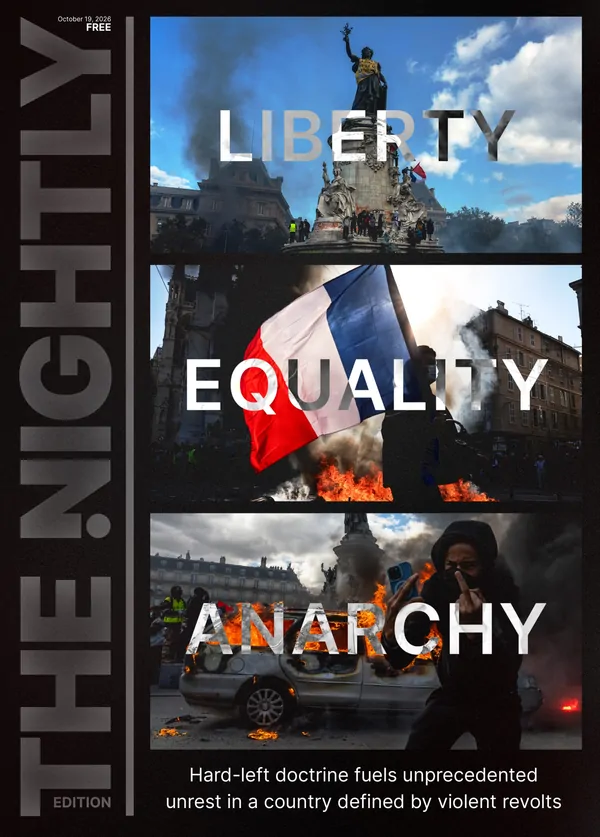
WASHINGTON POST: French cities impose curfews as leaders face scrutiny, admit security failures over unrest
THE WASHINGTON POST: French leaders have confronted mounting scrutiny on Monday over their handling of a weekend of riots that stunned the country.

French leaders confronted mounting scrutiny on Monday over their handling of a weekend of riots that stunned the country.
The Government ordered curfews in some neighbourhoods of Paris and other cities, as it rushes to restore order after France’s worst unrest in years.
Nearly 2500 people were detained after rioters torched public buildings and smashed storefronts in cities across France. Officials on Monday acknowledged failure to contain the chaos and looting that left streets strewn with debris.
Sign up to The Nightly's newsletters.
Get the first look at the digital newspaper, curated daily stories and breaking headlines delivered to your inbox.
By continuing you agree to our Terms and Privacy Policy.The disorder followed weeks of demonstrations that began with student walkouts over school funding but grew with the backing of labour unions. The protests transformed into a broader display of anger about cuts to public spending and other grievances with French President Emmanuel Macron’s administration, in a fraught political climate as the far left and far right gain traction ahead of next year’s presidential election.
Interior Minister Laurent Nunez conceded that police had “lost control” over the weekend. There was a “lack of anticipation,” and police were not sufficiently prepared to contain the nighttime rioting that spiraled from scheduled protests on Saturday, Nuñez said Monday.

He offered his resignation to Macron. The President rejected it, however, his office said in a statement, to maintain “continued leadership of law enforcement.” Instead, Macron ordered a security review to “ensure transparency over the failures in planning and intelligence that led to the violence.”
After the cabinet convened Monday, Prime Minister Sebastien Lecornu vowed an “absolute” determination to reassert order and deploy “all the tools at the government’s disposal.”
Lecornu announced that curfews on Monday night would be limited to particular areas for “the protection of people, but also shops,” without specifying where.
Two areas in Paris weree under curfew from 11pm Monday to 6am Tuesday, police said. Authorities also barred protests beginning Monday evening in several parts of the capital, including near train stations and government buildings such as the Elysée presidential palace and the parliament.
As ministers accepted liability for the government response, Lecornu focused blame on what he described as a shadowy movement of “ultraleft” agitators orchestrating “profound disorder in the country” ahead of the April election.
“While we witnessed very difficult scenes involving violence against property, no one was killed, and that is a miracle,” Lecornu said. He pledged a huge law enforcement operation to round up vandals, with “practically 200 investigators” in Paris.
More than half a million people had marched over rising costs of living and energy prices on Saturday, before the demonstrations gave way to mayhem. Officials said mobs on the fringes clashed with police while looters seized on the chaos to ransack shops and restaurants.
Masked rioters broke into city halls or defaced businesses late Saturday night in cities including Marseille, Bordeaux, Limoges, Lyon and Lille.
The government has blamed the hard-left leader and presidential candidate Jean-Luc Melenchon for stirring up violence. Melenchon called on the prime minister Monday to show proof, or “keep quiet and stop fueling the disorder.”
Some analysts said the dramatic scenes could give a boost to far-right leader Marine Le Pen, who was already leading in the polls and has leveraged the unrest to promote her presidential campaign.
In a video taking aim at the “extreme left” and the president’s leadership, Le Pen sat at a desk Sunday night, casting herself as the right candidate to bring back stability.
She said popular sentiment was hijacked “by thugs sowing chaos” in French cities. “In six months,” Le Pen added, “the French people will be able to choose a different path: That of restored authority and security.”
The tensions in France’s streets come as the Government is trying to approve budget cuts and reassure markets that are jittery about the state of the country’s finances.
Justice Minister Gérald Darmanin said on French television Monday that authorities had “undeniably failed” during the weekend’s rioting and were working to “understand what went wrong.” He pointed in part to “a failure in intelligence.”
In Marseille, on France’s southern Mediterranean coast, local officials had announced a ban on demonstrations Monday.
Overnight curfews for minors were also announced in parts of four northern cities, including Lille, as well as in the center of the Mediterranean city of Nice on Monday night. The mayor of Nice, Eric Ciotti, said the restriction would remain in place every night until next Sunday.
Some local officials have called for the Government to declare a national state of emergency, while mayors issued scathing criticism. Marseille’s Benoît Payan described “a near-total loss of control,” while Lyon’s Grégory Doucet demanded a “complete diagnosis of what happened.”
The interior minister said more police officers would be deployed around the country next weekend. There are already calls from some protest groups for another day of demonstration on Saturday, and French trade unions have called for a new round of strikes on November 5.