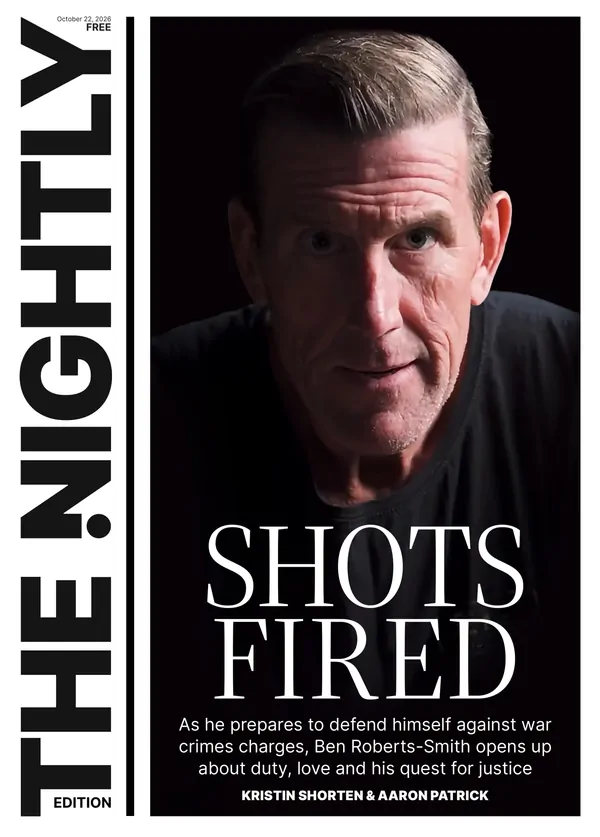
AARON PATRICK: Ben Roberts-Smith wants Australians to see him as the victim of a crime against decency
AARON PATRICK: For a person accused of such serious crimes to mount a public relations campaign is a sign this is one of the most remarkable murder trials in history.

Ben Roberts-Smith’s strategy to defeat the five charges of the war crime of murder emerged in two extended media interviews out today: argue the Afghans who died were likely Taliban insurgents and portray his treatment by investigators as a crime against decency.
The they-were-the-enemy argument will ultimately be fought in court. The case against the Australian Federal Police and the Office of the Special Investigator began today in embargoed interviews with Sydney radio host Ben Fordham and news.com.au.
Mr Roberts-Smith’s argument that the five dead men listed in the murder charges were guilty of being Talibs didn’t receive much attention today. But it is an important allegation. Knowing they could send a war hero to jail for life, would all 12 jurors convict Mr Roberts-Smith for killing the enemy?
Sign up to The Nightly's newsletters.
Get the first look at the digital newspaper, curated daily stories and breaking headlines delivered to your inbox.
By continuing you agree to our Terms and Privacy Policy.“The individuals that were part of these engagements, legitimate engagements, were members of the Taliban,” Mr Roberts-Smith told news.com.au. “It was never in any way proven that they were civilians.”
In each of the deaths, from 2009 to 2012, the former Special Air Service corporal is accused of killing or ordering killings not in the heat of battle, but in the immediate aftermath or in a moment of high emotion.
The yet-to-be tested law of war crimes doesn’t have a carve out for kicking someone off a cliff you think might be protecting a Taliban sympathiser who killed three Australian soldiers, Robert Poate, Sjtepan Milosevic and James Martin.
But the numerous public expressions of support for Mr Roberts-Smith suggest public opinion would prefer decisions about who should and should not be killed in war be left to military commanders.
Those officers have managed to keep remarkably low profiles throughout the decade-long saga — an anonymity that may not last if Mr Roberts-Smith decides to argue he was operating under a system that allowed or encouraged the SAS to not take prisoners when pursuing Taliban leaders.
For a person accused of such serious crimes to mount a public relations campaign is another sign this is one of the most remarkable murder trials in history.
By trying to win over more Australians to his side, Mr Roberts-Smith appears to be trying to influence his future jury, a group of 12 men and women who may not be chosen for five or even seven years, according to advice from his lawyers.
Some might argue this is an illegitimate way to fight the case, an argument undermined by the determination of prosecutors, investigators and their helpers to operate far outside the court room in their pursuit of the 98th Australian recipient of the Victoria Cross.
The most obvious example was the AFP’s decision to conduct his April 7 arrest in front of a load of passengers on a Qantas plane at Sydney Airport, including Mr Roberts-Smith’s children and partner.
The police said it was necessary for operational security. Mr Roberts-Smith argued in his interviews the explanation was bogus: if he was going to violently resist being arrested, why do it on a plane full with bystanders, including children?
Mr Roberts-Smith can speak with some authority on this point. The SAS is responsible for storming planes captured by terrorists. In his training he would have practiced assaulting aircraft many times.
Then there is his argument that the AFP was following him around the country when it could have been going after potential terrorists. The AFP was short of counter-terrorism officers, he said, so why waste resources shadowing one of the most famous men in Australia when at attack on Beach Beach was being planned?
“I fought for this country,” he said. “I was willing to die for this country.”
These arguments will resonate with Australians who feel the decision to spend more than $300 million investigating and prosecuting military veterans is misplaced money.
Mr Roberts-Smith’s PR campaign has started strong. But his trial is a long way away and prosecutors have undisclosed evidence they can use to undermine his popularity.
To retain Australians’ support Mr Roberts-Smith will have to maintain a public profile outside of his regular court appearances. Which suggests the BRS show is just getting started.