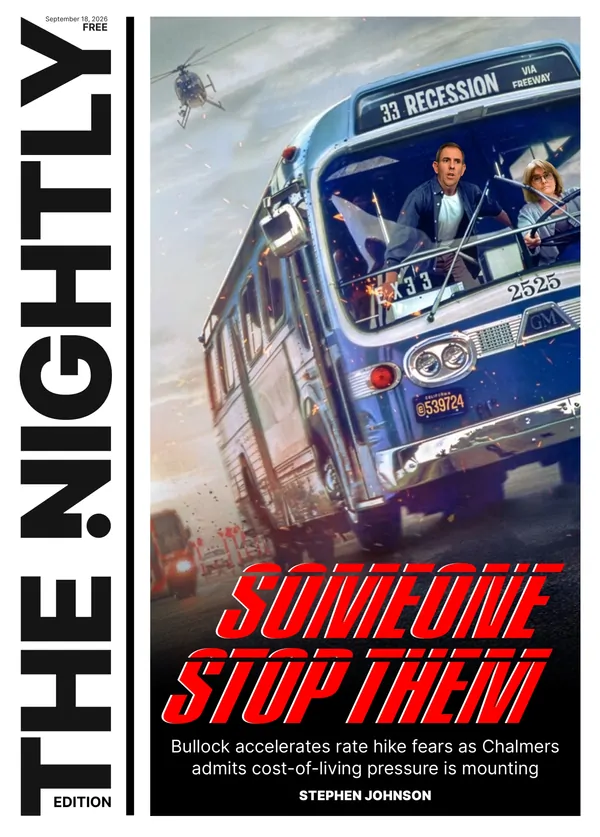
Jim Chalmers Budget: Treasurer talks down hopes for revenue windfall as war drives up commodity prices
Jim Chalmers has hosed down speculation that his upcoming Budget will score a big revenue boost from tax reform and the Middle East war.


Treasurer Jim Chalmers has hosed down speculation his upcoming Budget will score a big revenue boost from tax reform and the Middle East war.
The conflict in Iran and closure of key a oil and gas route through the Strait of Hormuz has pushed up petroleum prices and forced inflation higher. Consumer prices surged 4.6 per cent in the 12 months to March thanks partly to petrol costs.
Higher commodity prices would be expected to bring increased company tax revenue, while inflation will over time drive bracket creep — with families pushed into higher income tax brackets as their pay keeps up with cost of living.
Sign up to The Nightly's newsletters.
Get the first look at the digital newspaper, curated daily stories and breaking headlines delivered to your inbox.
By continuing you agree to our Terms and Privacy Policy.Top economist Chris Richardson reportedly forecast a $36 billion revenue boost from 2026 through 2030.
But Dr Chalmers played down the figures in a Commonwealth Bank podcast on Thursday.
“Any upgrade in any year will be a fraction of what you’ve seen speculated about,” he said.
“I sometimes read these stories, even very good, well-informed people, and I read it and I think I wish we were getting that kind of bump.”
He said there would also be a downside to revenue as the economy would slow from the energy shock, with unemployment likely to rise modestly and a higher exchange rate to reduce earnings.
“My current expectation is that some years will be worse, will be downgraded, and some years might be very slightly upgraded,” Dr Chalmers said.
There has also been talk the Government will trim capital gains tax concessions and crack down on negative gearing.
Both would not boost revenue much in the near term, Dr Chalmers said.
“Even if we went down the path that has been speculated about . . . people shouldn’t expect there to be this huge amount of new revenue show up over the course of the next few years in the Budget,” he said.
But he said debate was “welcome” into how tax reform can “rebalance this issue we’ve got between very generous treatment of assets and less generous treatment of labour income of workers”.
Capital gains have a 50 per cent discount applied before taxes are calculated so as to offset the impact of inflation.
Those rules may contribute to the country’s housing affordability crisis because they effectively treat ownership of land similarly to more mobile forms of capital.
Fresh figures showing inflation hit 4.6 per cent in the year to March amid surging petrol prices, released on Wednesday, have also put Dr Chalmers under pressure.
Yet betting on a third interest rate hike next week has eased marginally as core inflation, which is tracked by the Reserve Bank as it strips out volatility, remained at 3.3 per cent. Markets are still hawkish and expect a 70 per cent chance of a rate rise.
The Treasurer conceded on Thursday that the numbers were “confronting”.
“They show that Australians are paying a hefty price for this war in the Middle East and we expect the costs and consequences of that conflict on the other side of the world to persist for a while longer yet. So we’re upfront with people about that,” he said in an ABC interview.
Shadow Treasurer Tim Wilson hit back, warning Government spending was the main driver of rising inflation, not the war in Iran.
He said inflation had already been rising even before the war broke out. RBA governor Michele Bullock signalled as early as November that rate cuts would be put on hold as the economy was stronger than expected.
Federal spending has surged 60 per cent since the 2019 financial year — the last before COVID-19 — with much of that increase baked in by the former Coalition Government.
That’s sparked economists to warn Dr Chalmers to rein it in.
America’s Federal Reserve held interest rates steady overnight despite US inflation remaining above target and rising.
“Developments in the Middle East are contributing to a high level of uncertainty about the economic outlook,” the Fed said.