Commonwealth Bank slams Budget over failure to fight inflation
Economists from Australia’s biggest bank said interest rates could rise following the Budget, which will spend an extra $6.5 billion.

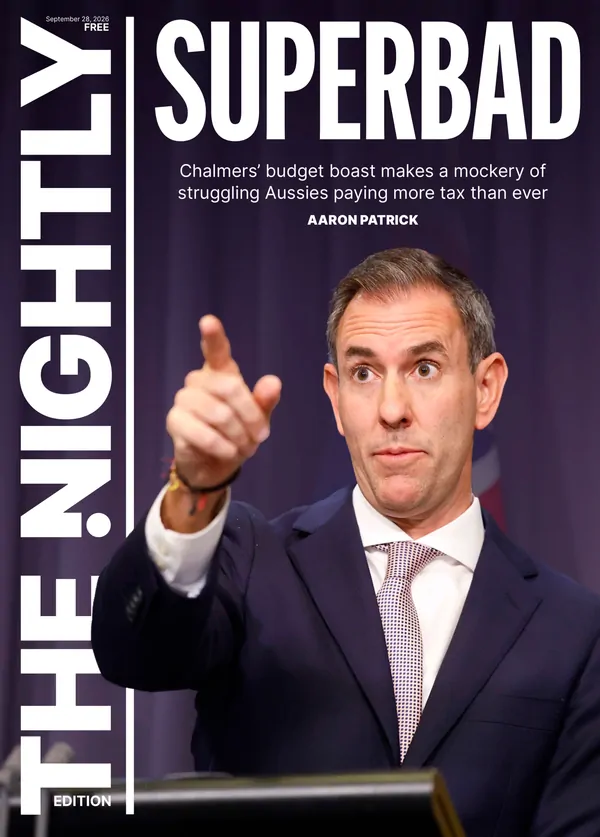
Treasurer Jim Chalmers’ fifth Budget will not lower inflation — one of its stated objectives — and could be followed by more interest rate rises, the Commonwealth Bank of Australia’s top economists said.
“Overall, the Budget is unlikely to shift the RBA’s near-term view on interest rates, but it does little to help in the fight against inflation,” wrote Luke Yeaman, Belinda Allen and Ashwin Clarke. “As it stands the risk sits with further tightening by the RBA.”

Sign up to The Nightly's newsletters.
Get the first look at the digital newspaper, curated daily stories and breaking headlines delivered to your inbox.
By continuing you agree to our Terms and Privacy Policy.Australia’s largest bank said the Government’s decision to increase the Budget deficit next financial year, “when the fight against inflation will be hardest” by spending an extra $6.5 billion, makes the Budget “neutral-to-mildly expansionary”.
Because inflation is out of control, many economists would like governments to help slow price rises by reducing spending. Tuesday night’s Budget will widen the federal deficit by $3.2 billion through extra spending on hospitals, defence and other priorities, spending a windfall in taxes from higher gas prices.
Increased taxes on investments and trusts won’t kick in for years and will be allocated to a $250 yearly tax cut for all workers.
Yesterday Dr Chalmers said the Government takes the inflation challenge “incredibly seriously”. “We are making a contribution by getting the deficit down,” he told reporters. “We are playing a helpful rather than a harmful role.”
Westpac Bank’s chief economist, Luci Ellis, said the Budget was “slightly expansionary”, the National Australia Bank economics team said it was “neutral” and AMP chief economist Shane Oliver said it “does nothing to make the RBA’s job in controlling inflation easier”.
Independent economist Chris Richardson said a $41b windfall from higher tax revenues would not reduce the deficit much because a lot of the money would be spent.
The extra spending will be needed to cover budget blowouts in the National Disability Insurance Scheme, military spending, subsidised medicine and anticipated higher unemployment benefits, he said.
“Yet that jump in the cash spend heading into the Australian economy in the near term may raise an eyebrow or two at the Reserve Bank, especially as it comes atop recent spending increases by the States,” he wrote.
Economists at KPMG, an accounting firm, calculated the Budget will raise an extra $126b over the next four years and spend $129b.
Chief economist Brendan Rynne predicted higher-than-expected interest rates would hit investment harder than anticipated by the federal Treasury, which expects economic growth to fall under 2 per cent next financial year and unemployment to rise from 4.25 per cent to 4.5 per cent.
“Couching this as a tax reform budget is generous,” he wrote. “Tax reform incorporates principles of simplicity, equity, efficiency and revenue adequacy and arguably the tax changes proposed in this budget, largely under the rationale of improving ‘intergenerational equity’, fall short of some of these ideals.”
On Wednesday morning television host Karl Stefanovic called Dr Chalmers “the highest taxing Treasurer in this country’s history”. “How does that sit with you this morning?” he said.
Dr Chalmers replied: “No, the highest taxing government was the Howard and Costello government. We’ve got taxes as a share of the economy lower than what those predecessors had. There are tax cuts in the budget, tax cuts for workers and tax cuts for business.”