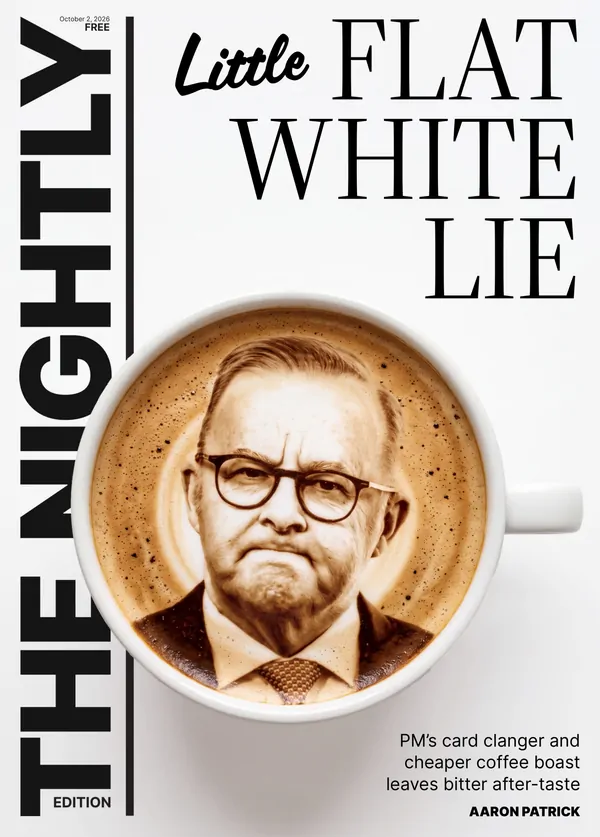
LATIKA M BOURKE: Australia off G7 invite list as French President Emmanuel Macron snubs Anthony Albanese
LATIKA M BOURKE: French President Emmanuel Macron has snubbed Anthony Albanese, leaving Australia off the official G7 invite list ahead of next month’s leaders’ summit.


French President Emmanuel Macron has snubbed Anthony Albanese, leaving Australia off the official G7 invite list ahead of next month’s leaders’ summit in Evian-les-Bains.
This is despite the French stating this year’s G7 will focus on trying to break China’s dominance over the supply of critical minerals as well as children’s safety online, through measures like Australia’s world-leading social media ban.
But despite speculation in international media that Australia would be on the guest list, The Nightly understands the Élysée is not expected to issue any more invites, meaning Australia will not be welcomed.
Sign up to The Nightly's newsletters.
Get the first look at the digital newspaper, curated daily stories and breaking headlines delivered to your inbox.
By continuing you agree to our Terms and Privacy Policy.Mr Macron has instead invited the leaders of Kenya, Brazil and South Korea. Australia was conspicuously absent from the G7 Finance Ministers’ meeting held in Paris this week.
The French government has said that “strengthening the resilience of critical minerals value chains is a “cross-cutting priority of the French Presidency”.
It has also singled out child safety online as an area for G7 collaboration. Australia pioneered the social media ban which Mr Macron is attempting to copy and impose on under-15s in France.
The Prime Minister’s office was contacted for comment.
The snub constitutes a humiliation for Mr Albanese, who told the Latika Takes podcast that the French President is one of his closest allies on the world stage.
It also undermines Mr Albanese’s claim that Labor has repaired the bilateral relationship, which was left in tatters after the former Coalition government tore up the French submarine deal in favour of AUKUS.
While Labor backed acquiring nuclear-propelled boats from the United States and the UK, it was highly critical of the way former Prime Minister Scott Morrison cancelled the French contract, which left the French blindsided.
Mr Albanese also dropped more aggressive demands for access to Europe’s beef markets in a bid to placate the French and win their support for an Australia-EU trade deal.
That exposed the Government to political attack from farmers and the Nationals.
French Trade Minister Nicolas Forissier visited Australia last month to declare France’s support for the EU — Australia trade deal, telling The Nightly that it was time to consign the bad blood over AUKUS to the past.
He said France wanted to build critical minerals investments with Australia.
But when questioned whether that meant Australia would be at the G7, he praised the “good relations” between both countries but said that it was President Macron’s decision to make and not his.
Mr Forissier’s high-profile visit was one of the last jobs of Pierre-Andre Imbert, who was France’s Ambassador in Australia. Mr Imbert has returned to Paris and is now serving as President Macron’s chief of staff.
Brendan Berne served as Australia’s Ambassador to France between 2017 and 2020 during which time Mr Macron extended Australia its first-ever invitation to sit at the premier table.
He said that, given President Macron’s focus on critical minerals and online safety, Australia deserved to be at the table.
“It’s surprising given that France was the first to bring Australia into the fold at the top table, motivated then by the submarine program,” Mr Berne, who lives in France and maintains high-level connections in Paris, told The Nightly.
“Obviously, there’s a limited number of places at the table, but with critical minerals and child safety online central to Macron’s agenda Australia has so much to contribute in those areas.
“I expect sense will prevail and Australia will be invited.”
The G7, once described as the “steering committee of the free world” by Joe Biden’s national security advisor Jake Sullivan, brings together the world’s leading industrialised economies, comprising the United States, France, Germany, Japan, Italy, Canada and the UK as well as the European Union.
Each year the host country can invite guest countries to sit at the top table where leaders try to thrash out common solutions to global issues, such as economic coercion, Chinese oversupply of manufactured goods and global conflicts including the wars in the Middle East and Ukraine.
This decade, the UK, Canada, and Japan have sought Australia’s attendance, meaning Anthony Albanese and Scott Morrison have represented the country at every summit since being first invited in 2019, excepting the years of 2022 and 2024 when Germany and Italy did not invite Australia.
France issued the G7’s first-ever invitation to Australia in 2019.
Then, the Prime Minister was Malcolm Turnbull, who signed the original submarine deal with the French and advocates for Australia to return to the continent for its underwater maritime capability instead of its Five Eyes intelligence allies.
But by the time the summit was held Scott Morrison had replaced Mr Turnbull and attended Biarritz.
Bryce Wakefield, CEO of the Australian Institute for International Affairs said the difference in Mr Macron’s position then and now was notable.
“Australia’s absence is striking because Canberra had effectively become a regular invitee to recent G7 summits alongside countries like India and South Korea, reflecting its growing role in Indo-Pacific strategy and economic security,” he said.
“South Africa also appears to have been dropped this year, while Kenya has been added, suggesting a broader reshaping of the G7’s political signalling.
“Still, given the summit’s focus on critical minerals and online child safety, two issues where Australia sees itself as a policy leader, the omission is diplomatically awkward.
“Critics may well interpret this as a sign that Macron has lingering doubts about Australia after France was dumped for AUKUS. The bigger question, however, is whether the trans-Atlantic powers are losing focus on the Indo-Pacific.”
A spokesman for Opposition leader Angus Taylor said: “After four years of Labor, Australia’s economy is going backwards, and it appears our standing in the world is going backwards too. Australia used to be at the table. Under Anthony Albanese, we now appear unable to even get in the room.”
“Australia gets invited to these meetings when our partners believe we have something to contribute. If Australia has not been invited, it is another sign our partners see this government as all talk and no action.”
“This G7 meeting will deal with fuel, fertiliser, AI, trade and global security. These are the big issues shaping Australia’s future. At the most dangerous time in decades, it appears Anthony Albanese has left Australia on the side lines.”